Translate

Mostrando entradas con la etiqueta Theotokos. Mostrar todas las entradas

miércoles, 22 de septiembre de 2021

Holy and Righteous Ancestors of God Joachim and Anna - Santos y Justos Joaquín y Ana, Ancestros de Dios.


ENGLISH:
The holy and righteous Joachim and Anna are the parents of the Theotokos, the grandparents of Jesus Christ. Their feast day is celebrated on September 9, following the Nativity of the Theotokos; the dormition of St. Anna is commemorated on July 25.
 

Lives

St. Joachim was of the tribe of Judah, and a descendant of King David. St. Anna was the daughter of Matthan the priest, of the tribe of Levi as was Aaron the High Priest. Matthan had three daughters: Mary, Zoia, and Anna. Mary was married in Bethlehem and bore Salome; Zoia was also married in Bethlehem and bore Elizabeth, the mother of St. John the Forerunner; and Anna was married in Nazareth to Joachim, and in old age gave birth to the Theotokos.

Sts. Joachim and Anna had been married for fifty years, and were barren. They lived devoutly and quietly, using only a third of their income for themselves and giving a third to the poor and a third to the Temple. Joachim had done this since he was 15-years-old, and God multiplied his flocks, so the couple was well provided for. They longed for a child but remained childless into their old age. When they were in Jerusalem to offer sacrifice to God, the High Priest, Issachar, upbraided Joachim, "You are not worthy to offer sacrifice with those childless hands." Others who had children jostled Joachim, thrusting him back as unworthy. In despair, he consulted the genealogical records of the tribes of Israel and discovered every righteous man in the nation had been blessed with children, except him. This caused the aged saint great grief, and he and his wife left with heavy hearts. Then the two of them gave themselves to prayer to God that He would work in them the wonder that He had worked in Abraham and Sarah, and give them a child to comfort their old age.

St. Joachim took his flocks and went to a high mountain, refusing to return home in shame. Meanwhile, St. Anna prayed in her garden. God sent the Archangel Gabriel to each of them, who gave them tidings of the birth of "a daughter most blessed, by whom all the nations of the earth will be blessed, and through whom will come the salvation of the world." Each promised to have their child raised in the Temple as a holy vessel of God. The archangel told St. Joachim to return home, where he would find his wife waiting for him in the city gate. St. Anna he told to wait at the gate. When they saw one another, they embraced, and this image is the traditional icon of their feast.

St. Anna conceived shortly thereafter, and in the ninth month gave birth to the Blessed Virgin Mary. This Conception of the Most Holy Mother of God is celebrated by the Church on December 9 and the Nativity of the Theotokos is celebrated on September 8.

Sts. Joachim and Anna took Mary, at the age of three, to the temple to be dedicated to the service of the Lord, and presented her to the priest Zechariahs. The parents then, after offering up her sacrifice (according to the custom of the time), left the Virgin with other maidens in the apartments of the temple to be brought up therein. The Church commemorates the Presentation of the Theotokos on November 21.
 

Dormition of the Righteous Anna

During the next seven years, Righteous Anna and Joachim visited Mary often at the temple until they died, leaving her an orphan at age ten. St. Joachim lived for 80 years and Anna for 79, and they both entered into the kingdom of God before the Annunciation to the Most Holy Theotokos. The Dormition feast day of St. Anna is celebrated on July 25.

The holy Ancestor-of-God Joachim had himself reposed at 80 years of age, several years after the Entry of the Most Holy Theotokos into the Temple (November 21). St Anna, having been left a widow, moved from Nazareth to Jerusalem, and lived near the Temple. At Jerusalem she bought two pieces of property: the first at the gates of Gethsemane, and the second in the valley of Josaphat. At the second locale she built a tomb for the members of her family, and where also she herself was buried with Joachim. It was there in the Garden of Gethsemane that the Savior often prayed with His disciples.

The most-pure body of the Mother of God was buried in the family tomb. Christians honored the sepulcher of the Mother of God, and they built a church on this spot. Within the church was preserved the precious funeral cloth, which covered Her all-pure and fragrant body.

The holy Patriarch Juvenal of Jerusalem (420-458) testified before the emperor Marcian (450-457) as to the authenticity of the tradition about the miraculous ascent of the Mother of God to Heaven, and he sent to the empress, St. Pulcheria (September 10), the grave wrappings of the Mother of God from Her tomb. St. Pulcheria then placed these grave-wrappings within the Blachernae church.
Relics

During the reign of St. Justinian the Emperor (527-565), a church was built in honor of St Anna at Deutera. And since St Anna had appeared to his pregnant wife, Emperor Justinian II (685-695; 705-711) restored her church. It was at this time that her body and maphorion (veil) were transferred to Constantinople.
 

Hymns

Troparion (Tone 5) Let us sing praises to Joachim and Anna,the couple honored by God (and they are His kinsmen).They have borne for us the Maiden who in a manner beyond understanding gave birth to Him Who though fleshless,became the incarnate to save the world.With her they intercede for our souls.

Kontakion (Tone 2) Anna rejoices, released from her barrenness,and nurses her most pure child.She calls all people to glorify Him Who gave the Virgin Mother to mankind from her womb.
 

Dormition of the Righteous Anna hymns

Troparion - Tone 4 Divinely-wise Anna, you carried in your womb the pure Mother of God, who gave life to our Life.Therefore, you are now carried joyfully to the inheritance of heaven,To the abode of those who rejoice in glory,Where you seek forgiveness of sins for those who faithfully honor you, ever blessed one.

Kontakion - Tone 2 We celebrate the memory of the progenitors of Christ,And with faith we ask their help,That deliverance from every affliction be granted to those who cry out:"Be with us, O God, who in Your good pleasure glorified them."

---------

ESPAÑOL:

Los santos y justos Joaquín y Ana son los padres de Theotokos, los abuelos de Jesucristo. Su fiesta se celebra el 9 de septiembre, siguiendo a la Natividad de la Theotokos; la dormición de Santa Ana se conmemora el 25 de julio


Biografía

San Joaquín era de la tribu de Judá y descendiente del rey David. Santa Ana era hija del sacerdote Matthan, de la tribu de Leví, al igual que Aarón el Sumo Sacerdote. Matthan tuvo tres hijas: Mary, Zoia y Anna. María se casó en Belén y dio a luz a Salomé; Zoia también se casó en Belén y dio a luz a Isabel, la madre de San Juan el Precursor; y Ana se casó en Nazaret con Joaquín, y en la vejez dio a luz a la Theotokos. 

San. Joaquín y Santa Ana llevaban cincuenta años casados ​​y eran estériles. Vivían devota y tranquilamente, usando sólo un tercio de sus ingresos para sí mismos y dando un tercio a los pobres y un tercio al templo. Joaquín había hecho esto desde que tenía 15 años, y Dios multiplicó sus rebaños, por lo que la pareja estaba bien provista. Anhelaban tener un hijo, pero permanecieron sin hijos hasta la vejez. Cuando estaban en Jerusalén para ofrecer sacrificios a Dios, el Sumo Sacerdote, Isacar, reprendió a Joaquín: "No eres digno de ofrecer sacrificios con esas manos sin hijos". Otros que tenían hijos empujaron a Joaquín, echándolo hacia atrás como indigno. Desesperado, consultó los registros genealógicos de las tribus de Israel y descubrió que todos los justos de la nación habían sido bendecidos con hijos, excepto él. Esto causó gran dolor al anciano santo, y él y su esposa se fueron con el corazón apesadumbrado. Entonces los dos se entregaron a orar a Dios para que obrara en ellos la maravilla que había obrado en Abraham y Sara, y les daría un hijo para consolar su vejez.

San Joaquín tomó sus rebaños y se fue a una montaña alta, negándose a regresar a casa avergonzado. Mientras tanto, Santa Ana rezaba en su jardín. Dios envió al Arcángel Gabriel a cada uno de ellos, quien les dio la noticia del nacimiento de "una hija bendita, por quien serán bendecidas todas las naciones de la tierra, y por quien vendrá la salvación del mundo". Cada uno prometió criar a su hijo en el templo como un vaso santo de Dios. El arcángel le dijo a San Joaquín que regresara a casa, donde encontraría a su esposa esperándolo en la puerta de la ciudad. A Santa Ana le dijo que esperara en la puerta. Cuando se vieron, se abrazaron, y esta imagen es el icono tradicional de su fiesta. 

Santa Ana concibió poco después y en el noveno mes dio a luz a la Santísima Virgen María. Esta Concepción de la Santísima Madre de Dios es celebrada por la Iglesia el 9 de diciembre y la Natividad de la Theotokos se celebra el 8 de septiembre. 

San Joaquín y Santa Ana llevaron a María, a la edad de tres años, al templo para dedicarla al servicio del Señor, y la presentaron al sacerdote Zacarías. Entonces los padres, después de ofrecer su sacrificio (según la costumbre de la época), dejaron a la Virgen con otras doncellas en los aposentos del templo para que la subieran allí. La Iglesia conmemora la Presentación de la Theotokos el 21 de noviembre.


Dormición de la Justa Ana 

Durante los siguientes siete años, los justos Ana y Joaquín visitaron a María con frecuencia en el templo hasta que murieron, dejándola huérfana a los diez años. San Joaquín vivió 80 años y Ana 79, y ambos entraron en el reino de Dios antes de la Anunciación de la Santísima Theotokos. La fiesta de la Dormición de Santa Ana se celebra el 25 de julio. 

El santo antepasado de Dios Joaquín había reposado él mismo a los 80 años de edad, varios años después de la entrada del Santísimo Theotokos en el templo (21 de noviembre). Santa Ana, habiendo quedado viuda, se mudó de Nazaret a Jerusalén y vivió cerca del Templo. En Jerusalén compró dos propiedades: la primera a las puertas de Getsemaní y la segunda en el valle de Josafat. En el segundo lugar construyó una tumba para los miembros de su familia, y donde también ella misma fue enterrada con Joaquín. Fue allí en el Huerto de Getsemaní donde el Salvador oraba a menudo con Sus discípulos. 

El cuerpo más puro de la Madre de Dios fue enterrado en la tumba familiar. Los cristianos honraron el sepulcro de la Madre de Dios y construyeron una iglesia en este lugar. Dentro de la iglesia se conservaba la preciosa tela funeraria, que cubría Su cuerpo totalmente puro y fragante. 

El santo Patriarca Juvenal de Jerusalén (420-458) testificó ante el emperador Marcian (450-457) sobre la autenticidad de la tradición sobre el milagroso ascenso de la Madre de Dios al cielo, y envió a la emperatriz, Santa Pulqueria. (10 de septiembre), las envolturas de la Madre de Dios de Su tumba. Santa Pulcheria luego colocó estos envoltorios de tumbas dentro de la iglesia Blachernae. 


Reliquias 

Durante el reinado de San Justiniano el Emperador (527-565), se construyó una iglesia en honor a Santa Ana en Deutera. Y desde que Santa Ana se apareció a su esposa embarazada, el emperador Justiniano II (685-695; 705-711) restauró su iglesia. Fue en este momento que su cuerpo y maphorion (velo) fueron trasladados a Constantinopla.


Himnos 

Troparion (Tono 5) Cantemos alabanzas a Joaquín y Ana, la pareja honrada por Dios (y son sus parientes). Ellos nos han dado a luz a la Doncella que de una manera más allá del entendimiento dio a luz a Aquel que, aunque sin carne, se convirtió en el encarnado para salvar al mundo. Con ella interceden por nuestras almas. 

Kontakion (Tono 2) Anna se regocija, liberada de su esterilidad, y amamanta a su hijo más puro. Llama a todos a glorificar a Aquel que entregó a la Virgen Madre a la humanidad desde su seno. 


Himnos de la Dormición de la Justa Ana 

Troparion - Tono 4 La divina Ana, llevaste en tu seno a la pura Madre de Dios, que dio vida a nuestra Vida; por tanto, ahora eres llevada con gozo a la herencia del cielo, a la morada de los que se regocijan en la gloria, Donde buscas el perdón de los pecados para aquellos que te honran fielmente, siempre bendito. 

Kontakion - Tono 2 Celebramos la memoria de los progenitores de Cristo, Y con fe pedimos su ayuda, Que la liberación de toda aflicción sea concedida a los que claman: "Quédate con nosotros, oh Dios, que en tu buena voluntad los glorificaste."

+++

lunes, 7 de diciembre de 2020

The Immaculate Conception Heresy - La Herejía de la Inmaculada Concepción


ENGLISH:
The following excerpt, from The Orthodox Veneration of the Mother of God by our modern day Saint John Maximovitch, Archbishop of Shanghai and San Francisco, is an Orthodox Christian response to the Papist belief of the Immaculate Conception of the Virgin Mary. The Immaculate Conception, the belief that the Mother of God was conceived and born without sin, was declared a dogma of the Papist Church by Pope Pius IX on December 8, 1854. The feast of the Immaculate Conception is a holy day of obligation for Roman Catholics.

Orthodox Christians, on the other hand, do not subscribe to the Immaculate Conception. Therefore, we do not have a feast day for it either. We do however have an important feast, on which we celebrate the Conception of the Theotokos by St. Anna. There is a difference, a profound one, for Orthodox Christians.

We Orthodox believe that the Panagia was conceived and born in a state of sin since she is a human being just like the rest of us. Only Christ was free of sin. We do venerate the Panagia highly though. She is the holiest of all the Saints and is like a member of our families. We do believe that the Panagia committed no actual personal sins. We believe that both through God’s grace and her free cooperation with God’s grace – both go together- she committed no sin. We believe she overcame every temptation to sin and thus remained ever pure, even in her mind and soul. There is a synergy, a cooperation, going on between God and the Panagia. She exercises her free will to respond to God.

The teaching of the complete sinlessness of the Mother of God does not correspond to Sacred Scripture, where there is repeatedly mentioned the sinlessness of the “One Mediator between God and man, the man Jesus Christ” (1 Tim. 2:5); “and in Him is no sin” (1 John 3:5); “Who did no sin, neither was guile found in His mouth.” (1 Peter 2:22); “One that hath been in all points tempted as we are, yet without sin” (Heb. 4:15); “Him who knew no sin, He made to be sin on our behalf” (II Cor. 5:21). But concerning the rest of men it is said, Who is pure of defilement? No one who has lived a single day of his life on earth (Job 14:4). God commendeth His own love toward us in that, while we were yet sinners, Christ died for us…If, while we were enemies, we were reconciled to God through the death of His Son, much more, being reconciled, shall we be saved by His life” (Rom. 5:8-10).

This teaching contradicts also Sacred Tradition, which is contained in numerous Patristic writings, where there is mentioned the exalted sanctity of the Virgin from her very birth, as well as her cleansing by the Holy Spirit at her conception of Christ, but not at her own conception by Anna. “There is none without stain before Thee, even though his life be but a day, save Thou alone, Jesus Christ our God, Who didst appear on earth without sin, and through Whom we all trust to obtain mercy and remission of sins.” (St. Basil the Great, Third Prayer of Vespers of Pentecost.) “But when Christ came through a pure, virginal, unwedded, God-fearing, undefiled Mother without wedlock and without father, and inasmuch as it befitted Him to be born, He purified the female nature, rejected the bitter Eve and overthrew the laws of the flesh” (St. Gregory the Theologian, “In Praise of Virginity”). However, even then, as Sts. Basil the Great and John Chrysostom speak of this, She was not placed in the state of being unable to sin, but continued to take care of Her salvation and overcame all temptations (St. John Chrysostom, Commentary on John, Homily 85; St. Basil the Great, Epistle 160).

The teaching that the Mother of God was purified before her birth, so that from her might be born the Pure Christ, is meaningless; because if the Pure Christ could be born only if the Virgin might be born pure, it would be necessary that her parents also should be pure of original sin, and they again would have to be born of purified parents, and going further in this way, one would have to come to the conclusion that Christ could not have become incarnate unless all His ancestors in the flesh, right up to Adam inclusive, had been purified beforehand of original sin. But then there would not have been any need for the very Incarnation of Christ, since Christ came down to earth in order to annihilate sin.

The teaching that the Mother of God was preserved from original sin, as likewise the teaching that she was preserved by God’s grace from person sins, makes God unmerciful and unjust; because if God could preserve Mary from sin and purify her before her birth, why does He not purify other men before their birth, but rather leaves them in sin? It follows likewise that God saves men apart from their will, predetermining certain ones before their birth to salvation.

This teaching, which seemingly has the aim of exalting the Mother of God, in reality completely denies all her virtues. After all, if Mary, even in the womb of her mother, when She could not even desire anything either good or evil, was preserved by God’s grace from every impurity, and then by that grace was preserved from sin even after Her birth, then in what does Her merit consist? If She could have been placed in the state of being unable to sin, and did not sin, then for what did God glorify Her? If she, without any effort, and without having any kind of impulses to sin, remained pure, then why is she crowned more than everyone else? There is no victory without an adversary.

The righteousness and sanctity of the Virgin Mary were manifested in the fact that she, being “human with passions like us,” so loved God and gave herself over to Him, that by her purity she was exalted high above the rest of the human race. For this, having been foreknown and forechosen, She was vouchsafed to be purified by the Holy Spirit Who came upon her, and to conceive of Him the very Saviour of the world. The teaching of the grace-given sinlessness of the Virgin Mary denies her victory over temptations; from a victor who is worthy to be crowned with crowns of glory, this makes her a blind instrument of God’s Providence.

It is not an exaltation and greater glory, but a belittlement of her, this “gift” which was given her by Pope Pius IX and all the rest who think they can glorify the Mother of God by seeking out new truths. The Most Holy Mary has been so much glorified by God Himself, so exalted is her life on earth and Her glory in heaven, that human inventions cannot add anything to her honor and glory. That which people themselves invent only obscures her face from their eyes. Brethren, take heed lest there shall be any one that maketh spoil of you through philosophy and vain deceit, after the tradition of men, after the rudiments of the world, and not after Christ, wrote the Apostle Paul by the Holy Spirit (Col. 2:18).

Such a vain deceit is the teaching of the Immaculate Conception by Anna of the Virgin Mary, which at first sight exalts, but in actual fact belittles her. Like every lie, it is a seed of the Father of Lies (John 8:44), the devil, who has succeeded by it in deceiving many who do not understand that they blaspheme the Theotokos. Together with it there should also be rejected all the other teaching which have come from it or are akin to it. The striving to exalt the Most Holy Virgin to an equality with Christ ascribing to her maternal tortures at the Cross an equal significance with the sufferings of Christ, so that the Redeemer and “Co-Redemptrix” suffered equally, according to the teaching of the Papists, or that “the human nature of the Mother of God in heaven together with the God-Man Jesus jointly reveal the full image of man” (Archpriest S. Bulgakov, The Unburnt Bush, p. 141) – is likewise a vain deceit and a seduction of philosophy. In Christ Jesus there is neither male nor female (Gal. 3:39), and Christ has redeemed the whole human race; therefore at His Resurrection equally did “Adam dance for joy and Eve rejoice” (Sunday Kontakia of the First and Third Tones), and by His Ascension did the Lord raise up the whole of human nature.

Likewise, that the Mother of God is a “complement of the Holy Trinity” or a “fourth Hypostasis”; that “the Son and the Mother are a revelation of the Father through the second and Third Hypostases”; that the Virgin Mary is a “creature, but also no longer a creature” – all this is the fruit of vain, false wisdom which is not satisfied with what the Church has held from the time of the Apostles, but strives to glorify the Holy Virgin more than God glorified her.

Thus are the words of St. Epiphanius of Cyprus fulfilled: “Certain senseless ones in their opinion about the Holy Ever-Virgin have striven and are striving to put her in place of God” (St. Epiphanius, “Against the Antidikomarionites”). But that which is offered to the Virgin in senselessness, instead of praise of her turns out to be blasphemy; and the All-Immaculate One rejected the lie, being the Mother of Truth (John 14:6).


St. John (Maximovich) of Shanghai and San Francisco


----------
ESPAÑOL:
El siguiente extracto, de La veneración ortodoxa de la Madre de Dios por nuestro actual San Juan Maximovitch, arzobispo de Shanghai y San Francisco, es una respuesta cristiana ortodoxa a la creencia papista de la Inmaculada Concepción de la Virgen María. La Inmaculada Concepción, la creencia de que la Madre de Dios fue concebida y nació sin pecado, fue declarada dogma de la iglesia papista por el Papa Pío IX el 8 de diciembre de 1854. La fiesta de la Inmaculada Concepción es un día sagrado de obligación para los católicos romanos

Los cristianos ortodoxos, por otro lado, no se suscriben a la Inmaculada Concepción. Por lo tanto, tampoco tenemos un día festivo. Sin embargo, tenemos una fiesta importante, en la que celebramos la Concepción de la Theotokos por Santa Ana. Hay una diferencia, profunda, para los cristianos ortodoxos. 

Los ortodoxos creemos que la Panagia fue concebida y nació en estado de pecado ya que es un ser humano como el resto de nosotros. Solo Cristo estaba libre de pecado. Sin embargo, veneramos mucho la Panagia. Ella es la más santa de todos los santos y es como un miembro de nuestra familia. Creemos que la Panagia no cometió ningún pecado personal real. Creemos que tanto a través de la gracia de Dios como de su cooperación libre con la gracia de Dios, ambas van juntas, ella no cometió ningún pecado. Creemos que ella superó todas las tentaciones de pecar y, por lo tanto, permaneció siempre pura, incluso en su mente y alma. Hay una sinergia, una cooperación, entre Dios y Panagia. Ejerce su libre albedrío para responder a Dios.

La enseñanza de la total impecabilidad de la Madre de Dios no corresponde a la Sagrada Escritura, donde se menciona repetidamente la impecabilidad del “Único Mediador entre Dios y los hombres, Jesucristo hombre” (1 Ti. 2: 5); “Y en él no hay pecado” (1 Juan 3: 5); "El cual no pecó, ni se halló engaño en su boca". (1 Pedro 2:22); “Uno que fue tentado en todo según nuestra semejanza, pero sin pecado” (Hebreos 4:15); “Al que no conoció pecado, por nosotros lo hizo pecado” (II Cor. 5:21). Pero del resto de los hombres se dice: ¿Quién es puro de contaminación? Nadie que haya vivido un solo día de su vida en la tierra (Job 14: 4). Dios alaba su propio amor para con nosotros en que, siendo aún pecadores, Cristo murió por nosotros ... Si, siendo enemigos, fuimos reconciliados con Dios por la muerte de su Hijo, mucho más, estando reconciliados, seremos salvos por su vida ”(Rom. 5: 8-10). 

Esta enseñanza contradice también la Sagrada Tradición, contenida en numerosos escritos patrísticos, donde se menciona la exaltada santidad de la Virgen desde su mismo nacimiento, así como su purificación por el Espíritu Santo en su concepción de Cristo, pero no en la propia. concepción por Ana. “No hay nadie sin mancha delante de ti, aunque su vida sea un día, salvo tú solo, Jesucristo nuestro Dios, que apareciste en la tierra sin pecado, y en quien todos confiamos para obtener misericordia y remisión de pecados”. (San Basilio el Grande, Tercera Oración de las Vísperas de Pentecostés.) “Pero cuando Cristo vino por una Madre pura, virginal, soltera, temerosa de Dios, inmaculada, sin matrimonio y sin padre, y en la medida en que le convenía nacer, Purificó la naturaleza femenina, rechazó la amarga Eva y anuló las leyes de la carne ”(San Gregorio el Teólogo,“ En Alabanza de la Virginidad ”). Sin embargo, incluso entonces, como los Sabtos Basilio el Grande y Juan Crisóstomo hablan de esto, Ella no fue colocada en el estado de no poder pecar, sino que continuó cuidando de Su salvación y venció todas las tentaciones (San Juan Crisóstomo, Comentario sobre Juan, Homilía 85; Basilio el Grande, Epístola 160).

La enseñanza de que la Madre de Dios fue purificada antes de su nacimiento, para que de ella pudiera nacer el Cristo puro, no tiene sentido; porque si el Cristo Puro pudiera nacer sólo si la Virgen pudiera nacer pura, sería necesario que sus padres también fueran puros del pecado original, y tendrían que nacer de nuevo de padres purificados, yendo más allá de esta manera. , uno tendría que llegar a la conclusión de que Cristo no podría haberse encarnado a menos que todos sus antepasados ​​en la carne, hasta Adán inclusive, hubieran sido purificados de antemano del pecado original. Pero entonces no habría habido ninguna necesidad de la misma Encarnación de Cristo, ya que Cristo descendió a la tierra para aniquilar el pecado. 

La enseñanza de que la Madre de Dios fue preservada del pecado original, así como la enseñanza de que fue preservada por la gracia de Dios de los pecados de la persona, hace a Dios despiadado e injusto; porque si Dios pudo preservar a María del pecado y purificarla antes de su nacimiento, ¿por qué no purifica a otros hombres antes de su nacimiento, sino que los deja en pecado? De la misma manera, Dios salva a los hombres aparte de su voluntad, predeterminando a ciertos antes de su nacimiento para la salvación.

Esta enseñanza, que aparentemente tiene por objeto exaltar a la Madre de Dios, en realidad niega por completo todas sus virtudes. Después de todo, si María, incluso en el vientre de su madre, cuando ni siquiera podía desear nada bueno o malo, fue preservada por la gracia de Dios de toda impureza, y luego por esa gracia fue preservada del pecado incluso después de su nacimiento, entonces ¿en qué consiste su mérito? Si ella pudo haber sido colocada en el estado de no poder pecar, y no pecó, entonces ¿por qué la glorificó Dios? Si ella, sin ningún esfuerzo y sin tener ningún tipo de impulso de pecar, permaneció pura, entonces ¿por qué es coronada más que todos los demás? No hay victoria sin adversario. 

La justicia y santidad de la Virgen María se manifestaron en el hecho de que ella, siendo “humana con pasiones como nosotros”, amó tanto a Dios y se entregó a Él, que por su pureza fue exaltada por encima del resto de la raza humana. . Por esto, habiendo sido conocida y elegida de antemano, se le concedió ser purificada por el Espíritu Santo que vino sobre ella, y concebirlo como el mismísimo Salvador del mundo. La enseñanza de la impecabilidad otorgada por la gracia de la Virgen María niega su victoria sobre las tentaciones; de un vencedor digno de ser coronado con coronas de gloria, esto la convierte en un instrumento ciego de la Providencia de Dios.

No es una exaltación y una gloria mayor, sino un menosprecio de ella, este “don” que le dio el Papa Pío IX y todos los demás que piensan que pueden glorificar a la Madre de Dios buscando nuevas verdades. La Santísima María ha sido tan glorificada por Dios mismo, tan exaltada es su vida en la tierra y su gloria en el cielo, que las invenciones humanas no pueden agregar nada a su honor y gloria. Lo que la gente misma inventa solo oculta su rostro a sus ojos. Hermanos, mirad que no haya quien os saquee con la filosofía y el vano engaño, según la tradición de los hombres, según los rudimentos del mundo y no según Cristo, escribió el apóstol Pablo por el Espíritu Santo (Col. 2:18). 

Tan vano engaño es la enseñanza de la Inmaculada Concepción de Ana de la Virgen María, que a primera vista la exalta, pero en realidad la menosprecia. Como toda mentira, es una semilla del Padre de la Mentira (Juan 8:44), el diablo, que ha logrado engañar a muchos que no entienden que blasfeman contra la Theotokos. Junto con él, también deben rechazarse todas las demás enseñanzas que provienen de él o que son afines. El esfuerzo por exaltar a la Santísima Virgen a la igualdad con Cristo atribuyendo a sus torturas maternas en la Cruz un significado igual al de los sufrimientos de Cristo, para que el Redentor y la “Corredentora” sufrieran por igual, según la enseñanza de los papistas, o que “la naturaleza humana de la Madre de Dios en el cielo junto con el Dios-Hombre Jesús conjuntamente revelan la imagen completa del hombre” (Arcipreste S. Bulgakov, The Unburnt Bush, p. 141) - es igualmente un vano engaño y una seducción de la filosofía. En Cristo Jesús no hay hombre ni mujer (Gá. 3:39), y Cristo ha redimido a toda la raza humana; por lo tanto, en Su Resurrección igualmente “Danzó Adán de gozo y Eva se regocijó” (Kontakia dominical de los tonos primero y tercero), y por Su Ascensión el Señor levantó toda la naturaleza humana.

Asimismo, que la Madre de Dios es un “complemento de la Santísima Trinidad” o una “cuarta hipóstasis;" que “el Hijo y la Madre son revelación del Padre a través de la segunda y tercera hipóstasis;" que la Virgen María es una “criatura, pero tampoco más criatura” - todo esto es fruto de una sabiduría falsa y vana que no se satisface con lo que la Iglesia ha sostenido desde la época de los Apóstoles, sino que se esfuerza por glorificar al Santo Virgen más que Dios la glorificó. 

Así se cumplen las palabras de San Epifanio de Chipre: “Ciertos insensatos en su opinión sobre la Santa Siempre Virgen se han esforzado y se esfuerzan por ponerla en el lugar de Dios” (San Epifanio, “Contra los antidikomarionitas”). Pero lo que se ofrece a la Virgen sin sentido, en lugar de alabanza de ella, resulta ser una blasfemia; y el Todo-Inmaculado rechazó la mentira, siendo la Madre de la Verdad (Juan 14: 6). 

San Juan (Maximovich) de Shanghai y San Francisco


viernes, 28 de agosto de 2020

Dormition of the Theotokos - Dormición de la Theotokos


ENGLISH:
Introduction
The Feast of the Dormition of Our Most Holy Lady, the Theotokos and Ever-Virgin Mary is celebrated on August 15 each year. The Feast commemorates the repose (dormition and in the Greek Koimisis) or "falling-asleep" of the Mother of Jesus Christ, our Lord. The Feast also commemorates the translation or assumption into heaven of the body of the Theotokos.


Biblical Story
The Holy Scriptures tell us that when our Lord was dying on the Cross, He saw His mother and His disciple John and said to the Virgin Mary, "Woman, behold your son!" and to John, "Behold your mother!" (John 19:25-27). From that hour, the Apostle took care of the Theotokos in his own home.
Along with the biblical reference in Acts 1:14 that confirms that the Virgin Mary was with the Holy Apostles on the day of Pentecost, the tradition of the Church holds that she remained in the home of the Apostle John in Jerusalem, continuing a ministry in word and deed.

At the time of her death, the disciples of our Lord who were preaching throughout the world returned to Jerusalem to see the Theotokos. Except for the Apostle Thomas, all of them including the Apostle Paul were gathered together at her bedside. At the moment of her death, Jesus Christ himself descended and carried her soul into heaven.

Following her repose, the body of the Theotokos was taken in procession and laid in a tomb near the Garden of Gethsemane. When the Apostle Thomas arrived three days after her repose and desired to see her body, the tomb was found to be empty. The bodily assumption of the Theotokos was confirmed by the message of an angel and by her appearance to the Apostles.

Icon of the Feast
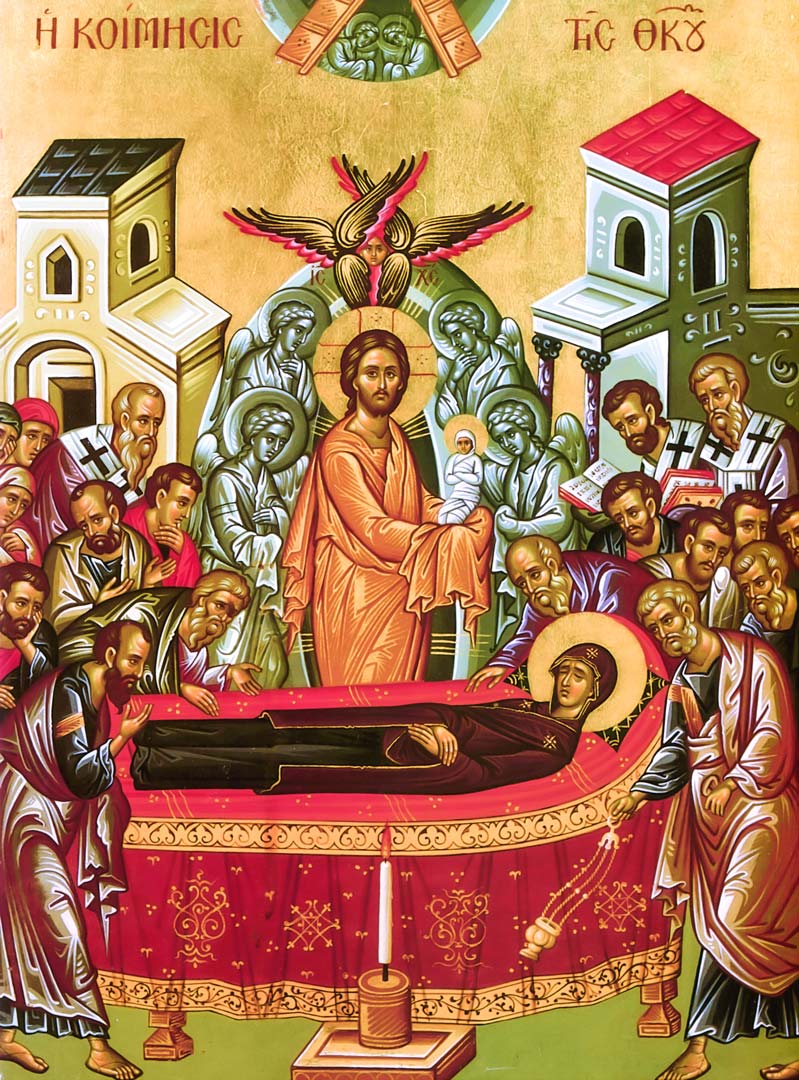
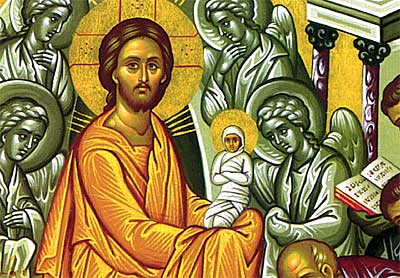
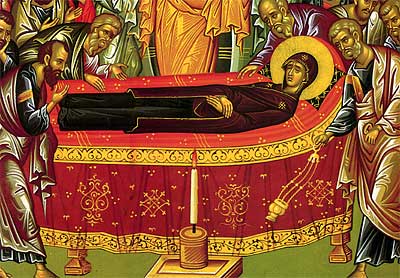
The Icon of the Feast of the Dormition of the Theotokos shows her on her deathbed surrounded by the Apostles. Christ is standing in the center (1.) looking at His mother. He is holding a small child clothed in white representing the soul of the Virgin Mary. With His golden garments, the angels above His head, and the mandorla surrounding Him, Christ is depicted in His divine glory.
1. Christ, appearing in His Glory, stands in the center of the icon cradling the soul of His Mother, the Theotokos and Ever-Virgin Mary.

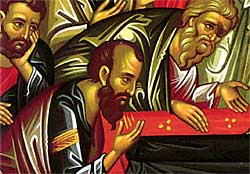
The posture of the Apostles direct attention toward the Theotokos (2.). On the right Saint Peter censes the body of the Theotokos. On the left Saint Paul (3.) bows low in honor of her.
2. The Apostles bow their heads in reverence to the Theotokos as Saint Peter (right) censes her body (detail).

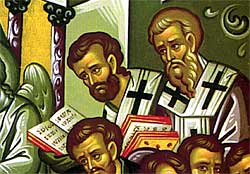
Together with the Apostles are several bishops (4.) and women. The bishops traditionally represented are James, the brother of the Lord, Timothy, Heirotheus, and Dionysius the Areopagite. They are shown wearing episcopal vestments. The women are members of the church in Jerusalem.
3. The Apostle Paul bows in honor of the Theotokos (detail).
4. Also in attendance to pray for the Theotokos were several Bishops (detail).


In front of the bed of the Theotokos is a candle (5.) that helps to form a central axis in the icon. Above the candle is the body of the Theotokos and Ever-Virgin Mary. Standing over His mother is Christ holding her most pure soul. Above Christ the gates of heaven stand open, ready to receive the Mother of God.
5. The Theotokos lies in the center of the icon surrounded by the Apostles and a candle in front of her bed (detail).

This great Feast of the Church and the icon celebrates a fundamental teaching of our faith—the Resurrection of the body. In the case of the Theotokos, this has been accomplished by the divine will of God. Thus, this Feast is a feast of hope, hope in Resurrection and life eternal. Like those who gathered around the body of the Virgin Mary, we gather around our departed loved ones and commend their souls into the hands of Christ. As we remember those who have reposed in the faith before us and have passed on into the communion of the Saints, we prepare ourselves to one day be received into the new life of the age to come.

We also affirm through this Feast as we journey toward our heavenly abode that the Mother of God intercedes for us. Through Christ she has become the mother of all of the children of God, embracing us with divine love.


Dormition or Assumption?
In the Orthodox tradition we are usually very careful to distinguish between the “Dormition” of the Mother of God and her “Assumption” into heaven. The former, we feel, is properly Orthodox, while the latter strikes us as a purely Western designation, derived from a Papist “misunderstanding” of the meaning of this feast, celebrated universally on August 15.

A misguided interpretations of Mary’s death and exaltation can be found both in Papist spiritual writings and in contemporary Western images: a tendency, for example, to exalt the Holy Virgin to a level of “divinity” that effectively erases the crucial and absolute distinction between human and divine life. Orthodox theologians will insist that the “deification” (theôsis) known by the Mother of God in no way involves an ontological transformation of her being from created humanity to divinity. She was and will always remain a human creature: the most exalted of all those who bear God’s image, yet always a human being, whose glory appears in her humility, her simple desire to “let it be” according to the divine will.

Traditional Orthodox icons of her “falling asleep,” therefore, focus especially on her death and entombment. The disciples, “gathered together from all the ends of the earth,” surround her in an attitude of grief and lament. Behind the bier on which she is laid there stands her glorified Son, holding in His arms a child clothed in radiant white garments, an image of His Mother’s soul. This is a theme of reversal. On every Orthodox iconastasis there is found a sacred image of the Mother of God, holding in her arms her newborn child, the God-Man who “took flesh” in order to save and sanctify a fallen, sinful, broken world. Here, in the icon of the Dormition, the Son embraces and offers to that world His Holy Mother, as she did Him at the time of His birth. At her falling asleep He receives her soul, her life, in order to exalt it in Himself and with Himself, to the glory, beauty and joy of eternal life.

Celebration of the Feast of the Dormition
The commemoration of the Dormition of the Theotokos and the preparation for the Feast begin on August 1 with a period of fasting. A strict fast is followed on most of the days (no meat, dairy, oil, or wine), with the exceptions of fish on the Feast of the Transfiguration (August 6) and the day of the Dormition. Oil and Wine are allowed on Saturdays and Sundays.

On the weekdays before the Feast, Paraklesis services are held in most parishes. These consist of the Great Paraklesis and the Small Paraklesis, both services of supplication and prayer for the intercessions of the Theotokos.

The Feast of the Dormition is celebrated with the Divine Liturgy of Saint John Chrysostom which is conducted on the morning of the Feast and preceded by a Matins (Orthros) service. A Great Vespers is conducted on the evening before the day of the Feast. Scripture readings for the Feast of the Dormition are the following: At Vespers: Genesis 28:10-17; Ezekiel 43:27-44:4; Proverbs 9:1-11. At the Matins: Luke 1:39-49, 56. At the Divine Liturgy: Philippians 2:5-11; Luke 10:38-42; 11:27-28.

----------------------------------------------

ESPAÑOL:

Introducción 

La fiesta de la Dormición de Nuestra Santísima Señora, Theotokos y Siempre Virgen María se celebra el 15 de agosto de cada año. La fiesta conmemora el reposo (dormición y en la Koimisis griega) o "quedarse dormido" de la Madre de Jesucristo, nuestro Señor. La fiesta también conmemora la traducción o asunción al cielo del cuerpo de la Theotokos.

Historia bíblica 
Las Sagradas Escrituras nos dicen que cuando nuestro Señor estaba muriendo en la Cruz, vio a su madre y a su discípulo Juan y le dijo a la Virgen María: "¡Mujer, mira a tu hijo!" y a Juan, "¡Mira a tu madre!" (Juan 19: 25-27). A partir de esa hora, el Apóstol se hizo cargo de la Theotokos en su propia casa. Junto con la referencia bíblica en Hechos 1:14 que confirma que la Virgen María estaba con los Santos Apóstoles el día de Pentecostés, la tradición de la Iglesia sostiene que permaneció en el hogar del Apóstol Juan en Jerusalén, continuando un ministerio en palabra y obra. En el momento de su muerte, los discípulos de nuestro Señor que predicaban en todo el mundo regresaron a Jerusalén para ver la  Theotokos. A excepción del apóstol Tomás, todos ellos, incluido el apóstol Pablo, se reunieron junto a su cama. En el momento de su muerte, Jesucristo mismo descendió y llevó su alma al cielo. Después de su reposo, el cuerpo de Theotokos fue llevado en procesión y colocado en una tumba cerca del Jardín de Getsemaní. Cuando el apóstol Tomás llegó tres días después de su descanso y deseó ver su cuerpo, se encontró que la tumba estaba vacía. La asunción corporal de la Theotokos fue confirmada por el mensaje de un ángel y por su aparición a los Apóstoles.

Icono de la fiesta 
El ícono de la fiesta de la Dormición de la Theotokos la muestra en su lecho de muerte rodeada de los Apóstoles. Cristo está de pie en el centro (1.) mirando a su madre. Él está sosteniendo a un niño pequeño vestido de blanco que representa el alma de la Virgen María. Con sus vestiduras doradas, los ángeles sobre su cabeza y la mandorla que lo rodea, Cristo está representado en su gloria divina.


1. Cristo, apareciendo en Su Gloria, se encuentra en el centro del ícono que acuna el alma de Su Madre, Theotokos y Siempre Virgen María.

La postura de los Apóstoles dirige la atención hacia el Theotokos (2.). A la derecha, San Pedro censura el cuerpo de la Theotokos. A la izquierda, San Pablo (3.) se inclina en honor de ella.


2. Los apóstoles inclinan sus cabezas en reverencia a la Theotokos cuando San Pedro (derecha) censura su cuerpo (detalle).

Junto con los apóstoles hay varios obispos (4) y mujeres. Los obispos tradicionalmente representados son Santiago, el hermano del Señor, Timoteo, Heirotheo y Dionisio el Areopagito. Se muestran con vestimentas episcopales. Las mujeres son miembros de la iglesia en Jerusalén.


3. El apóstol Pablo se inclina en honor a la Theotokos (detalle).


4. También asistieron a rezar por los Theotokos varios obispos (detalle).


Delante de la cama de la Theotokos hay una vela (5) que ayuda a formar un eje central en el ícono. Sobre la vela está el cuerpo de la Theotokos y Siempre Virgen María. De pie junto a su madre está Cristo sosteniendo su alma más pura. Sobre Cristo se abren las puertas del cielo, listas para recibir a la Madre de Dios.


5. Theotokos se encuentra en el centro del icono rodeado por los Apóstoles y una vela frente a su cama (detalle). 
Esta gran fiesta de la Iglesia y el ícono celebra una enseñanza fundamental de nuestra fe: la resurrección del cuerpo. En el caso de la Theotokos, esto se ha logrado por la voluntad divina de Dios. Así, esta fiesta es una fiesta de esperanza, esperanza en la resurrección y vida eterna. Al igual que aquellos que se reunieron alrededor del cuerpo de la Virgen María, nos reunimos alrededor de nuestros seres queridos difuntos y encomendamos sus almas a las manos de Cristo. Al recordar a aquellos que se han vuelto a depositar en la fe antes que nosotros y han pasado a la comunión de los santos, nos preparamos para ser recibidos algún día en la nueva vida del siglo venidero. 
También afirmamos a través de esta Fiesta mientras viajamos hacia nuestra morada celestial que la Madre de Dios intercede por nosotros. Por medio de Cristo, ella se convirtió en la madre de todos los hijos de Dios, abrazándonos con amor divino. 


¿Dormición o Asunción? 
En la tradición ortodoxa solemos tener mucho cuidado de distinguir entre la "Dormición" de la Madre de Dios y su "Asunción" al cielo. Creemos que el primero es propiamente ortodoxo, mientras que el segundo nos parece una designación puramente occidental, derivada de un “malentendido” papista del significado de esta fiesta, celebrada universalmente el 15 de agosto. 

Se pueden encontrar interpretaciones equivocadas de la muerte y exaltación de María tanto en los escritos espirituales papistas como en las imágenes occidentales contemporáneas: una tendencia, por ejemplo, a exaltar a la Santísima Virgen a un nivel de "divinidad" que borra efectivamente la distinción crucial y absoluta entre los seres humanos y vida divina. Los teólogos ortodoxos insistirán en que la “deificación” (Teosis) conocida por la Madre de Dios no implica en modo alguno una transformación ontológica de su ser de humanidad creada a divinidad. Ella fue y será siempre una criatura humana: la más exaltada de todos los que llevan la imagen de Dios, pero siempre un ser humano, cuya gloria se manifiesta en su humildad, su simple deseo de “dejarlo ser” según la voluntad divina. 

Los íconos ortodoxos tradicionales de su "quedarse dormida", por lo tanto, se enfocan especialmente en su muerte y sepultura. Los discípulos, “reunidos desde todos los confines de la tierra”, la rodean en actitud de dolor y lamento. Detrás del féretro sobre el que está acostada está su Hijo glorificado, sosteniendo en Sus brazos a un niño vestido con ropas blancas radiantes, una imagen del alma de Su Madre. Este es un tema de reversión. En cada iconastasis ortodoxa se encuentra una imagen sagrada de la Madre de Dios, sosteniendo en sus brazos a su hijo recién nacido, el Dios-Hombre que “se encarnó” para salvar y santificar un mundo caído, pecador y quebrantado. Aquí, en el icono de la Dormición, el Hijo abraza y ofrece a ese mundo a su Santa Madre, como lo hizo a Él en el momento de su nacimiento. Cuando ella se duerme, Él recibe su alma, su vida, para exaltarla en Sí mismo y consigo mismo, para la gloria, la belleza y el gozo de la vida eterna.


Celebración de la fiesta de la Dormición. 
La conmemoración de la Dormición de la Theotokos y la preparación para la Fiesta comienzan el 1 de agosto con un período de ayuno. Se sigue un ayuno estricto la mayoría de los días (sin carne, lácteos, aceite o vino), con la excepción de los pescados en la Fiesta de la Transfiguración (6 de agosto) y el día de la Dormición. Se permiten aceites y vinos los sábados y domingos.
Los días laborables antes de la Fiesta, los servicios de Paraklesis se llevan a cabo en la mayoría de las parroquias. Estos consisten en la Gran Paraklesis y la Pequeña Paraklesis, ambos servicios de súplica y oración por las intercesiones de la Theotokos. 
La Fiesta de la Dormición se celebra con la Divina Liturgia de San Juan Crisóstomo, que se lleva a cabo en la mañana de la Fiesta y precedida por un servicio de Matins (Orthros). A Grandes Vísperas se lleva a cabo la noche antes del día de la Fiesta. Las lecturas de las Escrituras para la Fiesta de la Dormición son las siguientes: En las vísperas: Génesis 28: 10-17; Ezequiel 43: 27-44: 4; Proverbios 9: 1-11. En los maitines: Lucas 1: 39-49, 56. En la Divina Liturgia: Filipenses 2: 5-11; Lucas 10: 38-42; 11: 27-28.


Dormición de la Madre de Dios

martes, 7 de abril de 2020

Annunciation of the Theotokos - Anunciación de la Theotokos


ENGLISH:
March 25, Annunciation of the Theotokos

This great festival takes its name from the happy tidings brought by the Archangel Gabriel to the Blessed Virgin, announcing the Incarnation of the Son of God. It commemorates the most important embassy that was ever known, an embassy sent by the King of kings, and performed by one of the chief princes of His heavenly court, and directed, not to the great ones of this earth, but to a poor, unknown virgin who, being endowed with angelic purity of soul and body, and perfect humility and submission to God, was greater in His eyes than the mightiest monarch in the world.

When the Son of God became man, He could have taken our nature without the cooperation of any creature; but He was pleased to be born of a woman, the One announced in the third chapter of Genesis. In choosing Her whom He raised to this most sublime of all dignities, He was turning to the one maiden who, by the riches of His grace and virtues, was of all others the most holy and the most perfect. The purpose of this embassy of the Archangel was to give a Savior to the world, a victim of propitiation to the sinner, a model to the just, a son to this Virgin who would remain a virgin, and a new nature to the Son of God — the nature of man, capable of suffering pain and anguish in order to satisfy God's justice for our transgressions.

When the Angel appeared to Mary and addressed Her, the Blessed Virgin was troubled; not at his coming, says St. Ambrose, for heavenly visions and conversation with the blessed spirits had been familiar to Her, but what alarmed Her, he says, was the Angel's appearing in human form, in the shape of a young man. What added to her alarm on this occasion was his words of praise. Mary, guarded by her modesty, was in confusion before expressions of this sort, and dreaded even the shadow of deluding flattery. Such high commendations made her cautious, until in silence She had more fully considered the matter: She deliberated in her mind, says Saint Luke, what manner of salutation this could be.

The Angel, to calm her, said: Fear not, Mary, for Thou hast found favor before God. He then informed Her that She was to conceive a Son whose name would be Jesus, who would be great and the Son of the Most High, and possessed of the throne of David, Her illustrious ancestor. Mary, out of a just concern to know how she may comply with the will of God without prejudice to Her vow of virginity, inquired, How shall this be? Nor did She give Her consent until the heavenly messenger informed Her that it was to be a work of the Holy Ghost, who, in making Her fruitful, would not alter in the slightest Her virginal purity. In submission to God's will, without any further inquiries, She expressed Her assent in these humble but powerful words: Behold the handmaid of the Lord; be it done unto Me according to thy word. What faith and confidence Her answer expressed! What profound humility and perfect obedience!

----------------------------------

ESPAÑOL:

25 de marzo,  Anunciación de la Theotokos


Este gran festival toma su nombre de las buenas nuevas traídas por el Arcángel Gabriel a la Santísima Virgen, anunciando la Encarnación del Hijo de Dios. Conmemora la embajada más importante que jamás se haya conocido, una embajada enviada por el Rey de reyes, y llevada a cabo por uno de los príncipes principales de Su corte celestial, y dirigida, no a los grandes de esta tierra, sino a una pobre, virgen desconocida que, siendo dotada de pureza angélica de alma y cuerpo, y perfecta humildad y sumisión a Dios, era mayor a sus ojos que el monarca más poderoso del mundo.

Cuando el Hijo de Dios se hizo hombre, Él podría haber tomado nuestra naturaleza sin la cooperación de ninguna criatura; pero se complació en nacer de una mujer, la que se anunció en el tercer capítulo de Génesis. Al elegir a aquella a quien Él elevó a la más sublime de todas las dignidades, se dirigió a la única doncella que, por las riquezas de Su gracia y virtudes, era la más santa y la más perfecta de todas las demás. El propósito de esta embajada del Arcángel era dar un Salvador al mundo, una víctima de la propiciación al pecador, un modelo a los justos, un hijo a esta Virgen que permanecería virgen y una nueva naturaleza al Hijo de Dios: la naturaleza del hombre, capaz de sufrir dolor y angustia para satisfacer la justicia de Dios por nuestras transgresiones.

Cuando el ángel se le apareció a María y se dirigió a ella, la Santísima Virgen estaba preocupada; no en su llegada, dice San Ambrosio, porque las visiones celestiales y la conversación con los espíritus bienaventurados le habían sido familiares, pero lo que la alarmó, dice, fue la aparición del Ángel en forma humana, en la forma de un hombre joven. Lo que se sumó a su alarma en esta ocasión fueron sus palabras de elogio. María, custodiada por su modestia, estaba confundida ante expresiones de este tipo, y temía incluso la sombra del engaño de la adulación. Tales elogios la hicieron cautelosa, hasta que, en silencio, había considerado el asunto con mayor detenimiento: deliberó mentalmente, dice San Lucas, qué tipo de saludo podría ser esto.

El Ángel, para calmarla, dijo: No temas, María, porque has encontrado gracia delante de Dios. Luego le informó que ella debía concebir un Hijo cuyo nombre sería Jesús, que sería grande y el Hijo del Altísimo, y poseedor del trono de David, su ilustre antepasado. María, por una justa preocupación por saber cómo puede cumplir con la voluntad de Dios sin perjuicio de su voto de virginidad, preguntó: ¿Cómo será esto? Tampoco dio su consentimiento hasta que el mensajero celestial le informó que debía ser una obra del Espíritu Santo, quien, al hacerla fructificar, no alteraría en lo más mínimo su pureza virginal. En sumisión a la voluntad de Dios, sin más preguntas, expresó su consentimiento con estas palabras humildes pero poderosas: He aquí la esclava del Señor; hágase en mí según tu palabra. ¡Qué fe y confianza expresó su respuesta! ¡Qué profunda humildad y perfecta obediencia!

+++


viernes, 31 de enero de 2020

St. Athanasius and Saint Cyril - San Atanasio y San Cirilo


ENGLISH:
January 18th,  Our Fathers among the Saints: Athanasius and Cyril, Archbishops of Alexandria. 

ST. ATHANASIUS was born between the years 295 or 296, in a humble family of Alexandria. God gave the saint many virtues such as deep faith and a great intellect that became clear when he finished his basic studies. At the age of 25, he was ordained a Deacon by the Patriarch of Alexandria Alexander, and who along with him participated in the first Ecumenical Synod in Nice, where the heresy of Arius is treated. In the year 328 Patriarch Alexander dies and for Athanasius a great moment is approaching, Patriarch of Alexandria is elected at the age of 33, by clergyman and by all the people. From now on the Saint begins a strong fight against the heresy of Arius. He was sent into exile five times by the Arian emperor Constantine, suffering innumerable hardships. However, with faith, courage and his inexhaustible patience, he wins and destroys the "wolves" of our orthodoxy. As the Holy Scriptures tell us: “Fight the good fight of faith; make yours eternal life, to which you were called and for which you made that admirable declaration of faith in front of many witnesses. ”(1 Timothy 6:12) These words come true in the life of Saint Athanasius who on the 2nd of May 373 between 75 and 77 years of age dies. It should also be remembered that the Saint was recognized as one of the greatest writers and Father of Our Holy Church.

ST. CYRIL, expressed his understanding of the Christian mystery in his exegetical writings, particularly in his interpretation of the Gospel of St. John and his comments on other New Testament writings. St. Cyril was a great fighter against heresies, a staunch defender of the Orthodox faith. 

His authority holyly served God's designs. St. Cyril is famous for his defense of orthodoxy against heresy, particularly against Nestorianism. 

Archbishop of Alexandria (Egypt). Defender of the doctrine that proclaims Mary the Theotokos: Mother of God. This doctrine was proclaimed as dogma at the Council of Ephesus (431) that St. Cyril presided. His great opponent was Nestorian, patriarch of Constantinople.
When in doubt that Mary is the mother of God, the identity of Jesus Christ who is a divine person was questioned.  

St. Cyril's argument: Mary is the Theotokos, not because she existed before God or created God. God is eternal and Mary Most Holy is a creature of God. But God wanted to be born of a woman. The person born of Mary is divine therefore she is the mother of God. 

His holy defense of the truth won him jail and many struggles but he emerged victorious.

-------------------------

ESPAÑOL:
18 de enero, Nuestros Padres entre los Santos: Atanasio y Cirilo, Arzobispos de Alejandría.

SAN ATANASIO nació entre los años 295 o 296, en el seno de una familia humilde de Alejandría. Dios le otorgó al santo muchas virtudes como la fe profunda y un gran intelecto que quedo de manifiesto al terminar sus estudios básicos. A los 25 años fue ordenado Diácono por el Patriarca de Alejandría Alejandro, y que junto a él participaron del primer Sínodo Ecuménico en Niza, donde es trato la herejía de Ario. En el año 328 fallece el Patriarca Alejandro y para Atanasio se acerca un gran momento, es elegido Patriarca de Alejandría a los 33 años, por clérigo y por todo el pueblo. De ahora en más el Santo comienza un fuerte combate contra la herejía de Ario Fue enviado al exilio cinco veces por el emperador arriano Constantino, sufriendo innumerables penurias. Sin embargo, con fe, valor y su inagotable paciencia, sale vencedor y destroza a los “lobos” de nuestra ortodoxia. Como nos dice las sagradas Escrituras: “Pelea la buena batalla de la fe; haz tuya la vida eterna, a la que fuiste llamado y por la cual hiciste aquella admirable declaración de fe delante de muchos testigos.” (1° Timoteo 6:12) estas palabras se hacen realidad en la vida de San Atanasio quien el 2 de mayo del 373 entre los 75 y 77 años de edad fallece. Se debe recordar también que el Santo fue reconocido como uno de los más grandes escritores y Padre de Nuestra Santa Iglesia.

SAN CIRILO, expresó su comprensión del misterio cristiano en sus escritos exegéticos, particularmente en su interpretación del Evangelio de san Juan y sus comentarios sobre otros escritos del Nuevo Testamento.
San Cirilo fue un gran luchador contra las herejías, defensor acérrimo de la fe ortodoxa.

Su autoridad sirvió santamente los designios de Dios. San Cirilo es famoso por su defensa de la ortodoxia contra la herejía, particularmente contra el nestorianismo.

Arzobispo de Alejandría (Egipto). Defensor de la doctrina que proclama a María la Theotokos: Madre de Dios. Esta doctrina fue proclamada como dogma en el Concilio de Efeso (431) que San Cirilo presidió. Su gran oponente era Nestóreo, patriarca de Constantinopla.
Al ponerse en duda que María es madre de Dios se ponía en duda la identidad de Jesucristo quien es una persona divina.

El argumento de San Cirilo: María es la Theotokos, no porque ella existiese antes de Dios o hubiese creado a Dios. Dios es eterno y María Santísima es una criatura de Dios. Pero Dios quiso nacer de mujer. La persona que nace de María es divina por lo tanto ella es madre de Dios.

Su santa defensa de la verdad le ganó la cárcel y muchas luchas pero salió victorioso.

+++

The World Cup: The Summit of Collective Hypnosis and the Disconnection with Nature

Versión en español  (click) We live in a hyper-connected society, yet we are profoundly disconnected from what truly matters. If you stop to...