Translate

Mostrando entradas con la etiqueta Essence-energies Distinction. Mostrar todas las entradas

viernes, 19 de agosto de 2022

The Uncreated Light - La Luz Increada


ENGLISH:

Saint Gregory Palamas (1296-1356) wrote about the nature of the luminosity of Tabor, who had to defend the orthodox teaching on spiritual light against the learned monks Barlaam, Akindin and their followers. It was the time of the Renaissance: the revival of paganism in art, thought and customs. In philosophy, pagan concepts of God began to return, as a transcendental, supramundane, inconceivable Absolute. Based on this non-Christian concept of God, Barlaam and Akindin claimed that on Tabor the apostles could not see God, they saw a common physical light. 

Saint Gregory Palamas, on the other hand, insisted that the light of Tabor only resembled physics, but was of a completely different nature. This light was brighter than sunlight and whiter than snow, but it did not blind, it warmed, but it did not burn. His radiance was accompanied by an intense feeling of joy. To differentiate it from ordinary light, Saint Gregory called the light of Tabor: “A divine, uncreated energy." The essence of this light is inseparable from the eternal divine essence, since God is simple and undivided. Although God in His essence is inconceivable; His acts and energy, being inseparable from His essence, are conceivable for beings created in His image and likeness. This is also why the Son of God became man, to make us commune with his divine nature and thus divinize us.

------------

ESPAÑOL:

San Gregorio Pálamas (1296-1356) escribió sobre la naturaleza de la luminosidad de Tabor, quien tuvo que defender la enseñanza ortodoxa sobre la luz espiritual frente a los eruditos monjes Barlaam, Akindin y sus seguidores. Era la época del Renacimiento: el renacimiento del paganismo en el arte, el pensamiento y las costumbres. En la filosofía, los conceptos paganos de Dios comenzaron a regresar, como un Absoluto trascendental, supramundano e inconcebible. Basándose en este concepto no cristiano de Dios, Barlaam y Akindin afirmaron que en el Tabor los apóstoles no podían ver a Dios, veían una luz física común.
 

San Gregorio Pálamas, por el contrario, insistía en que la luz de Tabor solo se parecía a la física, pero era de naturaleza completamente diferente. Esta luz era más brillante que la luz del sol y más blanca que la nieve, pero no cegaba, calentaba, pero no quemaba. Su resplandor fue acompañado por un intenso sentimiento de alegría. Para diferenciarla de la luz ordinaria, San Gregorio llamó a la luz del Tabor: “Una energía divina, increada." La esencia de esta luz es inseparable de la eterna esencia divina, ya que Dios es simple e indiviso. Aunque Dios en Su esencia es inconcebible; Sus actos y energía, siendo inseparables de Su esencia, son concebibles para los seres creados a Su imagen y semejanza. También por esto el Hijo de Dios se hizo hombre, para hacernos comulgar con su naturaleza divina y así divinizarnos.


                            Преображение Господнье. Transfiguración de Nuestro Señor.


  Преображение Господне

lunes, 14 de marzo de 2022

Anathemas Against The Papists - Anatemas Contra los Papistas


ENGLISH:

Roman Catholics fall under the following anathemas, among others: 

To those who sometimes think and say that the light that shone from the Lord in his Divine Transfiguration is an apparition, something created, and a ghost that appears for an instant and then immediately disappears, and who other times think and say that this light is the very essence of God, and in this way, the insane get involved in completely contradictory and impossible positions; to such men who, on the one hand, are delirious with the madness of Arius, and divide the one Divinity and the one God into created and uncreated, and who, on the other hand, are entangled in the impiety of the Messalians, who affirm that the Divine essence is visible, and who, moreover, do not confess according to the divinely-inspired theologies of the saints and the pious understanding of The Church that teaches that the Supreme and Divine Light is not a creature, nor is it the essence of God, but, instead, it is the uncreated and natural grace, illumination, and energy that eternally and inseparably proceed from the very essence of God: 

Anathema! 

Again, those same men who think and say that all the natural powers and energies of the Trihypostatic Divinity are created, and thus are bound to believe that the very essence of God is also created, because they oppose the saints, who teach that created energy evidences a created nature, and take uncreated energy to designate an uncreated nature; to these men who, in consequence, are now in danger of falling into complete atheism, who have annexed to the pure and unsullied faith of the Christians, the mythology of the Greeks and the worship of creatures, and who do not confess accordingly with the divinely inspired theologies of the saints and the pious understanding of the Church, which teaches that all natural power and energy of Trihypostatic Divinity is uncreated: 

Anathema!

-----------------

 ESPAÑOL:

Los Católicos Romanos caen bajo los siguiente anatemas, entre otros:

A aquellos quiénes a veces piensan y dicen que la luz que resplandeció del Señor en su Divina Transfiguración es una aparición, algo creado, y un fantasma que aparece por un instante y luego inmediatamente desaparece, y quiénes otras veces piensan y dicen que esta luz es el misma esencia de Dios, y de esta manera, dementemente se involucran en posiciones completamente contradictorias e imposibles; a tales hombres quienes, por un lado deliran con la locura de Arrio, y dividen a la única Divinidad y al único Dios en creado e increado, y quiénes, por otro lado, se enredan en la impiedad de los Mesalianos, quienes afirman que la esencia Divina es visible, y quiénes, además no confiesan de acuerdo con las teologías divinamente-inspiradas de los santos y el piadoso entendimiento de La iglesia que enseña que la Suprema y Divina Luz no es una creatura, ni tampoco es la esencia de Dios, pero, en cambio, es la gracia increada y natural, la iluminación, y energía que eternamente e inseparablemente procede de la mismísima esencia de Dios:

¡Anatema!

Nuevamente, a aquellos mismos hombres que piensan y dicen que todos los poderes naturales y las energías de la Trihipostatica Divinidad son creadas, y de esta manera, estan sometidos a creer que la mismísima esencia de Dios también es creada, debido a que se oponen a los santos, quienes enseñan que la energía creada evidencia una naturaleza creada, y consideran que la energía increada designa una naturaleza increada; a estos hombres quienes, en consecuencia, están ahora en peligro de caer en el completo ateísmo, quienes han anexado a la pura e inmaculada fe de los cristianos, la mitología de los griegos y el culto a las criaturas, y quienes no confiesan de acuerdo con las teologías divinamente inspiradas de los santos y el piadoso entendimiento de la Iglesia, cual enseña que todo poder natural y energía de Trihipostatica Divinidad es increada:

¡Anatema!  

viernes, 7 de mayo de 2021

The Holy Light Miracle - El Milagro de la Luz Sagrada


ENGLISH:
The Holy Fire (Greek Ἃγιον Φῶς, Holy Light) is described by Orthodox Christians as a miracle that occurs every year at the Church of the Holy Sepulcher in Jerusalem on Great Saturday, or Holy Saturday, the day preceding Pascha (Orthodox Easter).

The Holy Fire happens annually on the day preceding Orthodox Pascha (Orthodox Easter). During this time, blue light is said to emit within Jesus Christ's tomb, rising from the marble slab covering the stone bed believed to be that upon which Jesus' body is to have been placed for burial. The marble slab is now in the Church of the Holy Sepulcher in the Old City of Jerusalem. The light is believed to form a column of fire, from which candles are lit. This fire is then used to light the candles of the clergy and pilgrims in attendance. The fire is also said to spontaneously light other lamps and candles around the church. Pilgrims and clergy say that the Holy Fire does not burn them.

While the Patriarch is inside the chapel kneeling in front of the stone, there is darkness but far from silence outside. One hears a rather loud mumbling, and the atmosphere is very tense. When the Patriarch comes out with the two candles lit and shining brightly in the darkness, a roar of jubilation resounds in the Church.

Thousands of pilgrims as well as local Christians of all denominations gather in Jerusalem to partake and witness this annual event.

The Holy Fire is taken to Greece by special flight, and similarly to other Orthodox countries or countries with major Orthodox churches, such as Georgia, Bulgaria, Lebanon, Romania, Egypt, Cyprus, North Macedonia, Serbia, Ukraine and Russia, being received by church and state leaders. 

For all those who doubt the existence and health of the Holy Fire. These people just took the Holy Light from the Holy Sepulcher in Jerusalem, on the day of the Orthodox Easter, miraculously they are not burning. 

 Watch this BitChute Video: The Holy Light Miracle / El Milagro de la Luz Sagrada


For all those who doubt the existence and health of the Holy Fire. These people just took the Holy Light from the Holy Sepulcher in Jerusalem, on the day of the Orthodox Easter, miraculously they are not burning. / Para todos aquellos que dudan de la existencia y salud del Fuego Santo. Estas personas acaban de tomar la Luz Sagrada del Santo Sepulcro en Jerusalén, el día de la Pascua ortodoxa, milagrosamente no se están quemando.
--------------

ESPAÑOL:

El Fuego Santo (griego Ἃγιον Φῶς, Luz Sagrada) es descrito por los cristianos ortodoxos como un milagro que ocurre todos los años en la Iglesia del Santo Sepulcro en Jerusalén el Gran Sábado o Sábado Santo, el día anterior a la Pascha (Pascua Ortodoxa).

El Fuego Santo ocurre anualmente el día anterior a la Pascua Ortodoxa. Durante este tiempo, se dice que se emite luz azul dentro de la tumba de Jesucristo, que se eleva desde la losa de mármol que cubre el lecho de piedra que se cree que es el lugar donde se colocó el cuerpo de Jesús para el entierro. La losa de mármol se encuentra ahora en la Iglesia del Santo Sepulcro en la Ciudad Vieja de Jerusalén. Se cree que la luz forma una columna de fuego, a partir de la cual se encienden velas. Este fuego se utiliza luego para encender las velas del clero y los peregrinos presentes. También se dice que el fuego enciende espontáneamente otras lámparas y velas alrededor de la iglesia. Los peregrinos y el clero dicen que el Fuego Santo no los quema. 

Mientras el Patriarca está dentro de la capilla arrodillado frente a la piedra, afuera hay oscuridad pero lejos del silencio. Se oye un murmullo bastante fuerte y la atmósfera es muy tensa. Cuando el Patriarca sale con las dos velas encendidas y brillando en la oscuridad, un rugido de júbilo resuena en la Iglesia. 

Miles de peregrinos, así como cristianos locales de todas las denominaciones, se reúnen en Jerusalén para participar y presenciar este evento anual. 

El Fuego Santo es llevado a Grecia en vuelo especial, y de manera similar a otros países ortodoxos o países con importantes iglesias ortodoxas, como Georgia, Bulgaria, Líbano, Rumania, Egipto, Chipre, Macedonia del Norte, Serbia, Ucrania y Rusia, siendo recibido por líderes de la iglesia y el estado.

+++

miércoles, 19 de agosto de 2020

The Transfiguration of Christ - La Transfiguración de Cristo


ENGLISH:
The Transfiguration of Christ is one of the Great Feasts of the Orthodox Church, celebrated on August 6 (August 19). The feast commemorates the transfiguration or metamorphosis of Christ on Mount Tabor, when our Lord appeared in His divine glory before the Apostles Peter, James, and John.

Jesus had gone with his disciples Peter, James, and John to Mount Tabor. Christ's appearance was changed while they watched into a glorious radiant figure. There appeared Elijah and Moses, speaking with Jesus. The disciples were amazed and terribly afraid.

This event shows forth the divinity of Christ, so that the disciples would understand after his Ascension that He was truly the radiant splendor of the Father, and that his Passion was voluntary (Mark 9:2-9). It also shows the possibility of our own theosis.

This event was the subject of some debates between St.Gregory Palamas and Barlaam of Calabria. Barlaam believed that the light shining from Jesus was created light, while Gregory maintained the disciples were given grace to perceive the uncreated light of God. This supported Gregory's larger argument that although we cannot know God in His essence, we can know Him in his energies, as He reveals Himself.

Accounts of the Transfiguration are found in the Bible: Matthew 17:1-8, Mark 9:2-9, Luke 9:28-36, and 2 Peter 1:16-19.


Biblical Story
The event of the Transfiguration is recorded in three of the four Gospels:Matthew 17:1-9, Mark 9:2-8, and Luke 9:28-36. Jesus took the Apostles Peter, James, and John with Him up upon a mountain, and while they were on the mountain Jesus was transfigured. His face shone like the sun, and His garments became glistening white.

Moses and Elijah appeared with Christ, talking to Him. Peter declared how good it was for them to be there and expressed the desire to build three booths for Moses, Elijah, and Christ. This reference to the booths could imply that this occurred during the time of the Feast of Tabernacles when the Jews would be camping out in the fields for the grape harvest; for this Feast had acquired other associations in the course of its history, including the memory of the wanderings in the wilderness recorded in the Old Testament book of Exodus.

While Peter was speaking, a bright cloud overshadowed them. A voice came from the cloud saying, "This is my beloved Son, with whom I am well pleased; listen to Him." When the disciples heard this they fell on their faces filled with awe. Jesus came to them and told them to not be afraid. When the three looked up they saw only Jesus.

As Jesus and His disciples came down the mountain, He told them not to speak of what they had seen until He had risen from the dead.


Celebration of the Feast
Like all feasts of the Master, the Transfiguration is a vigil-ranked feast, though in parish practice a full All-Night Vigil is usually not celebrated. Typically, Great Vespers is conducted on the eve of the feast, and on the morning of the feast, the Divine Liturgy of Saint John Chrysostom celebrated, traditionally preceded by the Matins service.

The Vespers service includes the readings: Exodus 24:12-18, 33:11-23, 34:4-6, 8; 1Kings 19:3-9, 11-13, 15-16. The Matins service includes the reading: Luke 9:28-36. And the Divine Liturgy: 2 Peter 1:10-19; Matthew 17:1-9.

It is believed that Christ's transfiguration took place at the time of the Jewish Festival of Booths, and that the celebration of the event in the Christian Church became the New Testament fulfillment of the Old Testament feast. Presently it is celebrated on the sixth of August, forty days before the feast, Elevation of the Holy Cross. Just as Peter, James, and John saw the transfiguration before the crucifixion so that they might know who it is who will suffered for them, the Church connects these two feasts to help the faithful understand the mission of Christ and that his suffering was voluntary.

The feast of the Transfiguration of Christ once belonged to the season of Great Lent, but may have been considered too joyous for that time. Saint Gregory Palamas, a great teacher of the Transfiguration, is now celebrated on one of the Sundays of Lent instead.

Hymns
Troparion (Tone 7) You were Transfigured on the Mount, O Christ God,Revealing Your glory to Your disciples as far as they could bear it.Let Your everlasting Light shine upon us sinners!Through the prayers of the Theotokos, O Giver of Light, glory to You!

Kontakion (Tone 7) On the Mountain You were Transfigured, O Christ God,And Your disciples beheld Your glory as far as they could see it;So that when they would behold You crucified,They would understand that Your suffering was voluntary,And would proclaim to the world,That You are truly the Radiance of the Father!

Forefeast Hymns
Troparion (Tone 4) Come, you faithful, let us welcome the Transfiguration of Christ,And let us joyfully cry as we celebrate the prefeast:"The day of holy gladness has come;The Lord has ascended Mount TaborTo radiate the beauty of His divinity."

Kontakion (Tone 4) Podoben: “Today You have shown forth...”Today all mortal nature shines with the divine TransfigurationAnd cries with exultation:"Christ the Savior is transfigured to save us all!"


ESPAÑOL:
La Transfiguración de Cristo es una de las Grandes Fiestas de la Iglesia Ortodoxa, que se celebra el 6 de agosto (19 de agosto). La fiesta conmemora la transfiguración o metamorfosis de Cristo en el monte Tabor, cuando nuestro Señor apareció en su gloria divina ante los apóstoles Pedro, Santiago y Juan.

Jesús había ido con sus discípulos Pedro, Santiago y Juan al monte Tabor. La apariencia de Cristo cambió mientras miraban hacia una figura radiante y gloriosa. Allí aparecieron Elías y Moisés, hablando con Jesús. Los discípulos estaban asombrados y terriblemente asustados. 

Este evento muestra la divinidad de Cristo, para que los discípulos comprendan después de su Ascensión que Él era verdaderamente el esplendor radiante del Padre, y que su Pasión era voluntaria (Marcos 9: 2-9). También muestra la posibilidad de nuestra propia teosis. 

Este evento fue objeto de algunos debates entre San Gregorio Palamás y Barlaam de Calabria. Barlaam creía que la luz que brillaba de Jesús era luz creada, mientras que Gregorio sostenía que a los discípulos se les había dado la gracia de percibir la luz no creada de Dios. Esto apoyó el argumento más amplio de Gregorio de que aunque no podemos conocer a Dios en su esencia, podemos conocerlo en sus energías, tal como Él se revela a sí mismo. 

Los relatos de la Transfiguración se encuentran en la Biblia: Mateo 17: 1-8, Marcos 9: 2-9, Lucas 9: 28-36 y 2 Pedro 1: 16-19.

Historia Bíblica 
El evento de la Transfiguración se registra en tres de los cuatro evangelios: Mateo 17: 1-9, Marcos 9: 2-8 y Lucas 9: 28-36. Jesús llevó consigo a los apóstoles Pedro, Santiago y Juan a una montaña, y mientras estaban en la montaña, Jesús se transfiguró. Su rostro resplandeció como el sol, y sus vestiduras se volvieron de un blanco reluciente. 

Moisés y Elías aparecieron con Cristo, hablando con él. Pedro declaró lo bueno que era para ellos estar allí y expresó el deseo de construir tres casetas para Moisés, Elías y Cristo. Esta referencia a las cabañas podría implicar que esto ocurrió durante el tiempo de la Fiesta de los Tabernáculos cuando los judíos acampaban en los campos para la vendimia; porque esta Fiesta había adquirido otras asociaciones en el curso de su historia, incluyendo el recuerdo de los vagabundeos por el desierto registrados en el libro del Éxodo del Antiguo Testamento. 

Mientras Pedro hablaba, una nube brillante los cubrió. Una voz vino de la nube que decía: "Este es mi Hijo amado, en quien tengo complacencia; escúchalo". Cuando los discípulos oyeron esto, cayeron sobre sus rostros llenos de temor. Jesús se acercó a ellos y les dijo que no tuvieran miedo. Cuando los tres miraron hacia arriba, solo vieron a Jesús. 

Mientras Jesús y sus discípulos bajaban de la montaña, les dijo que no hablaran de lo que habían visto hasta que Él resucitara de entre los muertos.

Celebración de la Fiesta 
Como todas las fiestas del Maestro, la Transfiguración es una fiesta de vigilia, aunque en la práctica parroquial no se suele celebrar una Vigilia de Toda la Noche. Por lo general, las Grandes Vísperas se llevan a cabo en la víspera de la fiesta, y en la mañana de la fiesta, se celebra la Divina Liturgia de San Juan Crisóstomo, tradicionalmente precedida por el servicio de maitines. 

El servicio de Vísperas incluye las lecturas: Éxodo 24: 12-18, 33: 11-23, 34: 4-6, 8; 1 Reyes 19: 3-9, 11-13, 15-16. El servicio de maitines incluye la lectura: Lucas 9: 28-36. Y la Divina Liturgia: 2 Pedro 1: 10-19; Mateo 17: 1-9. 

Se cree que la transfiguración de Cristo tuvo lugar en el momento de la Fiesta Judía de las Cabañas, y que la celebración del evento en la Iglesia Cristiana se convirtió en el cumplimiento del Nuevo Testamento de la fiesta del Antiguo Testamento. Actualmente se celebra el 6 de agosto, cuarenta días antes de la fiesta, Elevación de la Santa Cruz. Así como Pedro, Santiago y Juan vieron la transfiguración antes de la crucifixión para saber quién sufrirá por ellos, la Iglesia conecta estas dos fiestas para ayudar a los fieles a comprender la misión de Cristo y que su sufrimiento fue voluntario. 

La fiesta de la Transfiguración de Cristo perteneció una vez a la temporada de la Gran Cuaresma, pero puede haber sido considerada demasiado alegre para ese momento. San Gregorio Palamás, un gran maestro de la Transfiguración, ahora se celebra uno de los domingos de Cuaresma.

Himnos 
Troparion (Tono 7) Tú fuiste transfigurado en el monte, oh Cristo Dios, revelando tu gloria a tus discípulos hasta donde ellos pudieron soportarla. ¡Deja que tu luz eterna brille sobre nosotros pecadores! Por las oraciones de la Theotokos, oh dador de luz ¡Gloria a Ti! 

 Kontakion (Tono 7) En la montaña fuiste transfigurado, oh Cristo Dios, y tus discípulos contemplaron tu gloria hasta donde podían verla; para que cuando te vieran crucificado, entendieran que tu sufrimiento era voluntario, y proclama al mundo, que eres verdaderamente el resplandor del Padre! 

Himnos de la fiesta 
 Troparion (Tono 4) Venid, fieles, acojamos la Transfiguración de Cristo, y clamemos gozosos mientras celebramos la fiesta previa: "Ha llegado el día de la santa alegría; el Señor ha subido al monte Tabor para irradiar la belleza de su divinidad. . " 

 Kontakion (Tono 4) Podoben: "Hoy te has manifestado ..." Hoy toda la naturaleza mortal brilla con la Transfiguración divina Y clama de júbilo: "¡Cristo el Salvador se transfigura para salvarnos a todos!"

sábado, 15 de agosto de 2020

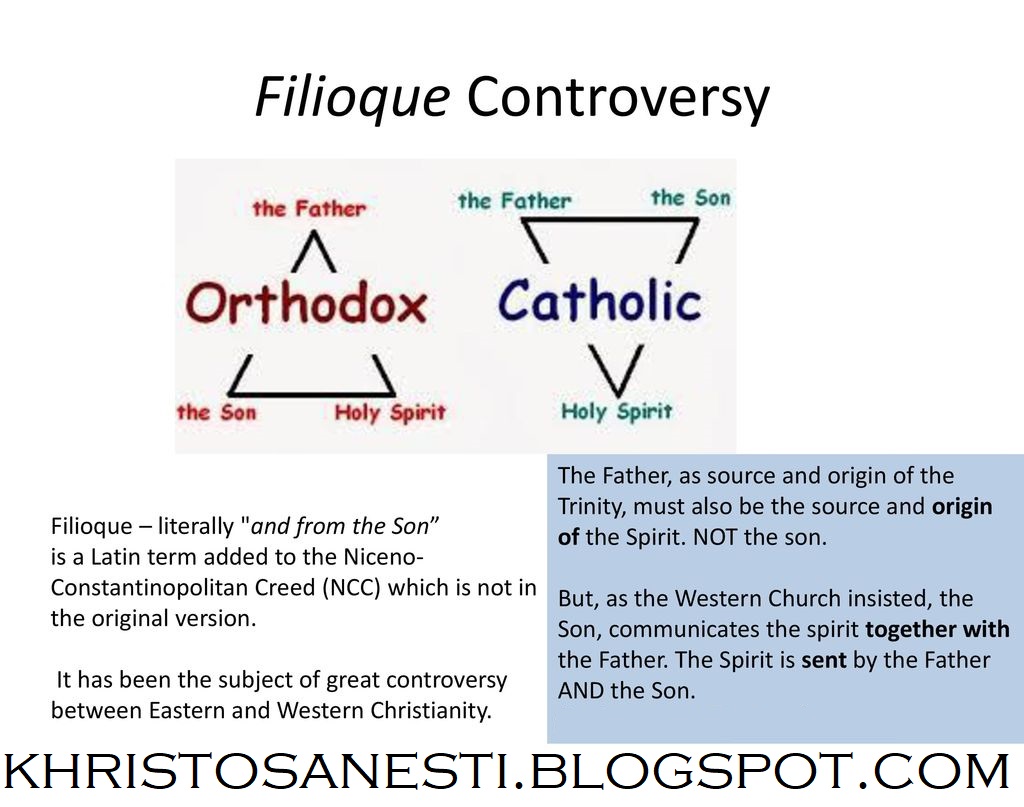
Filioquism is Arian Subordinationism Applied to The Spirit


Recently reviewing some old Roman Catholic dogmatic manuals and catechisms, a strange position stood out to me which I had not previously seen. I have long been familiar with Augustine’s speculations about the Trinity and the inter-Trinitarian relations based on the faulty analogy of human psychology and physiology, but as for their rising to the rank of being an official element of filioquism, I had not noticed. Naturally, Eastern Orthodox theology has officially rejected these faulty premises as leading to heresy, but exactly what kind of heresy was now made even more striking.
 

First, let’s consider one of the crucial forms of argument St. Athanasius uses to defend Orthodoxy against the Arian heresy that the Son was a creation. Indeed, were this so, the argument goes, the Son would be a product of the Father’s will. Were the Son a product of will, then His coming to being is not eternal, He is not the Logos, and generation is really no different from creation. All of these elements constitute the Athanasian apologetic, but consider the following from De Synodis where the Saint describes the Arian doctrine:

Blasphemies of Arius:
God Himself then, in His own nature, is ineffable by all men. Equal or like Himself He alone has none, or one in glory. And Ingenerate we call Him, because of Him who is generate by nature. We praise Him as without beginning because of Him who has a beginning. And adore Him as everlasting, because of Him who in time has come to be. The Unbegun made the Son a beginning of things originated; and advanced Him as a Son to Himself by adoption. He has nothing proper to God in proper subsistence. For He is not equal, no, nor one in essence with Him. Wise is God, for He is the teacher of Wisdom. There is full proof that God is invisible to all beings; both to things which are through the Son, and to the Son He is invisible. I will say it expressly, how by the Son is seen the Invisible; by that power by which God sees, and in His own measure, the Son endures to see the Father, as is lawful. Thus there is a Triad, not in equal glories. Not intermingling with each other are their subsistences. One more glorious than the other in their glories unto immensity. Foreign from the Son in essence is the Father, for He is without beginning. Understand that the Monad was; but the Dyad was not, before it was in existence. It follows at once that, though the Son was not, the Father was God. Hence the Son, not being (for He existed at the will of the Father), is God Only-begotten , and He is alien from either. Wisdom existed as Wisdom by the will of the Wise God. Hence He is conceived in numberless conceptions : Spirit, Power, Wisdom, God’s glory, Truth, Image, and Word. Understand that He is conceived to be Radiance and Light. One equal to the Son, the Superior is able to beget; but one more excellent, or superior, or greater, He is not able. At God’s will the Son is what and whatsoever He is. And when and since He was, from that time He has subsisted from God. He, being a strong God, praises in His degree the Superior. To speak in brief, God is ineffable to His Son. For He is to Himself what He is, that is, unspeakable. So that nothing which is called comprehensible does the Son know to speak about; for it is impossible for Him to investigate the Father, who is by Himself. For the Son does not know His own essence, For, being Son, He really existed, at the will of the Father.What argument then allows, that He who is from the Father should know His own parent by comprehension? For it is plain that for that which has a beginning to conceive how the Unbegun is, or to grasp the idea, is not possible.1

Thus, in Arianism because the definition of the Father is “ingenerate,” divine simplicity in this case mandated, for Arius, that Paternity and ousia be synonymous (as Eunomius would later say against St. Gregory of Nyssa). For another to be introduced would be impossible, as the distinctions would imply divisions and time intervals into the “ingenerate” Father-essence. For both the Arian and Eunomian, the Father-essence is a Monad wholly enclosed within itself, while along with creation, this essence has emanated a secondary creation, the “Son.” What is interesting is that St. Athanasius’ response is based on Colossians and many other texts, that the Son is the express image of the Father’s hypostasis, and this generation is from all eternity, and thus is not by will.

That generation is done by will is a lynchpin of the Arian argument and its rejection is fundamental to the Orthodox dogma that the Son is homoousios with the Father. Inasmuch as there is one will in God, and will is a property of nature, the Father, Son and Spirit all share the same natural will. This basic fact should be known and admitted by all, but a devastating problem arises when we come to the enshrined dogma of Rome concerning the so-called “double” procession of the Spirit—not only does Rome erroneously claim the Father-Son operate as a “single principle” source, the Spirit’s spiration is said to be from the will of the Father and Son.

Traditional Catholic systematic theologian Ludwig Ott explains:

“The Holy Ghost proceeds from the will or the mutual love of the Father and Son.” (Sent. certa.).

The Roman Catechism teaches that the “Holy Ghost proceeds from the Divine Will, Inflamed, as it were, with love (a divine voluntate veluti amore inflammata).”

“Holy Ghost designates a … Divine Person, the name pneuma indicates that the Holy Ghost, through an activity of the divine will, proceeds as the Principle of Divine Activity (per modum voluntatis)… the Holy Ghost proceeds as an act of love.”

“The object of the Divine Will, by which the Father and Son produce the Holy Ghost is primarily that which God necessarily loves, namely the Divine Essence, and secondarily that which He freely loves, created things…”2

The absurdity of this should immediately be evident, and to be clear the citation is the Catechism of the Council of Trent, pages 93-4. Note as well this is sententia certa, the silly level of classification which makes this a Roman proclamation of what is part of revealed theology—functioning “higher” than common, ordinary teaching. We know, of course, this doctrine arose based on the Augustinian “analogy” of human psychology. To be even clearer, this teaching is explicit in Denzinger 296 where the erroneous Western Council of Toledo interjected the filioque because of a perceived guard against Arianism, while also mandating absolute divine simplicity. This means the doctrine in question is Roman Catholic dogma, and no mere opinion:

Profession of Faith Concerning the Trinity:
Let the designation of this “holy will”—although through a comparative similitude of the Trinity, where it is called memory, intelligence, and will—refer to the person of the Holy Spirit; according to this, however, what applies to itself, is predicated substantially. For the will is the Father, the will is the Son, the will is the Holy Spirit; just as God is the Father, God is the Son, God is the Holy Spirit and many other similar things, which according to substance those who live as protectors of the Catholic faith do not for any reason hesitate to say. And just as it is Catholic to say: God from God, light from light, life from life, so it is a proved assertion of true faith to say the will from the will; just as wisdom from wisdom, essence from essence, and as God the Father begot God the Son, so the Will, the Father, begot the Son, the Will. Thus, although according to essence the Father is will, the Son is will and the Holy Spirit is will, we must not however believe that there is unity according to a relative sense, since one is the Father who refers to the Son, another the Son, who refers to the Father, another the Holy Spirit who, because He proceeds from the Father and the Son, refers to the Father and the Son; not the same but one in one way, one in another, because to whom there is one being in the nature of deity, to these there is a special property in the distinction of persons.

In a confused passage, purportedly refuting Eunomius, Augustine writes of the Son, Spirit and will:

It was certainly a sharp answer that somebody gave to the heretic, who most subtly asked him whether God begot the Son willingly or unwillingly, in order that if he said unwillingly, it would follow most absurdly that God was miserable; but if willingly, he would immediately infer, as though by an invincible reason, that at which he was aiming, viz. that He was the Son, not of His nature, but of His will. But that other, with great wakefulness, demanded of him in turn, whether God the Father was God willingly or unwillingly; in order that if he answered unwillingly, that misery would follow, which to believe of God is sheer madness; and if he said willingly, it would be replied to him, Then He is God too by His own will, not by His nature. What remained, then, except that he should hold his peace, and discern that he was himself bound by his own question in an insoluble bond? But if any person in the Trinity is also to be specially called the will of God, this name, like love, is better suited to the Holy Spirit; for what else is love, except will?3

Person, will, essence and act or energy are here fused and confused as will be the perennial norm for Western theology, but I cite this to show Augustine was quite aware of the Eunomian and Arian argument that the Son was a product of the Father’s will. Though admittedly a bad argument, Augustine’s response is that if any Person in the Trinity is the will (or a product of the will?) it is the Spirit! Why? Because in this Latin tradition, in God, His actions strictly are His essence—and not only that, they are also Persons. Rather than the Orthodox formulation of love as a natural divine energy all Three have in common, here “Love” is somehow more one Person than another. Is “Justice” also a divine Person? Foreknowledge? If the Spirit is the will, and is also a product of the will, the stupidity of this error becomes manifest, as the Spirit spirates Himself. This long, crazy train of confusion is ably refuted in the famous treatise of St. Photios the Great, the Mystagogy, which can be read here.

Briefly, though, let’s look and see that this is also the teaching of Thomas Aquinas (following in the train of Augustine) in his conflated double procession argument:

“Furthermore, the order of the procession of each one agrees with this conclusion. For it was said above (I:27:4; I:28:4), that the Son proceeds by the way of the intellect as Word, and the Holy Ghost by way of the will as Love. Now love must proceed from a word. For we do not love anything unless we apprehend it by a mental conception. Hence also in this way it is manifest that the Holy Ghost proceeds from the Son.”4

Because the divine essence is the hypostasis, will and action, all predicates of God blend into classical Eunomianism. Eunomius’ modalism, as shown in the voluminous treatise of St. Gregory of Nyssa against him, was predicated on an isomorphic identification of various terms and names with the divine essence. Proclaiming to know what he did not, Eunomius, like Arius before him, foolishly imagined divine persons as products of the divine will. St. Athanasius and the rest of Orthodox theology would emphatically and dogmatically go on to reject these notions, and specifically the heresy of divine hypostases as products of the will.

Roman Catholicism, in its zeal to defend this error has merely transferred an old Arian subordinationist argument concerning the Son, to one about the Spirit! The irony here is filioquism is ignorantly touted as some response to Arianism, while foolishly making the very same argument the Arians did about the Son and applying it to the Spirit—that He is a product of will. On top of that, it is touted in their dogmatic manuals, everyday apologists and classic catechisms. To admit this to be in error is really the collapse of the entire edifice (which is already happening anyway).


In fact, in the very same work St. Athanasius rebukes speculations based on human analogies for terms like “begotten,” and explains it is not by will:

Accordingly, as in saying “offspring,” we have no human thoughts, and, though we know God to be a Father, we entertain no material ideas concerning Him, but while we listen to these illustrations and terms, we think suitably of God, for He is not as man, so in like manner, when we hear of “coessential,” we ought to transcend all sense, and, according to the Proverb, “understand by the understanding what is set before us” (Proverbs 23:1); so as to know, that not by will, but in truth, is He genuine from the Father, as Life from Fountain, and Radiance from Light. Else why should we understand “offspring” and “son,” in no corporeal way, while we conceive of “coessential” as after the manner of bodies? Especially since these terms are not here used about different subjects, but of whom ‘offspring’ is predicated, of Him is “coessential” also.5

The Spirit, too, manifestly possesses the same Godhead, Essence, Power, Glory and Will of the Father and Son, while not being the Will, Father or Son:

And in One Lord Jesus Christ, His Son, Only-begotten God John (1:18), by whom are all things, who was begotten before all ages from the Father, God from God, whole from whole, sole from sole , perfect from perfect, King from King, Lord from Lord, Living Word, Living Wisdom, true Light, Way, Truth, Resurrection, Shepherd, Door, both unalterable and unchangeable; exact Image of the Godhead, Essence, Will, Power and Glory of the Father; the first born of every creature, who was in the beginning with God, God the Word, as it is written in the Gospel, and the Word was God? (John 1:1); by whom all things were made, and in whom all things consist; who in the last days descended from above, and was born of a Virgin according to the Scriptures, and was made Man, Mediator between God and man, and Apostle of our faith, and Prince of life, as He says, I came down from heaven, not to do My own will, but the will of Him that sent Me (John 6:38); who suffered for us and rose again on the third day, and ascended into heaven, and sat down on the right hand of the Father, and is coming again with glory and power, to judge quick and dead.6


1 De Synodis 2.15


2 Fundamentals of Catholic Dogma, pgs. 66-7


3 On the Holy Trinity 20.38


4 Summa Theologica, I. Q36, 3


5 De Synodis 3.42


6 Ibid. 2.23


viernes, 7 de agosto de 2020

Essence–energies Distinction


The Energies of God
by Megas L. Farandos, Athens University Professor. From the book: «The Orthodox Teaching on God» Athens 1985. Chapter 7, pages 423 – 478.Energies comprise the third “difference” in God, according to the terminology of Saint Gregory of Nyssa (“Against Eunomius”, A’ I’ 107).

The Orthodox teaching on the energies of God essentially constitutes a reliable evolvement of the New Testament witness regarding the reality of the God who is revealed in Jesus Christ. This God does not manifest Himself only as a trinity of hypostases - that is, as Father, Son and Holy Spirit. He also manifests Himself as the One who has (the congenital and not acquired) fullness of all good things - of “power, glory, wisdom, philanthropy” etc.; in other words, “all the good things that the Son has are the Father’s, and everything that the Father has, is made visible in the Son” (Gregory of Nyssa, “Against Eunomius”, A’ I’ 126). This means that God is not only a triple-hypostasis reality, but that He also has essence and “circum-essence”, which are essential virtues and distinctive features. God is a reality that exists, as well as one that possesses. He is a reality “in person”, who possesses the fullness of life and its bounties, in other words, “the true life” (Gregory of Nyssa, “Against Eunomius”, A’ I’ 126). “For, just as the Father has life within Him, thus did He also give the Son to have life within Him” (John 5:26). As we have already said, God is a reality “in person”, Who has life (or, as otherwise called, “essence”) and Who also has the fullness of all the good things peripherally related to this essence, that is, the “circum-essence”.

These “differences” of God that exist within Himself are apparent in the Holy Bible. The Bible does not make mention of the three Hypostases only - that is, of the Father, the Son and the Holy Spirit – but also of a multitude of qualities that the divine hypostases have and transmit; for example the power, the wisdom, the love, the grace of God etc., through which qualities God acts and transmits to the world all good things (otherwise known as “charismas” (Greek=gifts)). We must not construe these qualities as being a neutral or impersonal reality, existing in parallel to the hypostases within God. We should preferably see them in an ”inter-embracing” with the divine hypostases, or, rather, as a sublime unity, identity and coincidence, in the following context: “The triunal God IS life, truth, love, wisdom,” etc. That is, by coinciding the “being” and the “possessing” in the person of God, the Bible often represents God not only as a reality “in person”, but also as an impersonal reality, -that is, as “something Divine” - thus denoting the grace, the justice, the wisdom etc. that are manifested upon mankind. Besides, the very Bible itself distinguishes between the divine hypostases and their qualities – something that gives a legal right to have a theology on the qualities or energies of God. Even the theology of the West has not omitted to include chapters on the “attributes” of God in its Dogmatics, which by Orthodox Theology however are seen as unusual and extremely “human-prone” portrayals of the Triadic God. Orthodox dogmatics however has never developed any teaching on God’s “attributes”. Any relative chapters that may perhaps be found in Orthodox Dogmatics have originated from the influence of Western theology.

As mentioned previously, the “personal” and the “impersonal” element – or, rather, (as we shall see further along) – the “hypostatized” element are interwoven and inter-embraced in God in such a way, that God at times appears as “the One acting within us” (Phil. 2:13) and elsewhere as “His energy, that is potentially acting within me” (Colos. 1:29)

However, the Bible at times relates the divine hypostases to their qualities, as in the familiar verse of 1 Cor. 1:24: “Christ : the power of God and the wisdom of God”. The fact that Christ Himself is not that wisdom per se, but that He contains within Himself the wisdom of God, is educed from other relevant Scriptural passages, such as Coloss.2:3, where mention is made of “Christ, in Whom all the treasures of wisdom and of knowledge are hidden."

The theology of the first Christian centuries did not preoccupy itself particularly with the matter of divine energies and their association to the divine hypostases, instead, it conveyed in its works the relative testimonies of the Bible, more or less without suspecting that a problem existed. [Compare with article «Energeia» by Ε. Fascher, in the “Reallexikon fur Antike und Christentum”, V (1962), 4-51]. A formulated teaching on the energies of God did not exist in the theology of the ancient Church. (P. Martin Strohm had a different opinion, in his article: “Die Lehre von der Energeia” (Gottes. Eine dogmengeschichtliche Betrachtung, in the volume Kyrios, VIII (1968), p. 63 onward).

Whenever the ancient ecclesiastic authors made use of the excerpt 1 Cor. 1:24 (and they used it frequently), they aspired to one thing only: to show that the Son is not a creation, but that He in fact belongs to the Divine reality. However, they never posed the question, nor did they confront the problem, regarding the association between hypostases and energies in God. This problem had not as yet appeared. What had preoccupied the theologians of the three first Christian centuries was mainly the divinity of the Son and His association to God the Father. The problem of an association between the divine hypostases and energies appeared particularly during the era of the major Cappadocian Fathers who, after the divinity of the Son had been formally secured by the 1st Ecumenical Synod in Nice, found themselves in the need to confront the equally huge heresy (as compared to the Arian one) of Eunomius, who maintained precisely this: that the Son is the work of God’s energy, and that the Spirit is the work of the Son’s energy [ (Gregory of Nyssa), “Against Eunomius”, A’ I’ 123: «the Son is the work of the precedent essence’s energy, and the Spirit is likewise another work of that work». Similarly on p.72 onwards ]. In this way, he was alienating the Son from the essence of the Father and the Spirit from the essence of the Son, by accepting three beings just as Arius had, except that each being was supposedly of “another essence”. [ (Gregory of Nyssa), “Against Eunomius”, A’ I’ p.92, according to which, Eunomius maintained the following with regard to the three hypostases: “instead, the essences are rent apart from each other, disintegrated into a sort of isolated nature”. And on p.91: Eunomius accepted that “the Son is different in nature and dissimilar to the essence of God and thus in every way does not partake of the Father through any natural familiarity."]

In view of the introduction of the term “energy” by the heretic Eunomius in his speculations regarding God, the major Cappadocian Fathers were forced to focus on the term “energy” in more depth and to determine the relationship between this divine aspect and the essence and the hypostases of God. Thus, all the Cappadocian Fathers (that is, Gregory the Theologian, Basil the Great and John the Chrysostom) came to refer to the energies of God as “divine attributes”; but the one who preoccupied himself especially with the matter of divine energies was saint Gregory of Nyssa in his series of works “against Eunomius”, whom we shall mainly follow here. However, it is not a true assertion that Gregory of Nyssa was the one who introduced the teaching on the energies of God, given that the main theologian on divine energies is in fact Basil the Great. Gregory of Nyssa merely developed this teaching of his brother more systematically. The subject of divine energies constituted both an opportune and a central chapter during the time of the major Cappadocian theologians, and for some time thereafter. This is testified, not only by the works of these theologians, but also by the texts of the great theologians who followed, whose texts were attributed to predominant theological and ecclesiastic personalities so that they could claim a greater prestige. Such personalities were: Dionysios the Areopagite, Athanasius the Great, Basil the Great, Justin, etc.. (Check against Library of Hellenic Fathers, 4, 11 onwards, 36, 11 onwards). It is in these works – which quite possibly came from the same school – that the subject of Divine Energies is posed most vividly.

Consequently, the conflict regarding the divine and uncreated energies which appeared during the 14th century between the Latin monk Varlaam and his student Akindynus on the one hand and St. Gregory Palamas on the other, was not the first instance where the issue of divine energies was brought up. On the contrary, it was rather a rekindling of the very ancient quarrel regarding the Holy Trinity – naturally now in a new form and a different variation thereof. Gregory Palamas had undertaken the heavy burden of completing and systematizing the teaching on energies, based on the overall Orthodox dogmatic tradition which was precedent to his time. The existence, therefore, of divine energies – which are distinguished apart from the essence and the hypostases of God – constitutes a teaching that has existed from the time of the major Hellenic Fathers. And this is the teaching that is recognized, at least by Orthodox Tradition.

Prior to the Cappadocian Fathers, theology was rife with commentaries on divine energies; nevertheless, the issue of how they related to the divine hypostases was never brought up. The authors of this period made references to the Divine Energies, without concerning themselves with whether the energies related to the divine hypostases or if they comprised a separate kind of reality in God, or in what kind of relationship they were to the essence and the hypostases of God. One such example is Makarios the Egyptian, who, in his homilies made frequent references to divine energies and to other meanings that relate to energies (for example, Grace). Makarios the Egyptian would present divine energies personified, as though acting on their own [ for example in one place he says: “in various ways does Grace mingle with them and in many ways does it guide the soul” (Library of Hellenic Fathers 41, 252) ] and elsewhere, he presents the divine energies as though dependent on the divine hypostases [ example: “the Lord gives Grace, when He comes and dwells within us” (Library of Hellenic Fathers 42, 87)] and elsewhere he presents them as “one” energy [example: “…by the three hypostases of the one godhood…” (Library of Hellenic Fathers 42, 144) etc.] This is why Gregory Palamas rightly acted, by never (or at least rarely) making mention of any authors prior to the Cappadocian theologians, when consolidating the teaching on Divine Energies.

The sole exception in this case was Athanasius the Great, who albeit not making any special mention on divine energies, nevertheless speaks very clearly on discerning not only between the three hypostases, but also between nature and its volition (compare with Athanasius’ “Against Arians” B’ 2,3, C’ 62, Library of Hellenic Fathers 30, 180-181, also “On the Nicene Synod, 31, Library of Hellenic Fathers 31, 171). Thus, according to Athanasius the Great, the “sequels” and the works of nature and those of volition are entirely different things. That which is “born” belongs to nature, and that which is “made” belongs to volition.

Without any actual discerning between divine nature and its volition, it would not be possible to discern between the “products” of nature and the “products” of God’s volition, that is, between the Son and the Spirit on the one hand and the works of nature on the other. Volition, however, does not relate to nature, but differs from it and is discernible. It is “the energy and the power of nature” (Patrologia Graeca C’, 127). The “difference” between nature and volition in God constitutes one of the foremost arguments in Orthodox theology, whenever it supports the true distinction (between divine essence and its energy) that it professes. [ Basil the Great (MB), “Against Eunomius” B’ 32, Library of Hellenic Fathers 52, 216-217 ]. Volition is not an essence; it is something “instrumental to the essence” (“On the Holy Spirit”, H’21, Library of Hellenic Fathers 52, 248). Similarly, Cyril of Alexandria: “to make belongs to energy, whereas to give birth belongs to nature. Nature and energy are not the same thing” (“Treasures” 18, Patrologia Graeca 75, 312C). Also, (Athanasius the Great, pseudepigraphed), “Dialogue on the Trinity”, Library of Hellenic Fathers 36, 48, 49, 70-73. An extremely in-depth, philosophical-theological analysis of the “difference” between essence and volition is made by the unknown author of the texts which have been attributed to the apologete Justin: “Christian Questions addressed to Hellenes” C’1, Library of Hellenic Fathers 4, 160 onwards; also John the Damascene, in: “Precise edition of the Orthodox Faith”, I 8, published by B. Kotter, 1973, 18 onwards. Finally, also according to Gregory Palamas: “energy is the volition of nature” (C’ 53; compare with B’ 167).

However, the theology on the existence of Divine Energies, which are truly discerned from the divine essence and the hypostases, is based exclusively on the Oros of the 4th and 5th Ecumenical Synods, where mention is made of the two natures and the two volitions and the two energies of Jesus Christ – that is, the divine and the human (compare to the Oros of the 4th, 5th and 6th Ecumenical Synods, in the work “Monuments” by John Karmiris, 1 (1960), pp.175, 185-200, 222-224). This was expressed by saint John the Damascene as follows: “Thus, when referring to the one, “god-human” energy of Christ, we understand it as implying the two energies of His two natures, that is, the divine energy of His godhood, and the human energy of His humanity”. (compare with John the Damascene, ref. III 19, B. Kotter 1973, 162. Similarly, pseudep. Athanasius the Great, “Sermon on the Annunciation”.. 6 Library of Hellenic Fathers 36, 209).


AUGUSTINE, AQUINAS, BARLAAM & PALAMAS: THE ROOT OF WESTERN THEOLOGICAL ERROR  
By Jay Dyer

St. Gregory PalamasWhen Western theology attempts to understand and interact with Eastern Orthodox theology’s distinctions, it is generally dismissed as “Palamism” – some form of obscure, medieval Byzantine mysticism. Upon deeper reflection and the realization the Eastern Fathers all teach a distinction between essence and energy in God, in our watered-down ecumenical morass, it has become an exercise in seeing if oil and water can be mixed. As a Roman Catholic year back I tried to do this mixing job, as well. Is there some way to reconcile the two? As a good friend once said, if the two communions have argued against one another on this issue for hundreds of years, is it really plausible that a few online bloggers can reconcile the breach? No, it isn’t, nor is it plausible the Eastern Church desperately needs the pope, when, by the mere fact that the Eastern Church still expands and exists with the same “Palamite” dogma it had (before St. Gregory Palamas!) a thousand years ago, it therefore does not “need the pope.”

Let’s look at some recent arguments given in attempt to both prove the Thomistic doctrine of God’s absolute simplicity or reconcile it. Catholic apologist Taylor Marshall, for example, in trying to argue that because St. John of Damascus mentions “one energy” in God in his classic On the Orthodox Faith, somehow believes this equates to Thomism. This is incorrect for two reasons. First, because Aquinas explicitly rejects any distinction between essence and energy, and second, St. John says the energy of God is both one and multiple. Other Catholic apologists argue this “oneness” of energy means that “in God” all actions and attributes are therefore one and identified (following Aquinas again). Calvinist apologist Steven Wedgeworth (who has no grasp of these issues whatsoever) argues this and has been responded to here. A reading of the entire Book I, however, is necessary to grasp the full meaning of what St. John is saying, as well as Book III where St. John applies the essence – energy distinction at length to Christology. Indeed, what Protestants especially fail to grasp is that the essence-energy distinction that is found in God is also the sole foundation of Orthodox Christology as explicated at the Ecumenical Councils.

St. John says the natural energy of God is one because there is one God. There is one will in God because will is a property of nature. There is one divine nature, so there can only be one God operating. This is in contrast to certain heretics who said that willing is a property of a hypostasis, meaning there would then be three wills in God and one in Christ, the monothelite heresy St. Maximos the Confessor combatted. This was also applied to Christology by the post-Chalcedonian Nestorians, who argued that since there are two wills in Christ, there must be two Persons, since they also assumed will is a property of Person. Will is not a property of Person, but of nature, as the Ecumenical councils all teach and as is ably demonstrated from Scripture in St. Maximos’ Disputations with Pyrrhus (the monothelite). Ironically, the argument these western “apologists” make is the same heresy of the monothelites who made the case that because there were some mentions of Christ operating with “one theandric energy” by St. Cyril, this meant there was only one nature and energy in Christ. As St. Maximos explained to Pyrrhus, the statement applied to the fact that, as Incarnate, the mode of willing and operating was from one hypostatic subject, the Son of God. This did not mean that the two natures and distinct energies proper to those natures, were confused.

St. John will make this abundantly clear in his Book III on Christology. Since God has one will, it is one God operating, and that God, who is Father, Son, and Holy Spirit, operates with one natural energy. However, this does not mean that all of God’s actions are isomorphically identified. St. John does not believe this and makes it clear the operations are also multiple. And, contrary to the western apologists, are not strictly “all one in Him.” We can show this simply by asking whether, when Christ was Incarnate, whether that divine Person’s operation of Providence was the same as His operation of foreknowledge. Was Jesus’ raising of the dead man (a divine operation) identically the same operation as walking on water? Of course not. They are manifestly two different operations. It is one God who is operating and it’s one energy (because of One source) in that sense, but it’s not absolutely and identically the same operation because the hypostatic mode is different.

It was not, for example, the Father who became Incarnate, nor the Spirit who underwent crucifixion. Thus, while the willing is one, the mode of that willing is multiple because of multiple hypostaseis. In Thomism and classical Protestantism, these actions must all be strictly identified, since act, will and essence are all strictly one in God. Furthermore, even if St John taught that God only has one action, it still would not support Thomism or western simplicity, since this mischaracterization of St. John still affirms a real distinction between essence and energy – the very thing the western argument was intended to refute.

St. John explains:

“Each then of the affirmations about God should be thought of as signifying not what He is in essence, but either something that it is impossible to make plain, or some relation to some of those things which are contrasts or some of those things that follow the nature, or an energy. ” (I.9)

A bit earlier he had written:

“The Deity being incomprehensible is also assuredly nameless. Therefore since we know not His essence, let us not seek for a name for His essence. For names are explanations of actual things. But God, Who is good and brought us out of nothing into being that we might share in His goodness, and Who gave us the faculty of knowledge, not only did not impart to us His essence, but did not even grant us the knowledge of His essence. For it is impossible for nature to understand fully the supernatural. Moreover, if knowledge is of things that are , how can there be knowledge of the super-essential? Through His unspeakable goodness [an energy!], then, it pleased Him to be called by names that we could understand, that we might not be altogether cut off from the knowledge of Him but should have some notion of Him, however vague. Inasmuch, then, as He is incomprehensible, He is also unnameable. But inasmuch as He is the cause of all and contains in Himself the reasons and causes of all that is, He receives names drawn from all that is, even from opposites: for example, He is called light and darkness, water and fire: in order that we may know that these are not of His essence but that He is super-essential and unnameable: but inasmuch as He is the cause of all, He receives names from all His effects.”

Notice that we do a version of analogia, as I have continually argued, but not of His essence. This is a key quotation. St. John says that in deification, we do not participate in God’s essence, but in His energy of “goodness.” The goodness of God is an energy or operation, not some attribute of an absolutely simple essence. It’s an operation of a Person. This also refutes Steven Wedgeworth’s argument that the ”energy” is somehow one of many attributes of God’s essence. Furthermore, as Fr. Staniloae argues in his Orthodox Dogmatics Vol. I: The Experience of God pages 108-110, the Orthodox view is analogia energeia, not Aquinas’ analogia entis (and certainly not the Protestant analogia fide).

Thus, St. John says:

“When, then, we have perceived these things and are conducted from these to the divine essence, we do not apprehend the essence itself but only the attributes of the essence: just as we have not apprehended the essence of the soul even when we have learned that it is incorporeal and without magnitude and form…”

According to Aquinas, the attributes are real, substantial (negative) predicates of God’s essence, although not exhaustive. St. John says the attributes are notstatements of what He is, but of his energies/operations. Thomas explicitly rejects energies as distinct from essence, as well as these very arguments from St. John, which demonstrates Aquinas thought East and West were not “saying the same thing.”

Thomas writes in his work “On Divine Simplicity,” Art. 4:

Are good, wise, just and the like are predicated of God as accidents?

It seems that they are.

1. Whatever is predicated of something not as signifying substance but what follows on nature signifies an accident. But Damascene says that good and just and holy as said of God follow nature and do not signify substance itself.

On the Contrary:

Boethius says that God, since He is a simple form, cannot be a subject. But every accident is in a subject. Therefore, in God, there cannot be any accident….

Moreover, Rabbi Maimonides says that the names of this kind do not signify intentions added to the divine substance of God. But every accident signifies an intention added to the substance of its subject. Therefore the foregoing do not signify an accident in God.” (McInery, Selections From Thomas Aquinas, pg. 306-307).

In other words, everything must fit into the Aristotelian-Platonic scheme that “differentiation” or distinction in God must somehow mean “composition” or division. Instead of looking to what had been declared already in the Ecumenical Councils regarding God’s operations distinct from His essence (as the 6th Council mandates concerning Christology), Thomas relies on Rabbi Maimonides and the absolute simplicity doctrine of Boethius. Note also that he explicitly rejects this argument in St. John:

“Each then of the affirmations about God should be thought of as signifying not what He is in essence, but either something that it is impossible to make plain, or some relation to some of those things which are contrasts or some of those things that follow the nature, or an energy. ” (I.9)

That is the distinction between essence and energy and Thomas explicitly states it’s impossible because, in his Aristotelian dialectical mind, distinction necessitates division or composition. This is why, as I showed elsewhere, for Aquinas the “many” is naturally opposed to the “one.” This error originates in the Greek-Platonic philosophical assumption of what “absolute simplicity” or numerical oneness is. God must then conform to this scheme in almost all western theology, and whatever doesn’t, must mean composition and division. Yet no Eastern Father thought different operations of God distinct from His unknowable nature implied any kind of composition. There is absolutely no need to think that it does. For example, everyone admits the Father really is not the Son – but does that imply composition? Of course not, and neither does a real distinction between what God is and what God does.

Another example of how these ideas are not reconcilable is Thomas’ doctrine of analogis entis telling us something about the divine essence itself, compared with his doctrine of exemplarism, or divine ideas. Aquinas writes:

“Therefore we must hold a different doctrine–viz. that these names signify the divine substance, and are predicated substantially of God, although they fall short of a full representation of Him. Which is proved thus. For these names express God, so far as our intellects know Him. Now since our intellect knows God from creatures, it knows Him as far as creatures represent Him. Now it is shown above (Question 4, Article 2) that God prepossesses in Himself all the perfections of creatures, being Himself simply and universally perfect. Hence every creature represents Him, and is like Him so far as it possesses some perfection…” (ST, I.13.2)

The idea here is that creatures teach us something of God’s essence (since God is His essence), even if this is a negative, apophatic notion. Yet recall what St. John wrote:

“The Deity being incomprehensible is also assuredly nameless. Therefore since we know not His essence, let us not seek for a name for His essence. For names are explanations of actual things. But God, Who is good and brought us out of nothing into being that we might share in His goodness, and Who gave us the faculty of knowledge, not only did not impart to us His essence, but did not even grant us the knowledge of His essence.”

“Each then of the affirmations about God should be thought of as signifying not what He is in essence, but either something that it is impossible to make plain, or some relation to some of those things which are contrasts or some of those things that follow the nature, or an energy. ” (I.9)

These are therefore two different views:

Aquinas : “Therefore we must hold a different doctrine–viz. that these names signify the divine substance, and are predicated substantially of God, although they fall short of a full representation of Him.”

St. John: ”[God] gave us the faculty of knowledge, not only did He not impart to us His essence, but did not even grant us the knowledge of His essence.”

One states we can substantially predicate of God’s essence. The other says we cannot. So much for reconciliation, and, I want to stress (as I showed above) Aquinas explicitly rejects St. John’s very argument on a distinction.

The other path of demonstrating this (before getting to divine ideas) is to consider what St. John says of Christology and the two energies in Christ. St. John writes in Book III:

“We hold, further, that there are two energies in our Lord Jesus Christ. For He possesses on the one hand, as God and being of like essence with the Father, the divine energy, and, likewise, since He became man and of like essence to us, the energy proper to human nature.

But observe that energy and capacity for energy, and the product of energy, and the agent of energy, are all different. Energy is the efficient (δραστική) and essential activity of nature: the capacity for energy is the nature from which proceeds energy: the product of energy is that which is effected by energy: and the agent of energy is the person or subsistence which uses the energy. Further, sometimes energy is used in the sense of the product of energy, and the product of energy in that of energy, just as the terms creation and creature are sometimes transposed. For we say all creation, meaning creatures.

Note also that energy is an activity and is energized rather than energizes; as Gregory the Theologian says in his thesis concerning the Holy Spirit : If energy exists, it must manifestly be energized and will not energize: and as soon as it has been energized, it will cease.

Life itself, it should be observed, is energy, yea, the primal energy of the living creature and so is the whole economy of the living creature, its functions of nutrition and growth, that is, the vegetative side of its nature, and the movement stirred by impulse, that is, the sentient side, and its activity of intellect and free-will. Energy, moreover, is the perfect realization of power. If, then, we contemplate all these in Christ, surely we must also hold that He possesses human energy….

And with regard to the effect, the touching and handling and, so to speak, the embrace of what is effected, belong to the body, while the figuration and formation belong to the soul. And so in connection with our Lord Jesus Christ, the power of miracles is the energy of His divinity, while the work of His hands and the willing and the saying, I will, be thou clean Matthew 8:3, are the energy of His humanity. And as to the effect, the breaking of the loaves John 6:11, and the fact that the leper heard the I will, belong to His humanity, while the multiplication of the loaves and the purification of the leper belong to His divinity. For through both, that is through the energy of the body and the energy of the soul, He displayed one and the same, cognate and equal divine energy. For just as we saw that His natures were united and permeate one another, and yet do not deny that they are different but even enumerate them, although we know they are inseparable, so also in connection with the wills and the energies we know their union, and we recognize their difference and enumerate them without introducing separation. For just as the flesh was deified without undergoing change in its own nature, in the same way also will and energy are deified without transgressing their own proper limits. For whether He is the one or the other, He is one and the same, and whether He wills and energizes in one way or the other, that is as God or as man, He is one and the same.”

With this in mind, let’s take both our Catholic and Protestant opponents’ argument to it’s fullest absurdity. The claim is that since St. John says in one section the energy is one, it must mean all actions of God are strictly identified and one “in Him,” as “substantial predicates” of His essence. So, when Jesus worked one miracle, and then worked another miracle, these are two numerically different actions are really numerically the same actions “in His essence.” Such absurdities must be the conclusion of their confused claims. Jesus’ walking on water was then the same act as His multiplying the loaves, as divine acts in His essence (since they show forth the Divine operation as miracles).


This grasping at straws to save a ridiculous argument is all done to maintain the presuppositions of western simplicity, but don’t expect much consistency out of these “apologists.” Thomism and St. John (and by extension all of Eastern Orthodox Dogma) are not reconcilable on Aquinas’ own terms. In regards to Thomas’ doctrine of divine ideas, we see similar confusion and nonsense. This doctrine is also intimately tied to absolute simplicity. For example, according to the Catholic Encyclopedia, we read of the divine ideas:

“For them (the Fathers) the ideas are the creative thoughts of God, the archetypes, or patterns, or forms in the mind of the Author of the universe according to which he has made the various speciesof creatures. “Ideæ principales formæ quædam vel rationes rerum stabiles atque incommutabiles, quæ in divinâ intelligentiâ continentur” (St. Augustine, “De Div.”, Q. xlvi). These Divine ideas must not be looked on as distinct entities, for this would be inconsistent with the Divine simplicity. They are identical with the Divine Essence contemplated by the Divine Intellect as susceptible of imitation ad extra.”

For St. Maximus, these divine archetypes are uncreated energetic logoi or patterns or predeterminations of creatures, and are appropriately labeled and analogia energeia, but do not subsist in the divine ousia. In Thomas and Augustine, because of their doctrine of simplicity, these divine ideas all subsist in the absolutely simple essence (and thus are not really distinct at all, except in human conception, which supposedly, in Platonic fashion, mirrors the divine conception). In fact, according to Thomas, God does not directly relate to the world at all, but only indirectly through the archetypes in His essence [!].

Aquinas writes:

“7. In the Gospel according to John (1:3-4), we read: “What was made in him was life…” This means, as Augustine says,”, that all creatures are in the divine mind as a piece of furniture is in the mind of a cabinetmaker. Now, a piece of furniture is in the mind of a cabinetmaker by means of its idea and likeness. Therefore, ideas of all things are in God.

8. A mirror does not lead us to the knowledge of things unless their likenesses are reflected in it. Now, the uncreated Word is a mirror that leads to the knowledge of all creatures, because by the Word the Father utters Himself and all other things. Therefore, likenesses of all things are in the Word.

9. Augustine says: “The Son is the Father’s art, containing the living forms of all things.” Now, those forms are nothing other than ideas. Therefore, ideas exist in God.

10. Augustine says that there are two ways of knowing things: through an essence and through a likeness. Now, God does not know things by means of their essence, because only those things which are present in the knower are known in this manner. Therefore, since He does know things, as is clear from what has been said previously, He must know them by means of their likenesses. Hence, our conclusion is the same as before.” (citation)

This sounds fine at first, except that what is meant is later explained in the Summa and is not what St. Maximus means, but rather that the ideas are all “stuck” the absolutely simple essence:

“Reply to Objection 1. Creatures are said to be in God in a twofold sense. In one way, so far are they are held together and preserved by the divine power; even as we say that things that are in our power are in us. And creatures are thus said to be in God, even as they exist in their own natures. In this sense we must understand the words of the Apostle when he says, “In Him we live, move, and be”; since our being, living, and moving are themselves caused by God. In another sense things are said to be in God, as in Him who knows them, in which sense they are in God through their proper ideas, which in God are not distinct from the divine essence. Hence things as they are in God are the divine essence. And since the divine essence is life and not movement, it follows that things existing in God in this manner are not movement, but life.” (ST, I.18.4)

Aquinas’ doctrine (and Rome’s official dogma) is that all the divine ideas arethe absolutely simple essence, as well as His attributes. The absurdity here is obvious, since God doesn’t relate directly to us through any energy, but rather He relates only to the divine ideas of us “in His essence.” As Fr. Romanides points out, this system comes close to denying that God has any real love for the world. Thomas writes:

“Objection 2. Further, the love of God is eternal. But things apart from God are not from eternity; except in God. Therefore God does not love anything, except as it exists in Himself. But as existing in Him, it is no other than Himself. Therefore God does not love things other than Himself.”

And the response to this good question:

Reply to Objection 2. Although creatures have not existed from eternity, except in God, yet because they have been in Him from eternity, God has known them eternally in their proper natures; and for that reason has loved them, even as we, by the images of things within us, know things existing in themselves.” (ST, I.20.2)

If God has no direct relation with creatures, then how did the Incarnation occur? Remember, in this scheme God does not act within time, as this would mean the divine essence has direct relation with creatures, which is impossible in Thomism. In other words, as St. Gregory Palamas said, atheism would be the result: St. Gregory wrote in response to the Barlaamite [Western] arguments on simplicity:

“Barlaamite. They [Westerns] claim that God is active essence but that he has no other activity besides His essence lest He be a composite being.

XXXI. O[rthodox]. Take caution that they do not bestow upon God “active” as an empty sound of a word, while they contrive precisely by that fact to lead astray those who are in dialogue with them. For the divine Maximus says: “Just as it is impossible to be without being, so is it not possible to be active without activity.” [To Marinus200C] Hence, by taking away the divine activity and by fusing it with essence by saying that the activity does not differ from that essence, they have made God an essence without activity. And not only that, but they have also completely annihilated God’s being itself and they have become atheists in the universe [a world without god]; for the same Maximus says: “When the divine and human activity is taken away, there is no God, nor man.” [To Marinus 96B; cf. 201AB] For it is absolutely necessary that the person who says that the activity in God is not different from his essence falls into the trap of atheism. For we know that God is only from His proper activities. Hence, for him who destroys God’s activities and does not admit that they differ from His essence, the necessary consequence is that he does not know that God is. Furthermore, because the great Basil has revealed everywhere in his writings that “no activity can exist independently,” [Against Eunomius4] those who contend that the essence of God does not differ from His activity, have surpassed even Sabellius in impiety. For he made only the Son and the Spirit without existences (hypostasis), but those people make the essence of God, which has three hypostases, without existence (hypostasis).

–St. Gregory Palamas, Dialogue between an Orthodox and a Barlaamite which Invalidates in Detail the Barlaamite Error, XXX-XXXI (Global Publications/CEMERS, n.d.; tr. Rein Ferwerda).

In other words, if God has no operations different from His simple essence, which Aquinas says that the “attributes” are only human intellectual descriptions of causal effects we experience in time (and never really God directly), then God cannot be known. Only the causatory “effects of God” are known in this life (short of the “Beatific Vision” of God’s essence in Thomism!), of an absolutely simple monadic essence–and even these cannot be known truly, as they are all really the same! One does not know whether he is experiencing wrath, love, justice, etc., as all “actions” of God are merely causal, created effects in history.

St. BasilThis is why St. Basil said the following in response to Eunomius (who identified essence and attribute in God) which applies word-for-word to Thomas:

“Letter 234

To the same, in answer to another question.
Do you worship what you know or what you do not know? If I answer, I worship what I know, they immediately reply, What is the essence of the object of worship? Then, if I confess that I am ignorant of the essence, they turn on me again and say, So you worship you know not what. I answer that the word to know has many meanings. We say that we know the greatness of God, His power, His wisdom, His goodness, His providence over us, and the justness of His judgment; but not His very essence. The question is, therefore, only put for the sake of dispute. For he who denies that he knows the essence does not confess himself to be ignorant of God, because our idea of God is gathered from all the attributes which I have enumerated. But God, he says, is simple, and whatever attribute of Him you have reckoned as knowable is of His essence. But the absurdities involved in this sophism are innumerable. When all these high attributes have been enumerated, are they all names of one essence? And is there the same mutual force in His awfulness and His loving-kindness, His justice and His creative power, His providence and His foreknowledge, and His bestowal of rewards and punishments, His majesty and His providence? In mentioning any one of these do we declare His essence? If they say, yes, let them not ask if we know the essence of God, but let them enquire of us whether we know God to be awful, or just, or merciful. These we confess that we know. If they say that essence is something distinct, let them not put us in the wrong on the score of simplicity. For they confess themselves that there is a distinction between the essence and each one of the attributes enumerated. The operations are various, and the essence simple, but we say that we know our God from His operations, but do not undertake to approach near to His essence. His operations come down to us, but His essence remains beyond our reach.

2. But, it is replied, if you are ignorant of the essence, you are ignorant of Himself. Retort, If you say that you know His essence, you are ignorant of Himself. A man who has been bitten by a mad dog, and sees a dog in a dish, does not really see any more than is seen by people in good health; he is to be pitied because he thinks he sees what he does not see. Do not then admire him for his announcement, but pity him for his insanity. Recognize that the voice is the voice of mockers, when they say, if you are ignorant of the essence of God, you worship what you do not know. I do know that He exists; what His essence is, I look at as beyond intelligence. How then am I saved? Through faith. It is faith sufficient to know that God exists, without knowing what He is; and He is a rewarder of them that seek Him. Hebrews 11:6 So knowledge of the divine essence involves perception of His incomprehensibility, and the object of our worship is not that of which we comprehend the essence, but of which we comprehend that the essence exists.

3. And the following counter question may also be put to them. No man has seen God at any time, the Only-begotten which is in the bosom has declared him. John 1:18 What of the Father did the Only-begotten Son declare? His essence or His power? If His power, we know so much as He declared to us. If His essence, tell me where He said that His essence was the being unbegotten? When did Abraham worship? Was it not when he believed? And when did he believe? Was it not when he was called? Where in this place is there any testimony in Scripture to Abraham’s comprehending? When did the disciples worship Him? Was it not when they saw creation subject to Him? It was from the obedience of sea and winds to Him that they recognized His Godhead. Therefore the knowledge came from the operations, and the worship from the knowledge. Believest thou that I am able to do this? I believe, Lord; and he worshipped Him. So worship follows faith, and faith is confirmed by power. But if you say that the believer also knows, he knows from what he believes; and vice versa he believes from what he knows. We know God from His power. We, therefore, believe in Him who is known, and we worship Him who is believed in.”


+++

VERSIÓN EN ESPAÑOL: Distinción Esencia-energías

The World Cup: The Summit of Collective Hypnosis and the Disconnection with Nature

Versión en español  (click) We live in a hyper-connected society, yet we are profoundly disconnected from what truly matters. If you stop to...