Translate

Mostrando entradas con la etiqueta Holy Spirit. Mostrar todas las entradas

domingo, 20 de junio de 2021

Pentecost Icon Explained - Icono de Pentecostés Explicado


ENGLISH:

Pentecost1 

As with all icons of the Eastern Orthodox Church, the Pentecost icon teaches theology and brings us into the reality of the event depicted.  Below are a few reflections on the symbolism and meaning of this icon.

The Position of the figures represents harmony in which no apostle is better than another.  The inverse perspective prevents the apostles who are near the back of the semicircle from being painted as smaller, which would happen in the rendering of most normal paintings.  In actuality, they are depicted slightly larger, particularly Peter and Paul as the chief apostles.  But even then, they are among equals.

There is also no discord or chaos, which contrasts with some of the Western paintings of this event, which can be a bit dramatic.  There is no sign of appearing drunk, which they were accused of that morning.  Everything is sober and harmonious.

While it is not a typical iconographic meaning, the towering architecture here reminds me of the Tower of Babel.  Men of old thought they could reach divinity and become gods on their own by building a tower up into heaven.  But God scattered them with different languages (tongues).  Pentecost, however, shows that the Holy Spirit has been sent to unite all people in the new spiritual building of the Church, and through this new building we can reach heaven and become adopted children of God, no matter our race or tongue (language).

The Kontakion of Pentecost states,

When the most High came down and confused the tongues, / He divided the nations; / But when he distributed the tongues of fire / He called all to unity. / Therefore, with one voice, we glorify the All-holy Spirit!

Who are the figures in the icon?  On the left, starting from the top, we have Peter, Matthew, Luke, and other disciples.  On the right, we have Paul, John, Mark, and other disciples.  Paul, Luke, and Mark were not part of the twelve disciples, but because they played a significant role in preaching the Gospel to all humanity they are depicted as being in unity and harmony with the twelve.

Of course, Paul was not present during this event, but the reality of Pentecost transcends time and space, and in some sense, Paul was later mystically joined to this moment.  He is also included to show that he was in complete harmony with the other Apostles.

In many icons the four evangelists are depicted holding books and the remainder are holding scrolls.  The books symbolize the writings of the four gospels, the scrolls show that even those who did not write lengthy gospels still proclaimed the gospel message to the world.

Why is the head of the semicircle of Apostles empty?  Because it is the seat of our Lord Jesus Christ, who is invisibly present.  As he said before ascending, “Behold, I am with you even to the end of the age.”  He continues to keep that promise, being invisibly present in the church, guiding us through the Holy Spirit.

The twelve rays coming from the mandorla (semicircle at the top) and the tongues of fire, sometimes shown above each Apostle, represent the Holy Spirit coming upon all of those depicted.  The twelve symbolize that there are a diversity of gifts given by the one Spirit of God.  In the same way, each of the twelve Apostles are seated in slightly different ways: there is harmony, but not conformity.  We are all given different gifts by the same Spirit, but none of us are meant to be a copy of anyone else.  It is in the Church that we see diversity in its most beautiful harmony.

Something that stumps many people: who is the kingly figure at the bottom of the Pentecost icon?  It is Cosmos.  In the most ancient Pentecost icons, the crowd from Acts two was depicted at the bottom.  However, that was quickly replaced by Cosmos, who personifies all people of all nations.

A 17th century description reads, “The man sits in a dark place, since the whole world had formerly been without faith; he is bowed down with years, for he he was made old by the sin of Adam; his red garment signifies the devil’s blood sacrifices; the royal crown signifies sin, which ruled the world [as a tyrant]; the white cloth in his hands with the twelve scrolls means the twelve Apostles, who brought light to the whole world with their teaching.”

Ouspensky later writes that this icon is “an image of the inner life of the Church.”  How so?  It shows that Christ sits at the head of our Church, invisibly guiding us; we have descended directly from the Apostles; we have been given the gift of the Holy Spirit by God through the Apostles; we celebrate our own participation in Pentecost through Chrismation and the mysteries of the Church because these things transcend time and space; while we always work toward harmony and unity with one another, we have a diversity of gifts and talents and there is no forced uniformity; people of all nations, tribes, and tongues are united together in the new spiritual building of the Church that transforms us from being lowly earthly creatures to heavenly ones.

13th Century Pentecost icon from a Byzantine manuscript or Gospel book.
Pentecost icon from iconreader
A modern Pentecost icon

 ESPAÑOL:

Pentecost1

Como con todos los íconos de la Iglesia Ortodoxa Oriental, el ícono de Pentecostés enseña teología y nos lleva a la realidad del evento representado. A continuación se muestran algunas reflexiones sobre el simbolismo y el significado de este icono. 

La posición de las figuras representa la armonía en la que ningún apóstol es mejor que otro. La perspectiva inversa evita que los apóstoles que están cerca de la parte posterior del semicírculo sean pintados como más pequeños, lo que sucedería en la representación de la mayoría de las pinturas normales. En realidad, se los representa un poco más grandes, particularmente a Pedro y Pablo como los principales apóstoles. Pero incluso entonces, están entre iguales. 

Tampoco hay discordia ni caos, lo que contrasta con algunas de las pinturas occidentales de este evento, que puede resultar un poco dramático. No hay señales de que parezcan ebrios, de lo que fueron acusados ​​esa mañana. Todo es sobrio y armonioso.

Si bien no es un significado iconográfico típico, la imponente arquitectura aquí me recuerda a la Torre de Babel. Los hombres de antaño pensaban que podían alcanzar la divinidad y convertirse en dioses por sí mismos construyendo una torre en el cielo. Pero Dios los esparció con diferentes idiomas (lenguas). Pentecostés, sin embargo, muestra que el Espíritu Santo ha sido enviado para unir a todas las personas en el nuevo edificio espiritual de la Iglesia, y a través de este nuevo edificio podemos llegar al cielo y convertirnos en hijos adoptivos de Dios, sin importar nuestra raza o lengua (idioma). 

El Kontakion de Pentecostés dice: 

Cuando descendió el Altísimo y confundió las lenguas, dividió las naciones; / Pero cuando distribuyó las lenguas de fuego / llamó a todos a la unidad. / ¡Por tanto, a una sola voz, glorificamos al Espíritu Santo! 

¿Quiénes son las figuras del icono? A la izquierda, comenzando desde arriba, tenemos a Pedro, Mateo, Lucas y otros discípulos. A la derecha, tenemos a Pablo, Juan, Marcos y otros discípulos. Pablo, Lucas y Marcos no formaban parte de los doce discípulos, pero debido a que desempeñaron un papel importante en la predicación del Evangelio a toda la humanidad, se los describe como estando en unidad y armonía con los doce.

Por supuesto, Pablo no estuvo presente durante este evento, pero la realidad de Pentecostés trasciende el tiempo y el espacio, y en cierto sentido, Pablo se unió místicamente más tarde a este momento. También se incluye para demostrar que estaba en completa armonía con los demás apóstoles. 

En muchos iconos se representa a los cuatro evangelistas sosteniendo libros y el resto sosteniendo pergaminos. Los libros simbolizan los escritos de los cuatro evangelios, los rollos muestran que incluso aquellos que no escribieron evangelios extensos proclamaron el mensaje del evangelio al mundo. 

¿Por qué está vacía la cabeza del semicírculo de los Apóstoles? Porque es el asiento de nuestro Señor Jesucristo, que está presente de manera invisible. Como dijo antes de ascender: "He aquí, estoy contigo hasta el fin de los tiempos". Él continúa cumpliendo esa promesa, estando presente de manera invisible en la iglesia, guiándonos a través del Espíritu Santo.

Los doce rayos que provienen de la mandorla (semicírculo en la parte superior) y las lenguas de fuego, a veces mostradas sobre cada apóstol, representan el Espíritu Santo viniendo sobre todos los representados. Los doce simbolizan que hay una diversidad de dones dados por el único Espíritu de Dios. De la misma manera, cada uno de los doce Apóstoles está sentado de formas ligeramente diferentes: hay armonía, pero no conformidad. Todos recibimos diferentes dones del mismo Espíritu, pero ninguno de nosotros está destinado a ser una copia de los demás. Es en la Iglesia donde vemos la diversidad en su armonía más hermosa. 

Algo que desconcierta a mucha gente: ¿quién es la figura real en la parte inferior del icono de Pentecostés? Es el Cosmos. En los íconos más antiguos de Pentecostés, la multitud de Hechos dos estaba representada en la parte inferior. Sin embargo, eso fue rápidamente reemplazado por Cosmos, que personifica a todas las personas de todas las naciones. 

Una descripción del siglo XVII dice: “El hombre se sienta en un lugar oscuro, ya que antes el mundo entero había estado sin fe; está abrumado por los años, porque fue envejecido por el pecado de Adán; su vestidura roja significa los sacrificios de sangre del diablo; la corona real significa el pecado, que gobernó el mundo [como un tirano]; la tela blanca en sus manos con los doce rollos significa los doce apóstoles, que trajeron luz al mundo entero con sus enseñanzas."

Ouspensky escribe más tarde que este icono es "una imagen de la vida interior de la Iglesia". ¿Cómo es eso? Muestra que Cristo se sienta a la cabeza de nuestra Iglesia, guiándonos invisiblemente; hemos descendido directamente de los Apóstoles; Dios nos ha dado el don del Espíritu Santo a través de los Apóstoles; celebramos nuestra propia participación en Pentecostés a través de la Crismación y los misterios de la Iglesia porque estas cosas trascienden el tiempo y el espacio; si bien siempre trabajamos hacia la armonía y la unidad unos con otros, tenemos una diversidad de dones y talentos y no existe una uniformidad forzada; Personas de todas las naciones, tribus y lenguas están unidas en el nuevo edificio espiritual de la Iglesia que nos transforma de ser criaturas terrenales humildes a seres celestiales.

13th Century Pentecost icon from a Byzantine manuscript or Gospel book.
Icono de Pentecostés del siglo XIII de un manuscrito bizantino o un Evangelio.


Pentecost icon from iconreader
Un icono de Pentecostés actual

+++


sábado, 15 de agosto de 2020

Filioquism is Arian Subordinationism Applied to The Spirit


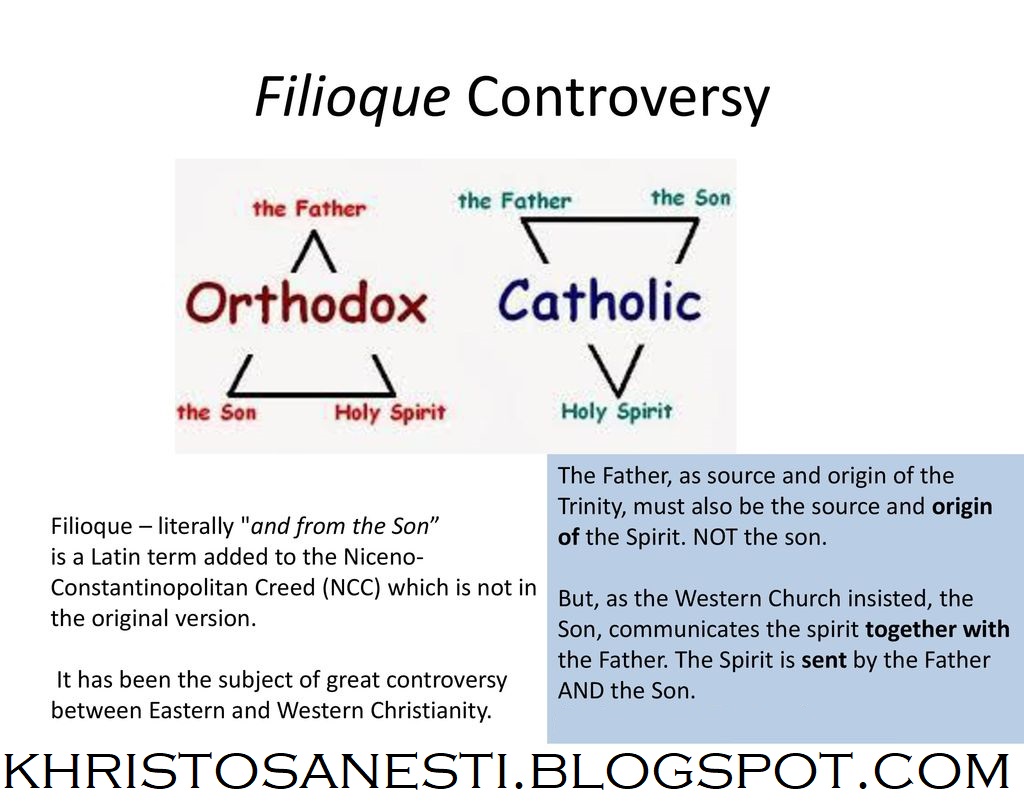
Recently reviewing some old Roman Catholic dogmatic manuals and catechisms, a strange position stood out to me which I had not previously seen. I have long been familiar with Augustine’s speculations about the Trinity and the inter-Trinitarian relations based on the faulty analogy of human psychology and physiology, but as for their rising to the rank of being an official element of filioquism, I had not noticed. Naturally, Eastern Orthodox theology has officially rejected these faulty premises as leading to heresy, but exactly what kind of heresy was now made even more striking.
 

First, let’s consider one of the crucial forms of argument St. Athanasius uses to defend Orthodoxy against the Arian heresy that the Son was a creation. Indeed, were this so, the argument goes, the Son would be a product of the Father’s will. Were the Son a product of will, then His coming to being is not eternal, He is not the Logos, and generation is really no different from creation. All of these elements constitute the Athanasian apologetic, but consider the following from De Synodis where the Saint describes the Arian doctrine:

Blasphemies of Arius:
God Himself then, in His own nature, is ineffable by all men. Equal or like Himself He alone has none, or one in glory. And Ingenerate we call Him, because of Him who is generate by nature. We praise Him as without beginning because of Him who has a beginning. And adore Him as everlasting, because of Him who in time has come to be. The Unbegun made the Son a beginning of things originated; and advanced Him as a Son to Himself by adoption. He has nothing proper to God in proper subsistence. For He is not equal, no, nor one in essence with Him. Wise is God, for He is the teacher of Wisdom. There is full proof that God is invisible to all beings; both to things which are through the Son, and to the Son He is invisible. I will say it expressly, how by the Son is seen the Invisible; by that power by which God sees, and in His own measure, the Son endures to see the Father, as is lawful. Thus there is a Triad, not in equal glories. Not intermingling with each other are their subsistences. One more glorious than the other in their glories unto immensity. Foreign from the Son in essence is the Father, for He is without beginning. Understand that the Monad was; but the Dyad was not, before it was in existence. It follows at once that, though the Son was not, the Father was God. Hence the Son, not being (for He existed at the will of the Father), is God Only-begotten , and He is alien from either. Wisdom existed as Wisdom by the will of the Wise God. Hence He is conceived in numberless conceptions : Spirit, Power, Wisdom, God’s glory, Truth, Image, and Word. Understand that He is conceived to be Radiance and Light. One equal to the Son, the Superior is able to beget; but one more excellent, or superior, or greater, He is not able. At God’s will the Son is what and whatsoever He is. And when and since He was, from that time He has subsisted from God. He, being a strong God, praises in His degree the Superior. To speak in brief, God is ineffable to His Son. For He is to Himself what He is, that is, unspeakable. So that nothing which is called comprehensible does the Son know to speak about; for it is impossible for Him to investigate the Father, who is by Himself. For the Son does not know His own essence, For, being Son, He really existed, at the will of the Father.What argument then allows, that He who is from the Father should know His own parent by comprehension? For it is plain that for that which has a beginning to conceive how the Unbegun is, or to grasp the idea, is not possible.1

Thus, in Arianism because the definition of the Father is “ingenerate,” divine simplicity in this case mandated, for Arius, that Paternity and ousia be synonymous (as Eunomius would later say against St. Gregory of Nyssa). For another to be introduced would be impossible, as the distinctions would imply divisions and time intervals into the “ingenerate” Father-essence. For both the Arian and Eunomian, the Father-essence is a Monad wholly enclosed within itself, while along with creation, this essence has emanated a secondary creation, the “Son.” What is interesting is that St. Athanasius’ response is based on Colossians and many other texts, that the Son is the express image of the Father’s hypostasis, and this generation is from all eternity, and thus is not by will.

That generation is done by will is a lynchpin of the Arian argument and its rejection is fundamental to the Orthodox dogma that the Son is homoousios with the Father. Inasmuch as there is one will in God, and will is a property of nature, the Father, Son and Spirit all share the same natural will. This basic fact should be known and admitted by all, but a devastating problem arises when we come to the enshrined dogma of Rome concerning the so-called “double” procession of the Spirit—not only does Rome erroneously claim the Father-Son operate as a “single principle” source, the Spirit’s spiration is said to be from the will of the Father and Son.

Traditional Catholic systematic theologian Ludwig Ott explains:

“The Holy Ghost proceeds from the will or the mutual love of the Father and Son.” (Sent. certa.).

The Roman Catechism teaches that the “Holy Ghost proceeds from the Divine Will, Inflamed, as it were, with love (a divine voluntate veluti amore inflammata).”

“Holy Ghost designates a … Divine Person, the name pneuma indicates that the Holy Ghost, through an activity of the divine will, proceeds as the Principle of Divine Activity (per modum voluntatis)… the Holy Ghost proceeds as an act of love.”

“The object of the Divine Will, by which the Father and Son produce the Holy Ghost is primarily that which God necessarily loves, namely the Divine Essence, and secondarily that which He freely loves, created things…”2

The absurdity of this should immediately be evident, and to be clear the citation is the Catechism of the Council of Trent, pages 93-4. Note as well this is sententia certa, the silly level of classification which makes this a Roman proclamation of what is part of revealed theology—functioning “higher” than common, ordinary teaching. We know, of course, this doctrine arose based on the Augustinian “analogy” of human psychology. To be even clearer, this teaching is explicit in Denzinger 296 where the erroneous Western Council of Toledo interjected the filioque because of a perceived guard against Arianism, while also mandating absolute divine simplicity. This means the doctrine in question is Roman Catholic dogma, and no mere opinion:

Profession of Faith Concerning the Trinity:
Let the designation of this “holy will”—although through a comparative similitude of the Trinity, where it is called memory, intelligence, and will—refer to the person of the Holy Spirit; according to this, however, what applies to itself, is predicated substantially. For the will is the Father, the will is the Son, the will is the Holy Spirit; just as God is the Father, God is the Son, God is the Holy Spirit and many other similar things, which according to substance those who live as protectors of the Catholic faith do not for any reason hesitate to say. And just as it is Catholic to say: God from God, light from light, life from life, so it is a proved assertion of true faith to say the will from the will; just as wisdom from wisdom, essence from essence, and as God the Father begot God the Son, so the Will, the Father, begot the Son, the Will. Thus, although according to essence the Father is will, the Son is will and the Holy Spirit is will, we must not however believe that there is unity according to a relative sense, since one is the Father who refers to the Son, another the Son, who refers to the Father, another the Holy Spirit who, because He proceeds from the Father and the Son, refers to the Father and the Son; not the same but one in one way, one in another, because to whom there is one being in the nature of deity, to these there is a special property in the distinction of persons.

In a confused passage, purportedly refuting Eunomius, Augustine writes of the Son, Spirit and will:

It was certainly a sharp answer that somebody gave to the heretic, who most subtly asked him whether God begot the Son willingly or unwillingly, in order that if he said unwillingly, it would follow most absurdly that God was miserable; but if willingly, he would immediately infer, as though by an invincible reason, that at which he was aiming, viz. that He was the Son, not of His nature, but of His will. But that other, with great wakefulness, demanded of him in turn, whether God the Father was God willingly or unwillingly; in order that if he answered unwillingly, that misery would follow, which to believe of God is sheer madness; and if he said willingly, it would be replied to him, Then He is God too by His own will, not by His nature. What remained, then, except that he should hold his peace, and discern that he was himself bound by his own question in an insoluble bond? But if any person in the Trinity is also to be specially called the will of God, this name, like love, is better suited to the Holy Spirit; for what else is love, except will?3

Person, will, essence and act or energy are here fused and confused as will be the perennial norm for Western theology, but I cite this to show Augustine was quite aware of the Eunomian and Arian argument that the Son was a product of the Father’s will. Though admittedly a bad argument, Augustine’s response is that if any Person in the Trinity is the will (or a product of the will?) it is the Spirit! Why? Because in this Latin tradition, in God, His actions strictly are His essence—and not only that, they are also Persons. Rather than the Orthodox formulation of love as a natural divine energy all Three have in common, here “Love” is somehow more one Person than another. Is “Justice” also a divine Person? Foreknowledge? If the Spirit is the will, and is also a product of the will, the stupidity of this error becomes manifest, as the Spirit spirates Himself. This long, crazy train of confusion is ably refuted in the famous treatise of St. Photios the Great, the Mystagogy, which can be read here.

Briefly, though, let’s look and see that this is also the teaching of Thomas Aquinas (following in the train of Augustine) in his conflated double procession argument:

“Furthermore, the order of the procession of each one agrees with this conclusion. For it was said above (I:27:4; I:28:4), that the Son proceeds by the way of the intellect as Word, and the Holy Ghost by way of the will as Love. Now love must proceed from a word. For we do not love anything unless we apprehend it by a mental conception. Hence also in this way it is manifest that the Holy Ghost proceeds from the Son.”4

Because the divine essence is the hypostasis, will and action, all predicates of God blend into classical Eunomianism. Eunomius’ modalism, as shown in the voluminous treatise of St. Gregory of Nyssa against him, was predicated on an isomorphic identification of various terms and names with the divine essence. Proclaiming to know what he did not, Eunomius, like Arius before him, foolishly imagined divine persons as products of the divine will. St. Athanasius and the rest of Orthodox theology would emphatically and dogmatically go on to reject these notions, and specifically the heresy of divine hypostases as products of the will.

Roman Catholicism, in its zeal to defend this error has merely transferred an old Arian subordinationist argument concerning the Son, to one about the Spirit! The irony here is filioquism is ignorantly touted as some response to Arianism, while foolishly making the very same argument the Arians did about the Son and applying it to the Spirit—that He is a product of will. On top of that, it is touted in their dogmatic manuals, everyday apologists and classic catechisms. To admit this to be in error is really the collapse of the entire edifice (which is already happening anyway).


In fact, in the very same work St. Athanasius rebukes speculations based on human analogies for terms like “begotten,” and explains it is not by will:

Accordingly, as in saying “offspring,” we have no human thoughts, and, though we know God to be a Father, we entertain no material ideas concerning Him, but while we listen to these illustrations and terms, we think suitably of God, for He is not as man, so in like manner, when we hear of “coessential,” we ought to transcend all sense, and, according to the Proverb, “understand by the understanding what is set before us” (Proverbs 23:1); so as to know, that not by will, but in truth, is He genuine from the Father, as Life from Fountain, and Radiance from Light. Else why should we understand “offspring” and “son,” in no corporeal way, while we conceive of “coessential” as after the manner of bodies? Especially since these terms are not here used about different subjects, but of whom ‘offspring’ is predicated, of Him is “coessential” also.5

The Spirit, too, manifestly possesses the same Godhead, Essence, Power, Glory and Will of the Father and Son, while not being the Will, Father or Son:

And in One Lord Jesus Christ, His Son, Only-begotten God John (1:18), by whom are all things, who was begotten before all ages from the Father, God from God, whole from whole, sole from sole , perfect from perfect, King from King, Lord from Lord, Living Word, Living Wisdom, true Light, Way, Truth, Resurrection, Shepherd, Door, both unalterable and unchangeable; exact Image of the Godhead, Essence, Will, Power and Glory of the Father; the first born of every creature, who was in the beginning with God, God the Word, as it is written in the Gospel, and the Word was God? (John 1:1); by whom all things were made, and in whom all things consist; who in the last days descended from above, and was born of a Virgin according to the Scriptures, and was made Man, Mediator between God and man, and Apostle of our faith, and Prince of life, as He says, I came down from heaven, not to do My own will, but the will of Him that sent Me (John 6:38); who suffered for us and rose again on the third day, and ascended into heaven, and sat down on the right hand of the Father, and is coming again with glory and power, to judge quick and dead.6


1 De Synodis 2.15


2 Fundamentals of Catholic Dogma, pgs. 66-7


3 On the Holy Trinity 20.38


4 Summa Theologica, I. Q36, 3


5 De Synodis 3.42


6 Ibid. 2.23


lunes, 8 de junio de 2020

Monday of The Holy Spirit - Día del Espíritu Santo


ENGLISH:
The Orthodox Church commemorates today, on Monday of the Holy Spirit, the Third Person of the Holy Trinity, the Holy Spirit. “[I believe] in the Holy Spirit, the Lord, the giver of life, who proceeds from the Father, who with the Father and the Son is adored and glorified […]”

In the Holy Trinity, there are three Persons: The Father, the Son and the Holy Spirit. The Holy Spirit proceeds eternally from the Father beyond the limits of time. It descended to the world on the day of Pentecost, as the Second Person of the Holy Trinity, the Son and Word of God. According to the Credo, these three Persons are united indivisibly and without confusion. We thus worship the Holy Spirit in the same way we worship the Father and the Son.

St. John Chrysostom said: “The gifts of the Holy Spirit go beyond human reason. So, let us all rejoice together and worship our Lord. It is a holiday and a celebration for us today. We recently commemorated the Cross, the Passion, the Resurrection, and then the Ascension of Jesus Christ. It is the feast of the feasts today; The fulfilment of the Lord’s promises.

Thanks to the power of the Holy Spirit, we washed out the sin and our souls have become pure. We were human beings, but now we are angels. Our nature has not altered, we have maintained our human nature through which we were able to obtain characteristics of an angel.

This week is dedicated to the Holy Spirit, and, therefore, we do not have to fast on Wednesday and Friday.
Thus, the faithful are taught that fasting is not a goal that they have to achieve, but a way to live an ascetic life, to be self-restrained, and to reflect on the gifts of the Holy Spirit.

Whit Monday, also known as Pentecost Monday or Monday of the Holy Spirit, is a moveable feast in the Christian calendar celebrated the day after Pentecost. Orthodox Whit Monday is a public holiday in some countries, namely Cyprus, Greece, Romania and Ukraine.

It is celebrated as the afterfeast of Pentecost dedicated to God the Holy Spirit. It is usually referred to as Day of the Holy Spirit or Monday of the Holy Spirit.

The feast commemorates the descent of the Holy Spirit upon the apostles on the fiftieth day after the Resurrection of Jesus Christ. As the date on which the feast is observed depends on Easter, it falls on different days in different years. It is celebrated either in May or in June. As far as liturgy is concerned, Whit Monday services are very similar to those held on Pentecost.

-----------
ESPAÑOL:
La Iglesia Ortodoxa conmemora hoy, el lunes del Espíritu Santo, la Tercera Persona de la Santísima Trinidad, el Espíritu Santo. "[Creo] en el Espíritu Santo, el Señor, el dador de la vida, que procede del Padre, que con el Padre y el Hijo es adorado y glorificado [...]" 

 En la Santísima Trinidad, hay tres personas: el Padre, el Hijo y el Espíritu Santo. El Espíritu Santo procede eternamente del Padre más allá de los límites del tiempo. Descendió al mundo el día de Pentecostés, como la Segunda Persona de la Santísima Trinidad, el Hijo y la Palabra de Dios. Según el Credo, estas tres personas están unidas indivisiblemente y sin confusión. De este modo adoramos al Espíritu Santo de la misma manera que adoramos al Padre y al Hijo.
San Juan Crisóstomo dijo: “Los dones del Espíritu Santo van más allá de la razón humana. Entonces, regocijémonos todos juntos y adoremos a nuestro Señor. Es una fiesta y una celebración para nosotros hoy. Recientemente conmemoramos la Cruz, la Pasión, la Resurrección y luego la Ascensión de Jesucristo. Es la fiesta de las fiestas de hoy; El cumplimiento de las promesas del Señor. 

Gracias al poder del Espíritu Santo, lavamos el pecado y nuestras almas se han vuelto puras. Éramos seres humanos, pero ahora somos ángeles. Nuestra naturaleza no ha cambiado, hemos mantenido nuestra naturaleza humana a través de la cual pudimos obtener las características de un ángel.

Esta semana está dedicada al Espíritu Santo y, por lo tanto, no tenemos que ayunar los miércoles y viernes. Por lo tanto, se les enseña a los fieles que el ayuno no es una meta que tienen que lograr, sino una forma de vivir una vida ascética, tener dominio propio y reflexionar sobre los dones del Espíritu Santo. 

Es una fiesta móvil en el calendario cristiano que se celebra el día después de Pentecostés. Es un día festivo en algunos países, a saber, Chipre, Grecia, Rumania y Ucrania. 

Se celebra como la fiesta posterior de Pentecostés dedicada a Dios el Espíritu Santo. Por lo general, se conoce como Día del Espíritu Santo o Lunes del Espíritu Santo. 

La fiesta conmemora el descenso del Espíritu Santo sobre los apóstoles en el quincuagésimo día después de la Resurrección de Jesucristo. Como la fecha en que se observa la fiesta depende de la Pascua, cae en diferentes días en diferentes años. Se celebra en mayo o en junio. En cuanto a la liturgia, los servicios del Día del Espíritu Santo son muy similares a los de Pentecostés.

+++

domingo, 16 de junio de 2019

Pentecost


Pentecost , Greek πεντηκοστή [ἡμέρα]

Pentecost (also called Trinity Day or Descent of the Holy Spirit) is one of the Great Feasts of the Orthodox Church, celebrated fifty days after Pascha. It is celebrated on the fiftieth day after Easter, commemorates the descent of the Holy Ghost upon the Apostles and other followers of Jesus Christ while they were in Jerusalem celebrating the Feast of Weeks, as described in the Acts of the Apostles (Acts 2:1–31). This event represents the birth of the Church.
The term Pentecost comes from the Greek Πεντηκοστή (Pentēkostē) meaning "fiftieth". It refers to the festival celebrated on the fiftieth day after Passover, also known as the "Feast of Weeks" 
 
Day of Pentecost 
Fifty days after the Resurrection, on the excising Jewish feast of Pentecost, while the disciples and many other followers of Jesus Christ were gathered together to pray, the Holy Spirit descended upon them in the form of "cloven tongues of fire," with the sound of a mighty rushing wind, and they began to speak in languages that they did not know. There were many visitors from the Jewish diaspora to Jerusalem at that time for the Jewish observance of the feast, and they were astonished to hear these untaught fisherman speaking praises to God in their alien tongues. This account is detailed in the Acts of the Apostles, chapter 2.

The number fifty, as in the fiftieth day after Pascha, stands for eternal and heavenly fulfillment, seven times seven, plus one. 

Feast of Pentecost
The Orthodox Church sees Pentecost as the final fulfillment of the mission of Jesus Christ and the first beginning of the messianic age of the Kingdom of God, mystically present in his Church. It is traditionally called the beginning of the Church.

Besides celebrating the coming of the Holy Spirit, the feast also celebrates the full revelation of the divine Trinity, Father, Son, and Holy Spirit. Hymns of the Church, celebrate the sign of the final act of God's self-disclosure to the world of His creation.

The feast of Pentecost is not just a celebration of an event in history. It is also a celebration their membership in the Church. They have lived Pentecost and received "the seal of the gift of the Holy Spirit" in the sacrament of chrismation.

For the feast of Pentecost the icon of the Holy Trinity, the three angelic figures who appeared to Abraham, is placed in the center of the church for veneration. This icon is used with the traditional Pentecost icon. The church building is decorated with flowers and the green leaves of the summer to show that God's divine breath comes to renew all creation. Green vestments and coverings are also used.

In many parishes the feast is celebrated starting the evening before with Great Vespers. Some parishes also serve Matins on the morning of the feast before the Divine Liturgy.

The Liturgy of Saint John Chrysostom with special hymns replacing the standard Antiphons. The hymns O Heavenly King and We have seen the True Light are sung for the first time since Easter, calling the Holy Spirit to "come and abide in us," and proclaiming that "we have received the heavenly Spirit."

An extraordinary service called the Kneeling Vespers, is observed on the evening of Pentecost. This is a Vespers service to which are added three sets of long poetical prayers, the composition of Saint Basil the Great, during which everyone makes a full prostration, touching their foreheads to the floor (prostrations in church having been forbidden from the day of Pascha (Easter) up to this point). In many parishes, this service is done immediately after the Liturgy.

HymnsTroparion (Tone 8)  Blessed art You O Christ Our God You have revealed the fishermen as most wise By sending down upon them the Holy Spirit Through them You drew the world into Your net O Lover of Man, Glory to You!

Kontakion (Tone 8) When the most High came down and confused the tongues, He divided the nations; But when he distributed the tongues of fire He called all to unity. Therefore, with one voice, we glorify the All-holy Spirit!
 
Lea en Español: Pentecostés

Alá No Tuvo Hijo

  English Version:   Allah Had No Son Fuente:  https://www.chick.com/products/tract?stk=572&ue=d