Translate

Mostrando entradas con la etiqueta Apóstoles. Mostrar todas las entradas

domingo, 5 de noviembre de 2023

Holy Apostle James the Just - Santo Apóstol San Jacobo el Justo


ENGLISH:
 

Saint James the Just, also called James Adelphos and James the Brother of Our Lord (died AD 62), was the first Bishop or Patriarch of Jerusalem. According to the Protoevangelion of James, James was the son of Joseph—along with the other 'brethren of the Lord' mentioned in the scripture—from a marriage prior to his betrothal to Mary. He wrote an epistle which is part of the New Testament. St. James is commemorated on October 23; on December 26 and also on the first Sunday after the Nativity, along with David the King and St. Joseph; and on January 4 among the Seventy Apostles.
 

Name

Eusebius, quoting from Hegesippus, writes that James was "called the Just by all from the time of our Savior to the present day; for there were many that bore the name of James."

He is called Adelphos (Greek "brother"). Jesus's 'brothers'—James as well as Jude, Simon, and Joses—are mentioned in Matthew 13:55, Mark 6:3, Luke 6:14, and by Paul in Galatians 1:19.
 

Life

Jerome, De Viris Illustribus, quotes Hegesippus' account of James from the fifth book of his lost Commentaries: "After the apostles, James the brother of the Lord surnamed the Just was made head of the Church at Jerusalem. Many indeed are called James. This one was holy from his mother's womb. He drank neither wine nor strong drink, ate no flesh, never shaved or anointed himself with ointment or bathed. He alone had the privilege of entering the Holy of Holies, since indeed he did not use woolen vestments but linen and went alone into the temple and prayed in behalf of the people, insomuch that his knees were reputed to have acquired the hardness of camels' knees."

Paul further describes James as being one of the persons the risen Christ showed himself to (I Corinthians 15:3-8); then later in I Corinthians, mentions James in a way that suggests James had been married (9:5); and in Galatians, Paul lists James with Cephas (better known as Peter) and John, as the three "pillars" of the Church, and who will minister to "the circumcised" (that is the Jews) in Jerusalem, while Paul and his fellows will minister to the Gentiles (2:9, 2:12).

Acts provides clear evidence that James was an important figure in the Christian community of Jerusalem. When Peter, having miraculously escaped from prison, must flee Jerusalem, he asks that James be informed (12:17). When the Christians of Antioch are concerned over whether Gentile Christians need be circumcised to be saved, they send Paul and Barnabas to confer with the church there, and it is James who utters the definitive judgment (15:13ff). When Paul arrives in Jerusalem to deliver the money he raised for the faithful there, it is James to whom he speaks, and who insists that Paul ritually cleanse himself (21:18).

A debated passage, often characterized as a Christian interpolation, in Josephus' Jewish Antiquities, records his death in Jerusalem as having occurred after the death of the procurator Porcius Festus, yet before Clodius Albinus took office (Antiquities 20,9)—which has thus been dated to AD 62. The high priest Ananus took advantage of this lack of imperial oversight to assemble a council of judges who condemned James "on the charge of breaking the law," then had him executed by stoning. Josephus reports that Ananus' act was widely viewed as little more than judicial murder, and offended a number of "those who were considered the most fair-minded people in the City, and strict in their observance of the Law," who went as far as meeting Albinus as he entered the province to petition him about the matter. Their agitations led to Ananus being deposed as high priest.

Eusebius, while quoting Josephus' account, also records otherwise lost passages from Hegesippus (see links below), and Clement of Alexandria (Historia Ecclesiae, 2.23). Hegesippus' account apparently varied from what Josephus reports: the Pharisees, upset at St. James' teachings, first threw him from the summit of the Temple in Jerusalem, then stoned him, and at last broke his skull with a fuller's club.

The Protevangelion of James (or Infancy Gospel of James), a work of the 2nd century, also presents itself as written by James.
 

Hymns

Troparion (Tone 4) As the Lord's disciple you received the Gospel, O righteous James;As a martyr you have unfailing courage;As God's brother, you have boldness;As a hierarch, you have the power to intercede.Pray to Christ God that our souls may be saved.

Kontakion (Tone 4) When God the Word, the Only-begotten of the Father,Came to live among us in these last days,He declared you, venerable James, to be the first shepherd and teacher of JerusalemAnd a faithful steward of the spiritual Mysteries.Therefore, we all honor you, O Apostle.

------------------------

 ESPAÑOL: 

Jacobo el Justo, también llamado Jacobo Adelfos y Santiago el Hermano de Nuestro Señor (fallecido en el año 62 d. C.), fue el primer obispo o patriarca de Jerusalén. Según el Protoevangelio de Santiago, Santiago era hijo de José, junto con los otros 'hermanos del Señor' mencionados en las Escrituras, de un matrimonio anterior a su compromiso con María. Escribió una epístola que forma parte del Nuevo Testamento. A Jacobo se conmemora el 23 de octubre; el 26 de diciembre y también el primer domingo después de la Natividad, junto con el Rey David y San José; y el 4 de enero entre los Setenta Apóstoles.


Nombre 

 Eusebio, citando a Hegesipo, escribe que Jacobo fue "llamado el Justo por todos desde los tiempos de nuestro Salvador hasta el día de hoy; porque había muchos que llevaban el nombre de Jacobo". Se llama Adelphos (en griego "hermano"). Los 'hermanos' de Jesús (Jacobo, así como Judas, Simón y José) son mencionados en Mateo 13:55, Marcos 6:3, Lucas 6:14 y Pablo en Gálatas 1:19.


Vida 

Jerónimo, De Viris Illustribus, cita el relato de Hegesipo sobre James del quinto libro de sus Comentarios perdidos: 

"Después de los apóstoles, Jacobo, el hermano del Señor, apodado el Justo, fue hecho jefe de la Iglesia en Jerusalén. Muchos, en verdad, se llaman Jacobo. Éste era santo desde el vientre de su madre. No bebía vino ni sidra, ni comía carne, nunca se afeitaba ni se ungía con ungüento ni se bañaba, sólo él tenía el privilegio de entrar al Lugar Santísimo, pues ciertamente no usaba vestiduras de lana sino de lino y entraba solo al templo y oraba a favor del pueblo, de tal manera que sus rodillas Tenían fama de haber adquirido la dureza de las rodillas de los camellos."

Pablo describe además a Jacobo como una de las personas a las que Cristo resucitado se mostró (1 Corintios 15:3-8); luego, más tarde, en I Corintios, menciona a Jacobo de una manera que sugiere que había estado casado (9:5); y en Gálatas, Pablo enumera a Jacobo, Cefas (mejor conocido como Pedro) y Juan, como los tres "pilares" de la Iglesia, y quienes ministrarán a "los circuncidados" (es decir, los judíos) en Jerusalén, mientras que Pablo y sus sus compañeros ministrarán a los gentiles (2:9, 2:12). 

Los Hechos proporciona evidencia clara de que Santiago era una figura importante en la comunidad cristiana de Jerusalén. Cuando Pedro, habiendo escapado milagrosamente de la prisión, debe huir de Jerusalén, pide que se informe a Santiago (12:17). Cuando los cristianos de Antioquía están preocupados sobre si los cristianos gentiles necesitan ser circuncidados para ser salvos, envían a Pablo y a Bernabé a consultar con la iglesia de allí, y es Jacobo quien pronuncia el juicio definitivo (15:13ss). Cuando Pablo llega a Jerusalén para entregar el dinero que recaudó para los fieles de allí, es a Jacobo con quien habla, y quien insiste en que Pablo se limpie ritualmente (21:18).

Un pasaje debatido, a menudo caracterizado como una interpolación cristiana, en las Antigüedades judías de Josefo, registra que su muerte en Jerusalén ocurrió después de la muerte del procurador Porcio Festo, pero antes de que Clodio Albino asumiera el cargo (Antigüedades 20,9), lo que por lo tanto ha se fecha en el año 62 d. C. El sumo sacerdote Anano aprovechó esta falta de supervisión imperial para reunir un consejo de jueces que condenó a Jacobo "bajo el cargo de violar la ley" y luego lo ejecutó por lapidación. Josefo informa que el acto de Ananus fue ampliamente visto como poco más que un asesinato judicial, y ofendió a varios "aquellos que eran considerados las personas más imparciales de la ciudad y estrictos en su observancia de la Ley", que llegaron hasta como reunirse con Albino cuando entró en la provincia para presentarle una petición sobre el asunto. Sus agitaciones llevaron a que Ananus fuera depuesto como sumo sacerdote. 

Eusebio, aunque cita el relato de Josefo, también registra pasajes perdidos de Hegesipo (ver enlaces a continuación) y de Clemente de Alejandría (Historia Ecclesiae, 2.23). El relato de Hegesipo aparentemente variaba de lo que relata Josefo: los fariseos, molestos por las enseñanzas de Santiago, primero lo arrojaron desde lo alto del templo en Jerusalén, luego lo apedrearon y finalmente le rompieron el cráneo con una maza de batanero. 

El Protevangelion de Santiago (o Evangelio de la infancia de Jacobo), obra del siglo II, también se presenta escrito por Jacobo.


Himnos 

Troparion (Tono 4) Como discípulo del Señor recibiste el Evangelio, oh justo Santiago; Como mártir tienes un valor inagotable; Como hermano de Dios, tienes valentía; Como jerarca, tienes el poder de interceder. Orad a Cristo Dios para que nuestras almas sean salvas. 

Kontakion (Tono 4) Cuando Dios el Verbo, el Unigénito del Padre, Vino a vivir entre nosotros en estos últimos días, A ti, venerable Santiago, te declaró el primer pastor y maestro de Jerusalén. Y fiel administrador de los Misterios espirituales. Por eso todos te honramos, oh Apóstol.

+++

domingo, 24 de octubre de 2021

St. Philip (of the Seventy) - San Felipe (de los Setenta)


ENGLISH:
The holy, glorious, all-laudable Apostle Philip (of the Seventy), one of the Seven Deacons, is commemorated by the Church on October 11. He was born in Palestine, was married, and had children. He was not the St. Philip (November 14) who was one of the Twelve Apostles.

After the Descent of the Holy Spirit, the Twelve Apostles made Philip, along with six others, a deacon in the Church of Jerusalem. They appointed him to deal with the offerings of the faithful and attend to the concerns of the widowed, the orphaned, and the needy. When the persecution of Christians began, and the Jews stoned the Protomartyr Stephen, the eldest of the Seven Deacons, the Apostle Philip left Jerusalem and settled in Samaria. There he successfully preached Christianity. Among the disciple's converts was the noted magician Simon, who "after being baptized, continued with Philip." (Acts 8:9-13)

At the command of an angel of the Lord, St. Philip set out upon the road connecting Jerusalem with Gaza. There he met an official of the empress of Ethiopia, whom he also converted to Christianity (Acts 8:26-39). The holy disciple Philip tirelessly preached the Word of God in many of the lands of the Near East adjoining Palestine. At Jerusalem the Apostles made him a bishop and sent him to Tralles in Asia Minor, where he also baptized many. St. Philip died in old age.
Hymns

Troparion (Tone 4) The universe is adorned and Ethiopia rejoices,For she is enlightened by you and adorned by your crown.O most eloquent Philip she brightly celebrates your memory.You accomplished a course worthy of the Gospel,For you taught all to believe in Christ.Wherefore Ethiopia extends her arms to God,Pray to Him, O Philip, that He will grant us great mercy.

Kontakion (Tone 4) Inspired by the Holy SpiritYou enlightened the whole world with your teachingsAnd the splendor of your miraclesO Apostle Philip, contemplator of Divine Truths. 

-------

ESPAÑOL:

El santo, glorioso y loable apóstol Felipe (de los Setenta), uno de los Siete Diáconos, es conmemorado por la Iglesia el 11 de octubre. Nació en Palestina, estuvo casado y tuvo hijos. No era San Felipe (14 de noviembre) que era uno de los Doce Apóstoles. Después del Descenso del Espíritu Santo, los Doce Apóstoles nombraron a Felipe, junto con otros seis, diácono en la Iglesia de Jerusalén. Lo designaron para ocuparse de las ofrendas de los fieles y atender las preocupaciones de los viudos, los huérfanos y los necesitados. Cuando comenzó la persecución de los cristianos y los judíos apedrearon al protomártir Esteban, el mayor de los siete diáconos, el apóstol Felipe abandonó Jerusalén y se estableció en Samaria. Allí predicó con éxito el cristianismo. Entre los conversos del discípulo se encontraba el notable mago Simón, quien "después de ser bautizado, continuó con Felipe". (Hechos 8: 9-13) Por orden de un ángel del Señor, San Felipe se puso en camino por la carretera que conecta Jerusalén con Gaza. Allí conoció a un funcionario de la emperatriz de Etiopía, a quien también convirtió al cristianismo (Hechos 8: 26-39). El santo discípulo Felipe predicó incansablemente la Palabra de Dios en muchas de las tierras del Cercano Oriente colindantes con Palestina. En Jerusalén, los Apóstoles lo nombraron obispo y lo enviaron a Tralles en Asia Menor, donde también bautizó a muchos. San Felipe murió en la vejez.

Himnos 

Troparion (tono 4)  El universo se adorna y Etiopía se regocija, Porque ella es iluminada por ti y adornada por tu corona. Oh elocuente Felipe, ella celebra vivamente tu recuerdo. Has cumplido un derrotero digno del Evangelio, Porque enseñaste a todos a creer en Cristo. Por tanto, Etiopía extiende sus brazos a Dios, Ruega a él, oh Felipe, que nos conceda gran misericordia. 

Kontakion (tono 4)  Inspirado por el Espíritu Santo Iluminaste al mundo entero con tus enseñanzas Y el esplendor de tus milagros Oh Apóstol Felipe, contemplador de las Verdades Divinas.


+++


viernes, 22 de octubre de 2021

Holy Apostle James, Son of Alphaeus - Santo Apóstol Jacobo, Hijo de Alfeo


ENGLISH:
Holy Apostle James the son of Alphaeus one of the Twelve Apostles, was the brother of the holy Evangelist Matthew. He heard the Lord’s words and witnessed His miracles. After the Descent of the Holy Spirit, the Apostle James Alphaeus and the Apostle Andrew the First-Called (November 30), made missionary journeys preaching in Judea, Edessa, Gaza, Eleutheropolis, proclaiming the Gospel, healing all sorts of sickness and disease, and converting many to the path of salvation. Saint James finished his apostolic work In the Egyptian city of Ostrachina, where he was crucified by the pagans.
 

Troparion (Tone 3)

Holy Apostle James, / entreat the merciful God / to grant our souls forgiveness of transgressions.
 

Kontakion (Tone 2 )

Let us bless James, praising him as the messenger of God, / for he filled the souls of the pious with wise dogmas. / Standing at the throne of glory before the Master, / he rejoices with all the angels unceasingly praying for us all.

--------

ESPAÑOL: 

El Santo Apóstol Santiago, hijo de Alfeo, uno de los Doce Apóstoles, era hermano del santo evangelista Mateo. Escuchó las palabras del Señor y fue testigo de sus milagros. Después de la Venida del Espíritu Santo, el Apóstol Santiago Alfeo y el Apóstol Andrés el Primero Llamado (30 de noviembre), hicieron viajes misioneros predicando en Judea, Edesa, Gaza, Eleuteropolis, proclamando el Evangelio, sanando todo tipo de dolencias y dolencias, y convertir a muchos al camino de la salvación. Santiago terminó su labor apostólica en la ciudad egipcia de Ostrachina, donde fue crucificado por los paganos. 

Troparion (tono 3) Santo Apóstol Santiago, / suplico al Dios misericordioso / que conceda a nuestra alma el perdón de las transgresiones. 

Kontakion (tono 2) Bendigamos a Santiago, alabándolo como el mensajero de Dios, / porque llenó las almas de los piadosos de sabios dogmas. / De pie en el trono de gloria ante el Maestro, / se regocija con todos los ángeles que oran sin cesar por todos nosotros.


+++


domingo, 13 de diciembre de 2020

St. Andrew the First-Called Apostle - San Andrés Apóstol el Primer Llamado


ENGLISH:
The holy, glorious and all-laudable Apostle Andrew the First-Called was the first of the apostles of Jesus Christ and the brother of the Apostle Peter. His great missionary legacy led him to become the patron saint of several countries, including Romania and Scotland. His feast day is November 30.

Andrew was a fisherman by trade, born in Bethsaida. A disciple of John the Forerunner, he left St. John to follow Jesus Christ following his baptism and brought along his brother, the Apostle Peter. Both are numbered among the Twelve Great Apostles. After Pentecost, the lot fell to St. Andrew to preach in:
Byzantium: he appointed St. Stachys as its first bishop
Thrace, Peloponnese, Greece, and Epirus: he converted many to the Faith and ordained bishops and priests for them
Georgia: he entered Georgia from Ajara, preached Christianity in Atsquri, built small church there and left miracle-working icon of Theotokos.
Rus' lands: in Kiev he planted a cross on one of the high hills of Kiev, and he prophesied a city that would have many golden-domed churches, and a bright Christian future for the Rus' people.

St. Andrew was martyred in Peloponnese, in the city of Patras. The Proconsul Aegeates' family believed in the miracles and preaching of St. Andrew, and the enraged Proconsul tortured and crucified St. Andrew. The new converts wanted to remove him from his cross, but the saint would not allow them. Instead, he comforted them from the cross and as he prayed an extraordinary light encompassed him for about a half hour. When it left, he gave up his soul. It was the year 62 AD.


Hymns

Troparion (Tone 4) Andrew, first-called of the Apostlesand brother of the foremost disciple,entreat the Master of allto grant peace to the worldand to our souls great mercy.

Kontakion (Tone 2) Let us praise Andrew, the herald of God,the namesake of courage,the first-called of the Savior's disciplesand the brother of Peter.As he once called to his brother, he now cries out to us:"Come, for we have found the One whom the world desires!"

---------
ESPAÑOL:
El santo, glorioso y loable apóstol Andrés el Primero-Llamado fue el primero de los apóstoles de Jesucristo y hermano del apóstol Pedro. Su gran legado misionero lo llevó a convertirse en el santo patrón de varios países, entre ellos Rumania y Escocia. Su fiesta es el 30 de noviembre. 

Andrés era un pescador de oficio, nacido en Betsaida. Discípulo de Juan el Precursor, dejó a San Juan para seguir a Jesucristo después de su bautismo y trajo consigo a su hermano, el Apóstol Pedro. Ambos se cuentan entre los Doce Grandes Apóstoles. Después de Pentecostés, la suerte recayó en San Andrés para predicar en: Bizancio: nombró a San. Stachys como su primer obispo Tracia, Peloponeso, Grecia y Epiro: convirtió a muchos a la Fe y les ordenó obispos y sacerdotes. Georgia: entró en Georgia desde Ajara, predicó el cristianismo en Atsquri, construyó una pequeña iglesia allí y dejó el icono milagroso de la Theotokos. Tierras de Rus: en Kiev plantó una cruz en una de las altas colinas de Kiev, y profetizó una ciudad que tendría muchas iglesias con cúpulas doradas y un futuro cristiano brillante para la gente de Rus. 

San Andrés fue martirizado en el Peloponeso, en la ciudad de Patras. La familia del Procónsul Aegeates creía en los milagros y la predicación de San Andrés, y el enfurecido Procónsul torturó y crucificó a San Andrés. Los nuevos conversos querían sacarlo de su cruz, pero el santo no se lo permitió. En cambio, los consoló desde la cruz y mientras oraba una luz extraordinaria lo envolvió durante aproximadamente media hora. Cuando se fue, entregó su alma. Era el año 62 d.C. 

 
Himnos:

Troparion (Tono 4) Andrés, primer llamado de los Apóstoles y hermano del primer discípulo, suplica al Maestro de todo que conceda paz al mundo y gran misericordia a nuestras almas. 

 Kontakion (Tono 2) Alabemos a Andrés, el heraldo de Dios, el homónimo de valor, el primer llamado de los discípulos del Salvador y el hermano de Pedro. Como una vez llamó a su hermano, ahora nos grita: "Ven , porque hemos encontrado a Aquel a quien el mundo desea! "


+++


domingo, 29 de noviembre de 2020

St. Matthew Apostle and Evangelist - San Mateo Apóstol y Evangelista


ENGLISH:
The Holy Apostle and Evangelist Matthew, was also named Levi (Mark 2:14; Luke 5:27); he was one of the Twelve Apostles (Mark 3:18; Luke 6:45; Acts 1:13), and was brother of the Apostle James Alphaeus (Mark 2:14). He was a publican, or tax-collector for Rome, in a time when the Jews were under the rule of the Roman Empire. He lived in the Galilean city of Capernaum. When Matthew heard the voice of Jesus Christ: “Come, follow Me” (Mt. 9:9), left everything and followed the Savior. Christ and His disciples did not refuse Matthew’s invitation and they visited his house, where they shared table with the publican’s friends and acquaintances. Like the host, they were also publicans and known sinners. This event disturbed the pharisees and scribes a great deal.

Publicans who collected taxes from their countrymen did this with great profit for themselves. Usually greedy and cruel people, the Jews considered them pernicious betrayers of their country and religion. The word “publican” for the Jews had the connotation of “public sinner” and “idol-worshipper.” To even speak with a tax-collector was considered a sin, and to associate with one was defilement. But the Jewish teachers were not able to comprehend that the Lord had “come to call not the righteous, but sinners to repentance” (Mt. 9:13).

Matthew, acknowledging his sinfulness, repaid fourfold anyone he had cheated, and he distributed his remaining possessions to the poor, and he followed after Christ with the other apostles. Saint Matthew was attentive to the instructions of the Divine Teacher, he beheld His innumerable miracles, he went together with the Twelve Apostles preaching to “the lost sheep of the house of Israel” (Mt. 10:6). He was a witness to the suffering, death, and Resurrection of the Savior, and of His glorious Ascension into Heaven.

Having received the grace of the Holy Spirit, which descended upon the Apostles on the day of Pentecost, Saint Matthew preached in Palestine for several years. At the request of the Jewish converts at Jerusalem, the holy Apostle Matthew wrote his Gospel describing the earthly life of the Savior, before leaving to preach the Gospel in faraway lands.

In the order of the books of the New Testament, the Gospel of Matthew comes first. Palestine is said to be the place where the Gospel was written. Saint Matthew wrote in Aramaic, and then it was translated into Greek. The Aramaic text has not survived, but many of the linguistic and cultural-historical peculiarities of the Greek translation give indications of it.

The Apostle Matthew preached among people who were awaiting the Messiah. His Gospel manifests itself as a vivid proof that Jesus Christ is the Messiah foretold by the prophets, and that there would not be another (Mt. 11:3).

The preaching and deeds of the Savior are presented by the evangelist in three divisions, constituting three aspects of the service of the Messiah: as Prophet and Law-Giver (Ch. 5-7), Lord over the world both visible and invisible (Ch. 8-25), and finally as High Priest offered as Sacrifice for the sins of all mankind (Ch. 26-27).

The theological content of the Gospel, besides the Christological themes, includes also the teaching about the Kingdom of God and about the Church, which the Lord sets forth in parables about the inner preparation for entering into the Kingdom (Ch. 5-7), about the worthiness of servers of the Church in the world (Ch. 10-11), about the signs of the Kingdom and its growth in the souls of mankind (Ch. 13), about the humility and simplicity of the inheritors of the Kingdom (Mt. 18:1-35; 19 13-30; 20:1-16; 25-27; 23:1-28), and about the eschatological revelations of the Kingdom in the Second Coming of Christ within the daily spiritual life of the Church (Ch. 24-25).

The Kingdom of Heaven and the Church are closely interconnected in the spiritual experience of Christianity: the Church is the historical embodiment of the Kingdom of Heaven in the world, and the Kingdom of Heaven is the Church of Christ in its eschatological perfection (Mt. 16:18-19; 28:18-20).

The holy Apostle brought the Gospel of Christ to Syria, Media, Persia, Parthia, and finishing his preaching in Ethiopia with a martyr’s death. This land was inhabited by tribes of cannibals with primitive customs and beliefs. The holy Apostle Matthew converted some of the idol-worshippers to faith in Christ. He founded the Church and built a temple in the city of Mirmena, establishing there his companion Platon as bishop.

When the holy apostle was fervently entreating God for the conversion of the Ethiopians the Lord Himself appeared to him in the form of a youth. He gave him a staff, and commanded him to plant it at the doors of the church. The Lord said that a tree would grow from this staff and it would bear fruit, and from its roots would flow a stream of water. When the Ethiopians washed themselves in the water and ate the fruit, they lost their wild ways and became gentle and good.

When the holy apostle carried the staff towards the church, he was met by the wife and son of the ruler of the land, Fulvian, who were afflicted by unclean spirits. In the Name of Christ the holy apostle healed them. This miracle converted a number of the pagans to the Lord. But the ruler did not want his subjects to become Christians and cease worshiping the pagan gods. He accused the apostle of sorcery and gave orders to execute him.

They put Saint Matthew head downwards, piled up brushwood and ignited it. When the fire flared up, everyone then saw that the fire did not harm Saint Matthew. Then Fulvian gave orders to add more wood to the fire, and frenzied with boldness, he commanded to set up twelve idols around the fire. But the flames melted the idols and flared up toward Fulvian. The frightened Ethiopian turned to the saint with an entreaty for mercy, and by the prayer of the martyr the flame went out. The body of the holy apostle remained unharmed, and he departed to the Lord.

The ruler Fulvian deeply repented of his deed, but still he had doubts. By his command, they put the body of Saint Matthew into an iron coffin and threw it into the sea. In doing this Fulvian said that if the God of Matthew would preserve the body of the apostle in the water as He preserved him in the fire, then this would be proper reason to worship this One True God.

That night the Apostle Matthew appeared to Bishop Platon in a dream, and commanded him to go with clergy to the shore of the sea and to find his body there. The righteous Fulvian and his retinue went with the bishop to the shore of the sea. The coffin carried by the waves was taken to the church built by the apostle. Then Fulvian begged forgiveness of the holy Apostle Matthew, after which Bishop Platon baptized him, giving him the name Matthew in obedience to a command of God.

Soon Saint Fulvian-Matthew abdicated his rule and became a presbyter. Upon the death of Bishop Platon, the Apostle Matthew appeared to him and exhorted him to head the Ethiopian Church. Having become a bishop, Saint Fulvian-Matthew toiled at preaching the Word of God, continuing the work of his heavenly patron.


Troparion (Tone 3)  With zeal, you followed Christ the Master,who in His goodness, appeared on earth to mankind.Summoning you from the custom house,He revealed you as a chosen apostle:the proclaimer of the Gospel to the whole world!Therefore, divinely eloquent Matthew,we honor your precious memory!Entreat merciful God that He may grant our souls remission of transgressions.

Kontakion (Tone 4) Casting aside the bonds of the custom house for the yoke of justice,you were revealed as an excellent merchant, rich in wisdom from on high.You proclaimed the word of truthand roused the souls of the slothfulby writing of the hour of Judgment.

----------------
ESPAÑOL:
El santo apóstol y evangelista Mateo, también se llamaba Leví (Marcos 2:14; Lucas 5:27); era uno de los Doce Apóstoles (Marcos 3:18; Lucas 6:45; Hechos 1:13), y era hermano del apóstol Santiago Alfeo (Marcos 2:14). Era un publicano o recaudador de impuestos de Roma, en una época en que los judíos estaban bajo el dominio del Imperio Romano. Vivía en la ciudad galilea de Capernaum. Cuando Mateo escuchó la voz de Jesucristo: “Ven, sígueme” (Mt. 9: 9), dejó todo y siguió al Salvador. Cristo y sus discípulos no rechazaron la invitación de Mateo y visitaron su casa, donde compartieron mesa con los amigos y conocidos del publicano. Como el anfitrión, también eran publicanos y pecadores conocidos. Este acontecimiento perturbó mucho a los fariseos y escribas. 

Los publicanos que recaudaban impuestos de sus compatriotas lo hacían con grandes beneficios para ellos. Por lo general, personas codiciosas y crueles, los judíos los consideraban traidores perniciosos de su país y religión. La palabra "publicano" para los judíos tenía la connotación de "pecador público" y "adorador de ídolos.". Incluso hablar con un recaudador de impuestos se consideraba un pecado, y asociarse con uno era contaminación. Pero los maestros judíos no pudieron comprender que el Señor había "venido para llamar no a justos, sino a pecadores al arrepentimiento" (Mt. 9:13).

Mateo, reconociendo su pecaminosidad, le pagó cuatro veces a cualquiera a quien había engañado, y distribuyó sus posesiones restantes entre los pobres, y siguió a Cristo con los otros apóstoles. San Mateo estuvo atento a las instrucciones del Divino Maestro, contempló Sus innumerables milagros, fue junto con los Doce Apóstoles a predicar a “las ovejas perdidas de la casa de Israel” (Mt 10, 6). Fue testigo del sufrimiento, la muerte y la resurrección del Salvador y de su gloriosa ascensión al cielo. 

Habiendo recibido la gracia del Espíritu Santo, que descendió sobre los Apóstoles el día de Pentecostés, San Mateo predicó en Palestina durante varios años. A pedido de los judíos conversos en Jerusalén, el santo apóstol Mateo escribió su Evangelio describiendo la vida terrenal del Salvador, antes de partir a predicar el Evangelio en tierras lejanas.

En el orden de los libros del Nuevo Testamento, el Evangelio de Mateo es lo primero. Se dice que Palestina es el lugar donde se escribió el Evangelio. San Mateo escribió en arameo y luego se tradujo al griego. El texto arameo no ha sobrevivido, pero muchas de las peculiaridades lingüísticas y cultural-históricas de la traducción griega dan indicios de ello. 

El apóstol Mateo predicó entre las personas que esperaban al Mesías. Su Evangelio se manifiesta como una vívida prueba de que Jesucristo es el Mesías predicho por los profetas, y que no habría otro (Mt. 11: 3). 

La predicación y los hechos del Salvador son presentados por el evangelista en tres divisiones, que constituyen tres aspectos del servicio del Mesías: como Profeta y Legislador (Cap. 5-7), Señor del mundo tanto visible como invisible (Cap. 8-25), y finalmente como Sumo Sacerdote ofrecido como sacrificio por los pecados de toda la humanidad (Cap. 26-27).

El contenido teológico del Evangelio, además de los temas cristológicos, incluye también la enseñanza sobre el Reino de Dios y sobre la Iglesia, que el Señor expone en parábolas sobre la preparación interior para entrar en el Reino (Cap. 5-7), sobre la dignidad de los servidores de la Iglesia en el mundo (cap. 10-11), sobre los signos del Reino y su crecimiento en las almas de la humanidad (cap. 13), sobre la humildad y sencillez de los herederos del Reino (Mt.18: 1-35; 19 13-30; 20: 1-16; 25-27; 23: 1-28), y sobre las revelaciones escatológicas del Reino en la Segunda Venida de Cristo dentro de la vida espiritual diaria. de la Iglesia (Cap. 24-25). 

El Reino de los Cielos y la Iglesia están íntimamente relacionados en la experiencia espiritual del cristianismo: la Iglesia es la encarnación histórica del Reino de los Cielos en el mundo, y el Reino de los Cielos es la Iglesia de Cristo en su perfección escatológica (Mt.16). : 18-19; 28: 18-20).

El santo Apóstol llevó el Evangelio de Cristo a Siria, Media, Persia, Partia y terminó su predicación en Etiopía con una muerte de mártir. Esta tierra fue habitada por tribus de caníbales con costumbres y creencias primitivas. El santo apóstol Mateo convirtió a algunos de los adoradores de ídolos a la fe en Cristo. Fundó la Iglesia y construyó un templo en la ciudad de Mirmena, estableciendo allí a su compañero Platón como obispo. 

Cuando el santo apóstol suplicaba fervientemente a Dios por la conversión de los etíopes, el Señor mismo se le apareció en forma de joven. Le dio una vara y le ordenó que la plantara a las puertas de la iglesia. El Señor dijo que un árbol crecería de esta vara y daría fruto, y de sus raíces brotaría un arroyo de agua. Cuando los etíopes se lavaron en el agua y comieron la fruta, perdieron sus caminos salvajes y se volvieron amables y buenos.

Cuando el santo apóstol llevó el bastón hacia la iglesia, se encontró con la esposa y el hijo del gobernante de la tierra, Fulviano, que estaban afligidos por espíritus inmundos. En el Nombre de Cristo, el santo apóstol los sanó. Este milagro convirtió a varios paganos al Señor. Pero el gobernante no quería que sus súbditos se hicieran cristianos y dejaran de adorar a los dioses paganos. Acusó al apóstol de brujería y dio órdenes de ejecutarlo. 

Pusieron a San Mateo con la cabeza hacia abajo, amontonaron leña y la encendieron. Cuando el fuego se encendió, todos vieron que el fuego no dañaba a San Mateo. Entonces Fulviano dio órdenes de agregar más leña al fuego y, frenético de audacia, ordenó colocar doce ídolos alrededor del fuego. Pero las llamas derritieron a los ídolos y se encendieron hacia Fulvio. El asustado etíope se volvió hacia el santo con una súplica de misericordia, y por la oración del mártir la llama se apagó. El cuerpo del santo apóstol quedó ileso y se fue al Señor.

El gobernante Fulviano se arrepintió profundamente de su acto, pero aún tenía dudas. Por su orden, pusieron el cuerpo de San Mateo en un ataúd de hierro y lo arrojaron al mar. Al hacer esto, Fulviano dijo que si el Dios de Mateo preservaba el cuerpo del apóstol en el agua como lo preservó en el fuego, entonces esta sería la razón adecuada para adorar a este único Dios verdadero. 

Esa noche el apóstol Mateo se apareció al obispo Platón en un sueño y le ordenó que fuera con el clero a la orilla del mar y encontrara allí su cuerpo. El justo Fulviano y su séquito fueron con el obispo a la orilla del mar. El ataúd llevado por las olas fue llevado a la iglesia construida por el apóstol. Entonces Fulvio pidió perdón al santo apóstol Mateo, después de lo cual el obispo Platón lo bautizó, dándole el nombre de Mateo en obediencia a un mandato de Dios. 

Pronto San Fulviano-Mateo abdicó de su gobierno y se convirtió en presbítero. A la muerte del obispo Platón, el apóstol Mateo se le apareció y lo exhortó a encabezar la Iglesia etíope. San Fulvio-Mateo, convertido en obispo, se afanó en predicar la Palabra de Dios, continuando la obra de su patrón celestial.

Troparion (Tono 3) Con celo seguiste a Cristo Maestro, que en su bondad se apareció en la tierra a los hombres, te llamó desde la aduana y te reveló como un apóstol elegido: ¡el anunciador del Evangelio a todo el mundo! Por tanto, Mateo elocuente y divino, ¡honramos tu preciosa memoria! Ruega a Dios misericordioso que conceda a nuestra alma la remisión de las transgresiones. 

Kontakion (Tono 4) Dejando a un lado las ataduras de la aduana por el yugo de la justicia, fuiste revelado como un excelente comerciante, rico en sabiduría de lo alto, proclamaste la palabra de la verdad y despertaste las almas de los perezosos con la escritura de la hora. de juicio.

+++

sábado, 31 de octubre de 2020

St. Luke, Apostle and Evangelist - San Lucas, Apóstol y Evangelista


ENGLISH:
Luke the Evangelist (Ancient Greek: ΛουκᾶςLoukãs, Hebrew: לוקא‎‎, Lūqās, Aramaic:ܠܘܩܐ ‏‎‎‎, Lūqā’‎) is one of the Four Evangelists—the four traditionally ascribed authors of the canonical Gospels. The Early Church Fathers ascribed to him authorship of both the Gospel according to St. Luke and the book of Acts of the Apostles, which would mean St. Luke contributed over a quarter of the text of the New Testament, more than any other author.  

Companion of the Apostle Paul (Phil 1:24, 2 Tim 4:10-11), and is numbered among the Seventy Apostles. He was a native of Syrian Antioch and a physician, and is the founder of iconography.

His emblem is the calf, the third symbolical beast mentioned by Ezekiel (1:10), which is a symbol of Christ's sacrificial and priestly office, as pointed out by St. Irenaeus. His feast days are celebrated on October 18; on April 22 with Apostles Nathaniel and Clement; on June 20 on which day his relics, among others, were translated to the Church of the Holy Apostles in Constantinople; and on January 4, the synaxis of the Seventy.

 
The New Testament mentions St. Luke briefly a few times, and the Pauline epistle to the Colossians refers to him as a physician (from Greek for 'one who heals'); thus he is thought to have been both a physician and a disciple of St. Paul. Christians since the faith's early years have regarded him as a saint. He is believed to have been a martyr, reportedly as having been hanged from an olive tree, though some believe otherwise.


His life
Saint Luke, was of Greek origin born in the Hellenistic city of Antioch, and was extremally educated. His studies included Greek philosophy, medicine, and art in his youth. He was also a professional physician. St. Luke came to Jerusalem where he came to believe in the Lord. He and Cleopas met the resurrected Lord on the road to Emmaus (Luke 24).

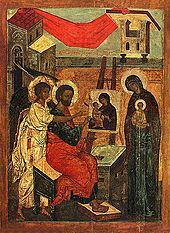
After Pentecost, Luke returned to Antioch and worked with the Apostle Paul, traveling with him to Rome, and converting Jews and pagans to the Christian Faith. "Luke, the beloved physician, ... greets you," writes the Apostle Paul to the Colossians (Colossians 4:14). At the request of Christians, St. Luke wrote his Gospel in the first century. According to some accounts this took place around 60 A.D., and according to others around 80 A.D. After St. Paul's martyrdom, St. Luke preached the Gospel throughout Italy, Dalmatia, Macedonia, and other regions. He painted icons of the Most-holy Theotokos—not just one, but three—as well as icons of the Holy Apostles Peter and Paul. For this reason, St. Luke is considered the founder of Christian iconography. In his old age, he visited Libya and Upper Egypt; from Egypt he returned to Greece, where he continued to preach and convert many with great zeal despite his age.

In addition to his Gospel, St. Luke wrote the Acts of the Apostles and dedicated each of these works to Theophilus, the governor of Achaia. Luke was 84 years old when the wicked idolaters tortured him for the sake of Christ and hanged him from an olive tree in the town of Thebes, in Beothia of Greece.
The gospel of Luke and the Acts of the Apostles make up a two-volume work which scholars call Luke–Acts. Together they account for 27.5% of the New Testament, the largest contribution by a single author.

St. Luke wrote the first icon, of the Most Holy Theotokos Directress or Hodigitria, mentioned in the Paraklesis to the Theotokos:

Speechless be the lips of impious ones,
Those who do not reverence
Your great icon, the sacred one
Which is called Directress,And was depicted for us
By one of the apostles,
Luke the Evangelist.

—The Service of the Small Paraklesis 


Luke the Evangelist writing the first icon of the Virgin Mary.


Hymns

Troparion (Tone 5) 
Let us praise with sacred songs the Holy Apostle Luke,The recorder of the Joyous Gospel of Christ,And the scribe of the Acts of the Apostles,For his writings are a testimony of the Church of Christ:He is the Physician of human weaknesses and infirmities.He heals the wounds of our souls,And constantly intercedes for our salvation!

Kontakion (Tone 4)
You became a disciple of God the Word,With Paul you enlightened all the world,Casting out its darkness by composing the Holy Gospel of Christ.

Kontakion (Tone 2)
Let us praise the godly Luke:He is the true preacher of piety,The orator of ineffable mysteriesAnd the star of the Church,For the Word who alone knows the hearts of men,Chose him, with the wise Paul, to be a teacher of the gentiles! 


--------------------------------------------------

ESPAÑOL:
Lucas el Evangelista (Griego antiguo: Λουκᾶς, Loukãs, hebreo: לוקא, Lūqās, arameo: ܠܘܩܐ, Lūqā ') es uno de los cuatro evangelistas, de los cuatro autores tradicionalmente atribuidos a los Evangelios canónicos. Los Primeros Padres de la Iglesia le atribuyeron la autoría tanto del Evangelio según Lucas como del libro de los Hechos de los Apóstoles, lo que significaría que San Lucas contribuyó con más de un cuarto del texto del Nuevo Testamento, más que cualquier otro autor.  

Compañero del apóstol Pablo (Filipenses 1:24, 2 Timoteo 4: 10-11), y se cuenta entre los Setenta Apóstoles. Nació en la Antioquía siria y fue médico, y es el fundador de la iconografía. 


Su emblema es el becerro, la tercera bestia simbólica mencionada por Ezequiel (1:10), que es un símbolo del oficio sacrificial y sacerdotal de Cristo, como lo señala San Ireneo. Sus fiestas se celebran el 18 de octubre; el 22 de abril con los apóstoles Nathaniel y Clement; el 20 de junio en el que sus reliquias, entre otras, fueron trasladadas a la Iglesia de los Santos Apóstoles en Constantinopla; y el 4 de enero, la sinaxis de los Setenta.
 
El Nuevo Testamento menciona a San Lucas brevemente unas pocas veces, y la epístola paulina a los colosenses se refiere a él como un médico (del griego para 'el que sana'); por lo que se cree que fue a la vez médico y discípulo de San Pablo. Los cristianos desde los primeros años de la fe lo han considerado como un santo. Se cree que fue un mártir, al parecer colgado de un olivo, aunque algunos creen lo contrario. 
 
Su vida 
San Lucas, era de origen griego nacido en la ciudad helenística de Antioquía, y fue extremadamente educado. Sus estudios incluyeron filosofía, medicina y arte griegas en su juventud. También fue médico profesional. San Lucas llegó a Jerusalén donde llegó a creer en el Señor. Él y Cleofás se encontraron con el Señor resucitado en el camino a Emaús (Lucas 24). 

Después de Pentecostés, Lucas regresó a Antioquía y trabajó con el apóstol Pablo, viajó con él a Roma y convirtió a judíos y paganos a la fe cristiana. "Lucas, el médico amado, ... os saluda", escribe el apóstol Pablo a los colosenses (Colosenses 4:14). A petición de los cristianos, San Lucas escribió su Evangelio en el siglo primero. Según algunos relatos, esto tuvo lugar alrededor del año 60 d.C., y según otros alrededor del 80 d.C. Después del martirio de San Pablo, San Lucas predicó el Evangelio en toda Italia, Dalmacia, Macedonia y otras regiones. Pintó íconos de la Santísima Theotokos, no solo uno, sino tres, así como íconos de los Santos Apóstoles Pedro y Pablo. Por este motivo, se considera a San Lucas el fundador de la iconografía cristiana. En su vejez, visitó Libia y el Alto Egipto; de Egipto regresó a Grecia, donde continuó predicando y convirtiendo a muchos con gran celo a pesar de su edad.

Además de su Evangelio, San Lucas escribió los Hechos de los Apóstoles y dedicó cada una de estas obras a Teófilo, el gobernador de Acaya. Lucas tenía 84 años cuando los malvados idólatras lo torturaron por causa de Cristo y lo colgaron de un olivo en la ciudad de Tebas, en Beotia de Grecia. 
El evangelio de Lucas y los Hechos de los Apóstoles constituyen una obra de dos volúmenes que los eruditos llaman Lucas-Hechos. Juntos representan el 27.5% del Nuevo Testamento, la mayor contribución de un solo autor.

San Lucas escribió el primer icono, de la Santísima Directora de la Theotokos o Hodigitria, mencionado en la Paraklesis a la Theotokos: 

Sin palabras sean los labios de los impíos, 
Los que no reverencian 
Tu gran icono, el sagrado 
Que se llama directora, y fue representada para nosotros 
Por uno de los apóstoles, 
Lucas el evangelista. 

—El servicio de la pequeña Paraklesis


 Lucas el Evangelista escribiendo el primer ícono de la Virgen María.


Himnos:

Troparion (tono 5) 
Alabemos con cánticos sagrados al Santo Apóstol Lucas, 
El registrador del gozoso evangelio de Cristo, 
Y el escriba de los Hechos de los Apóstoles, 
Porque sus escritos son un testimonio de la Iglesia de Cristo: 
Es el Médico de las debilidades y enfermedades humanas. 
El sana las heridas de nuestras almas, 
¡E intercede constantemente por nuestra salvación! 

Kontakion (tono 4) 
Te convertiste en discípulo de Dios Verbo, 
Con Pablo iluminaste a todo el mundo, 
Expulsando sus tinieblas componiendo el Santo Evangelio de Cristo. 

Kontakion (tono 2) 
Alabemos al piadoso Lucas: 
Él es el verdadero predicador de la piedad, 
El orador de misterios inefables 
Y la estrella de la Iglesia, 
Por el Verbo que es el único que conoce el corazón de los hombres, 
¡Elegímoslo, con el sabio Pablo, para ser maestro de los gentiles!

+++

lunes, 19 de octubre de 2020

St. Thomas The Apostle - Santo Tomás Apóstol


ENGLISH:
Thomas the Apostle (Biblical Hebrew: תוֹמָאס הקדוש‎; Ancient Greek: Θωμᾶς; Coptic: ⲑⲱⲙⲁⲥ; Classical Syriac: ܬܐܘܡܐ ܫܠܝܚܐ‎ Tʾōmā šliḥā (Thoma Sheliha)), also called Didymus ("twin"), was one of the Twelve Apostles of Jesus according to the New Testament. Thomas is commonly known as "Doubting Thomas" because he doubted Jesus' resurrection when first told of it (as related in the Gospel of John alone); later, he confessed his faith, "My Lord and my God," on seeing Jesus' crucifixion wounds.

The holy, glorious and all-laudable Apostle Thomas is included in the number of the holy Twelve Apostles of the Savior. He is commemorated on October 6 and on June 30 with the Synaxis of the Glorious and All-Praiseworthy Twelve Apostles of Christ.

Life of the Saint:
The Holy Apostle Thomas, also called Didymus, was born in Judea. His parents were poor but they passed on to him a great love for the Law of Moses. When he was still young, he drew apart from the noisy games of his companions to devote himself to reading and meditating upon the Scriptures. His knowledge of God’s word and well-disposed conscience enabled him, without hesitation to recognize Christ as the Messiah spoken of by the Prophets and to follow him as soon as He called him. He left his boat and his nets and became one of the Twelve. He was persecuted, excluded and stoned by the Jews, yet followed the Savior everywhere with such burning zeal that when Christ took the road for Jerusalem to offer himself for those who were going to kill him, Thomas said to the other disciples, Let us also go, that we may die with him (John 11:16).

When the Savior of the world had overcome death by rising from the tomb, He appeared to his disciples who were assembled with the doors shut for fear of the Jews; He showed them the marks of his Passion upon his body, and the disciples were filled with joy. God so provided that Thomas was not then with them and, when the others told him they had seen the Lord risen from the dead, he was unwilling to believe them. In his great patience and forbearance, the Lord appeared again to his disciples a week later, and asked Thomas to certify that He was well and truly risen from the dead in the flesh; He told him to put his finger into the holes in his hands left by the nails and to thrust his hand into his side pierced by the spear. In admonishing Thomas for his lack of faith, the Savior showed that we too are called upon to thrust our hands into his side, not physically but spiritually, to quench our thirst there at the well-spring of grace (cf. John 20:19-29).

Thomas was with the other Apostles when, on the day of Pentecost, the Holy Spirit came down upon their heads in the form of tongues of fire. He was filled, like the rest, with the power from on High for the proclamation of the world’s Salvation; and, when the Apostles went their separate ways, it fell to Thomas to bring the Glad Tidings to the distant lands of the Medes and Parthians (Iran), and as far as India.

Troparion (Tone 2)You were a disciple of ChristAnd a member of the divine college of Apostles.Having been weak in faith you doubted the Resurrection of Christ.But by feeling the wounds you believed in His all-pure passion:Pray now to Him, O all-praised Thomas to grant us peace and great mercy.

Kontakion (Tone 4)Thomas, the faithful servant and disciple of Christ,Filled with divine grace, cried out from the depth of his love:You are my Lord and my God!


ESPAÑOL:
Tomás el Apóstol (hebreo bíblico: תוֹמָאס הקדוש; griego antiguo: Θωμᾶς; copto: ⲑⲱⲙⲁⲥ; siríaco clásico: ܬܐܘܡܐ ܫܠܝܚܐ Tʾōmā šliḥā (Thoma Sheliha)), también llamado Didymus ("gemelo"), fue uno de los Doce Apóstoles de Jesús según el Nuevo Testamento. A Tomás se le conoce comúnmente como "Tomás incrédulo" porque dudó de la resurrección de Jesús cuando se la contó por primera vez (como se relata solo en el Evangelio de Juan); más tarde confesó su fe, "Señor mío y Dios mío", al ver las heridas de la crucifixión de Jesús.

El santo, glorioso y todo loable Apóstol Tomás está incluido en el número de los santos Doce Apóstoles del Salvador. Se le conmemora el 6 de octubre y el 30 de junio con la Sinaxis de los Doce Apóstoles de Cristo Gloriosos y Loable.

Vida del santo :
El Santo Apóstol Tomás, también llamado Didymus, nació en Judea. Sus padres eran pobres pero le transmitieron un gran amor por la Ley de Moisés. Cuando aún era joven, se apartó de los ruidosos juegos de sus compañeros para dedicarse a leer y meditar las Escrituras. Su conocimiento de la palabra de Dios y su buena conciencia le permitieron, sin dudarlo, reconocer a Cristo como el Mesías del que hablaban los Profetas y seguirlo tan pronto como lo llamó. Dejó su bote y sus redes y se convirtió en uno de los Doce. Fue perseguido, excluido y apedreado por los judíos, pero siguió al Salvador por todas partes con un celo tan ardiente que cuando Cristo tomó el camino de Jerusalén para ofrecerse por los que lo iban a matar, Tomás dijo a los otros discípulos: Nosotros también ve, para que muramos con él (Juan 11:16).

Cuando el Salvador del mundo venció a la muerte levantándose del sepulcro, se apareció a sus discípulos que estaban reunidos con las puertas cerradas por temor a los judíos; Les mostró las marcas de su Pasión en su cuerpo y los discípulos se llenaron de gozo. Dios dispuso que Tomás no estuviera entonces con ellos y, cuando los demás le dijeron que habían visto al Señor resucitar de entre los muertos, él no quiso creerles. En su gran paciencia y tolerancia, el Señor se apareció de nuevo a sus discípulos una semana después, y le pidió a Tomás que certificara que estaba bien y verdaderamente resucitado de entre los muertos en la carne; Le dijo que metiera el dedo en los agujeros de las manos que habían dejado los clavos y que metiera la mano en el costado perforado por la lanza. Al amonestar a Tomás por su falta de fe, el Salvador mostró que nosotros también estamos llamados a poner nuestras manos en su costado, no físicamente sino espiritualmente, para saciar nuestra sed allí en el manantial de la gracia (cf. Juan 20:19 -29). 

 Tomás estaba con los otros Apóstoles cuando, en el día de Pentecostés, el Espíritu Santo descendió sobre sus cabezas en forma de lenguas de fuego. Fue llenado, como los demás, con el poder de lo Alto para la proclamación de la Salvación del mundo; y, cuando los Apóstoles tomaron caminos separados, le tocó a Tomás llevar las Buenas Nuevas a las lejanas tierras de los medos y partos (Irán), y hasta la India. 

 Troparion (Tono 2) Eras discípulo de Cristo y miembro del divino colegio de los Apóstoles; habiendo sido débil en la fe, dudaste de la resurrección de Cristo; pero al sentir las heridas creías en su pura pasión: ora ahora a él. Oh, todo elogiado Tomás, que nos concedas paz y gran misericordia. 

 Kontakion (Tono 4) Tomás, el fiel servidor y discípulo de Cristo, Lleno de la gracia divina, clamó desde lo más profundo de su amor: ¡Tú eres mi Señor y mi Dios!

+++


viernes, 28 de agosto de 2020

Dormition of the Theotokos - Dormición de la Theotokos


ENGLISH:
Introduction
The Feast of the Dormition of Our Most Holy Lady, the Theotokos and Ever-Virgin Mary is celebrated on August 15 each year. The Feast commemorates the repose (dormition and in the Greek Koimisis) or "falling-asleep" of the Mother of Jesus Christ, our Lord. The Feast also commemorates the translation or assumption into heaven of the body of the Theotokos.


Biblical Story
The Holy Scriptures tell us that when our Lord was dying on the Cross, He saw His mother and His disciple John and said to the Virgin Mary, "Woman, behold your son!" and to John, "Behold your mother!" (John 19:25-27). From that hour, the Apostle took care of the Theotokos in his own home.
Along with the biblical reference in Acts 1:14 that confirms that the Virgin Mary was with the Holy Apostles on the day of Pentecost, the tradition of the Church holds that she remained in the home of the Apostle John in Jerusalem, continuing a ministry in word and deed.

At the time of her death, the disciples of our Lord who were preaching throughout the world returned to Jerusalem to see the Theotokos. Except for the Apostle Thomas, all of them including the Apostle Paul were gathered together at her bedside. At the moment of her death, Jesus Christ himself descended and carried her soul into heaven.

Following her repose, the body of the Theotokos was taken in procession and laid in a tomb near the Garden of Gethsemane. When the Apostle Thomas arrived three days after her repose and desired to see her body, the tomb was found to be empty. The bodily assumption of the Theotokos was confirmed by the message of an angel and by her appearance to the Apostles.

Icon of the Feast
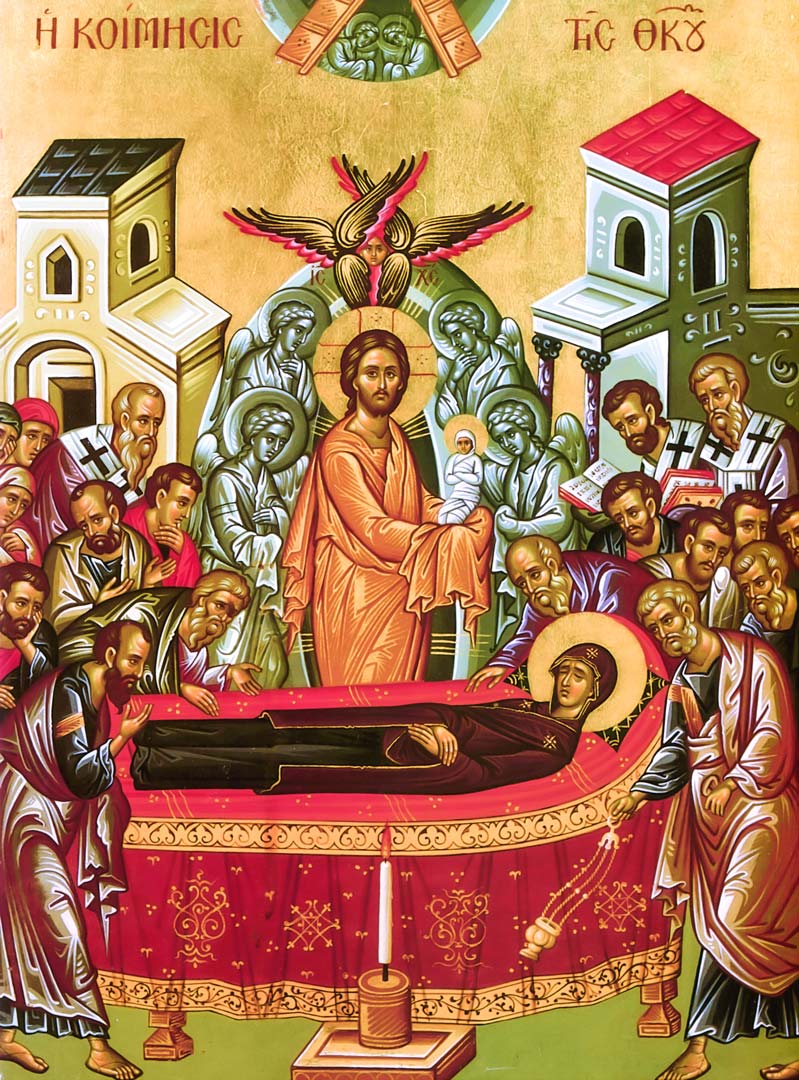
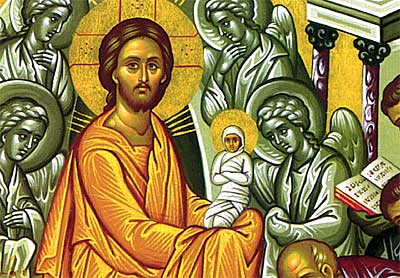
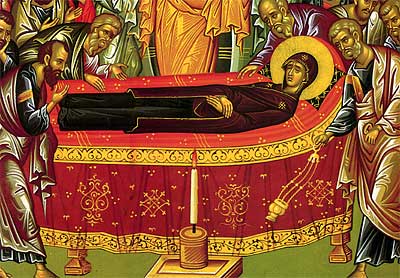
The Icon of the Feast of the Dormition of the Theotokos shows her on her deathbed surrounded by the Apostles. Christ is standing in the center (1.) looking at His mother. He is holding a small child clothed in white representing the soul of the Virgin Mary. With His golden garments, the angels above His head, and the mandorla surrounding Him, Christ is depicted in His divine glory.
1. Christ, appearing in His Glory, stands in the center of the icon cradling the soul of His Mother, the Theotokos and Ever-Virgin Mary.

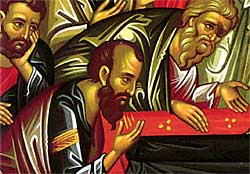
The posture of the Apostles direct attention toward the Theotokos (2.). On the right Saint Peter censes the body of the Theotokos. On the left Saint Paul (3.) bows low in honor of her.
2. The Apostles bow their heads in reverence to the Theotokos as Saint Peter (right) censes her body (detail).

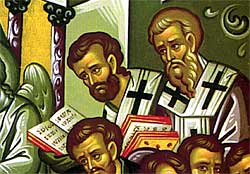
Together with the Apostles are several bishops (4.) and women. The bishops traditionally represented are James, the brother of the Lord, Timothy, Heirotheus, and Dionysius the Areopagite. They are shown wearing episcopal vestments. The women are members of the church in Jerusalem.
3. The Apostle Paul bows in honor of the Theotokos (detail).
4. Also in attendance to pray for the Theotokos were several Bishops (detail).


In front of the bed of the Theotokos is a candle (5.) that helps to form a central axis in the icon. Above the candle is the body of the Theotokos and Ever-Virgin Mary. Standing over His mother is Christ holding her most pure soul. Above Christ the gates of heaven stand open, ready to receive the Mother of God.
5. The Theotokos lies in the center of the icon surrounded by the Apostles and a candle in front of her bed (detail).

This great Feast of the Church and the icon celebrates a fundamental teaching of our faith—the Resurrection of the body. In the case of the Theotokos, this has been accomplished by the divine will of God. Thus, this Feast is a feast of hope, hope in Resurrection and life eternal. Like those who gathered around the body of the Virgin Mary, we gather around our departed loved ones and commend their souls into the hands of Christ. As we remember those who have reposed in the faith before us and have passed on into the communion of the Saints, we prepare ourselves to one day be received into the new life of the age to come.

We also affirm through this Feast as we journey toward our heavenly abode that the Mother of God intercedes for us. Through Christ she has become the mother of all of the children of God, embracing us with divine love.


Dormition or Assumption?
In the Orthodox tradition we are usually very careful to distinguish between the “Dormition” of the Mother of God and her “Assumption” into heaven. The former, we feel, is properly Orthodox, while the latter strikes us as a purely Western designation, derived from a Papist “misunderstanding” of the meaning of this feast, celebrated universally on August 15.

A misguided interpretations of Mary’s death and exaltation can be found both in Papist spiritual writings and in contemporary Western images: a tendency, for example, to exalt the Holy Virgin to a level of “divinity” that effectively erases the crucial and absolute distinction between human and divine life. Orthodox theologians will insist that the “deification” (theôsis) known by the Mother of God in no way involves an ontological transformation of her being from created humanity to divinity. She was and will always remain a human creature: the most exalted of all those who bear God’s image, yet always a human being, whose glory appears in her humility, her simple desire to “let it be” according to the divine will.

Traditional Orthodox icons of her “falling asleep,” therefore, focus especially on her death and entombment. The disciples, “gathered together from all the ends of the earth,” surround her in an attitude of grief and lament. Behind the bier on which she is laid there stands her glorified Son, holding in His arms a child clothed in radiant white garments, an image of His Mother’s soul. This is a theme of reversal. On every Orthodox iconastasis there is found a sacred image of the Mother of God, holding in her arms her newborn child, the God-Man who “took flesh” in order to save and sanctify a fallen, sinful, broken world. Here, in the icon of the Dormition, the Son embraces and offers to that world His Holy Mother, as she did Him at the time of His birth. At her falling asleep He receives her soul, her life, in order to exalt it in Himself and with Himself, to the glory, beauty and joy of eternal life.

Celebration of the Feast of the Dormition
The commemoration of the Dormition of the Theotokos and the preparation for the Feast begin on August 1 with a period of fasting. A strict fast is followed on most of the days (no meat, dairy, oil, or wine), with the exceptions of fish on the Feast of the Transfiguration (August 6) and the day of the Dormition. Oil and Wine are allowed on Saturdays and Sundays.

On the weekdays before the Feast, Paraklesis services are held in most parishes. These consist of the Great Paraklesis and the Small Paraklesis, both services of supplication and prayer for the intercessions of the Theotokos.

The Feast of the Dormition is celebrated with the Divine Liturgy of Saint John Chrysostom which is conducted on the morning of the Feast and preceded by a Matins (Orthros) service. A Great Vespers is conducted on the evening before the day of the Feast. Scripture readings for the Feast of the Dormition are the following: At Vespers: Genesis 28:10-17; Ezekiel 43:27-44:4; Proverbs 9:1-11. At the Matins: Luke 1:39-49, 56. At the Divine Liturgy: Philippians 2:5-11; Luke 10:38-42; 11:27-28.

----------------------------------------------

ESPAÑOL:

Introducción 

La fiesta de la Dormición de Nuestra Santísima Señora, Theotokos y Siempre Virgen María se celebra el 15 de agosto de cada año. La fiesta conmemora el reposo (dormición y en la Koimisis griega) o "quedarse dormido" de la Madre de Jesucristo, nuestro Señor. La fiesta también conmemora la traducción o asunción al cielo del cuerpo de la Theotokos.

Historia bíblica 
Las Sagradas Escrituras nos dicen que cuando nuestro Señor estaba muriendo en la Cruz, vio a su madre y a su discípulo Juan y le dijo a la Virgen María: "¡Mujer, mira a tu hijo!" y a Juan, "¡Mira a tu madre!" (Juan 19: 25-27). A partir de esa hora, el Apóstol se hizo cargo de la Theotokos en su propia casa. Junto con la referencia bíblica en Hechos 1:14 que confirma que la Virgen María estaba con los Santos Apóstoles el día de Pentecostés, la tradición de la Iglesia sostiene que permaneció en el hogar del Apóstol Juan en Jerusalén, continuando un ministerio en palabra y obra. En el momento de su muerte, los discípulos de nuestro Señor que predicaban en todo el mundo regresaron a Jerusalén para ver la  Theotokos. A excepción del apóstol Tomás, todos ellos, incluido el apóstol Pablo, se reunieron junto a su cama. En el momento de su muerte, Jesucristo mismo descendió y llevó su alma al cielo. Después de su reposo, el cuerpo de Theotokos fue llevado en procesión y colocado en una tumba cerca del Jardín de Getsemaní. Cuando el apóstol Tomás llegó tres días después de su descanso y deseó ver su cuerpo, se encontró que la tumba estaba vacía. La asunción corporal de la Theotokos fue confirmada por el mensaje de un ángel y por su aparición a los Apóstoles.

Icono de la fiesta 
El ícono de la fiesta de la Dormición de la Theotokos la muestra en su lecho de muerte rodeada de los Apóstoles. Cristo está de pie en el centro (1.) mirando a su madre. Él está sosteniendo a un niño pequeño vestido de blanco que representa el alma de la Virgen María. Con sus vestiduras doradas, los ángeles sobre su cabeza y la mandorla que lo rodea, Cristo está representado en su gloria divina.


1. Cristo, apareciendo en Su Gloria, se encuentra en el centro del ícono que acuna el alma de Su Madre, Theotokos y Siempre Virgen María.

La postura de los Apóstoles dirige la atención hacia el Theotokos (2.). A la derecha, San Pedro censura el cuerpo de la Theotokos. A la izquierda, San Pablo (3.) se inclina en honor de ella.


2. Los apóstoles inclinan sus cabezas en reverencia a la Theotokos cuando San Pedro (derecha) censura su cuerpo (detalle).

Junto con los apóstoles hay varios obispos (4) y mujeres. Los obispos tradicionalmente representados son Santiago, el hermano del Señor, Timoteo, Heirotheo y Dionisio el Areopagito. Se muestran con vestimentas episcopales. Las mujeres son miembros de la iglesia en Jerusalén.


3. El apóstol Pablo se inclina en honor a la Theotokos (detalle).


4. También asistieron a rezar por los Theotokos varios obispos (detalle).


Delante de la cama de la Theotokos hay una vela (5) que ayuda a formar un eje central en el ícono. Sobre la vela está el cuerpo de la Theotokos y Siempre Virgen María. De pie junto a su madre está Cristo sosteniendo su alma más pura. Sobre Cristo se abren las puertas del cielo, listas para recibir a la Madre de Dios.


5. Theotokos se encuentra en el centro del icono rodeado por los Apóstoles y una vela frente a su cama (detalle). 
Esta gran fiesta de la Iglesia y el ícono celebra una enseñanza fundamental de nuestra fe: la resurrección del cuerpo. En el caso de la Theotokos, esto se ha logrado por la voluntad divina de Dios. Así, esta fiesta es una fiesta de esperanza, esperanza en la resurrección y vida eterna. Al igual que aquellos que se reunieron alrededor del cuerpo de la Virgen María, nos reunimos alrededor de nuestros seres queridos difuntos y encomendamos sus almas a las manos de Cristo. Al recordar a aquellos que se han vuelto a depositar en la fe antes que nosotros y han pasado a la comunión de los santos, nos preparamos para ser recibidos algún día en la nueva vida del siglo venidero. 
También afirmamos a través de esta Fiesta mientras viajamos hacia nuestra morada celestial que la Madre de Dios intercede por nosotros. Por medio de Cristo, ella se convirtió en la madre de todos los hijos de Dios, abrazándonos con amor divino. 


¿Dormición o Asunción? 
En la tradición ortodoxa solemos tener mucho cuidado de distinguir entre la "Dormición" de la Madre de Dios y su "Asunción" al cielo. Creemos que el primero es propiamente ortodoxo, mientras que el segundo nos parece una designación puramente occidental, derivada de un “malentendido” papista del significado de esta fiesta, celebrada universalmente el 15 de agosto. 

Se pueden encontrar interpretaciones equivocadas de la muerte y exaltación de María tanto en los escritos espirituales papistas como en las imágenes occidentales contemporáneas: una tendencia, por ejemplo, a exaltar a la Santísima Virgen a un nivel de "divinidad" que borra efectivamente la distinción crucial y absoluta entre los seres humanos y vida divina. Los teólogos ortodoxos insistirán en que la “deificación” (Teosis) conocida por la Madre de Dios no implica en modo alguno una transformación ontológica de su ser de humanidad creada a divinidad. Ella fue y será siempre una criatura humana: la más exaltada de todos los que llevan la imagen de Dios, pero siempre un ser humano, cuya gloria se manifiesta en su humildad, su simple deseo de “dejarlo ser” según la voluntad divina. 

Los íconos ortodoxos tradicionales de su "quedarse dormida", por lo tanto, se enfocan especialmente en su muerte y sepultura. Los discípulos, “reunidos desde todos los confines de la tierra”, la rodean en actitud de dolor y lamento. Detrás del féretro sobre el que está acostada está su Hijo glorificado, sosteniendo en Sus brazos a un niño vestido con ropas blancas radiantes, una imagen del alma de Su Madre. Este es un tema de reversión. En cada iconastasis ortodoxa se encuentra una imagen sagrada de la Madre de Dios, sosteniendo en sus brazos a su hijo recién nacido, el Dios-Hombre que “se encarnó” para salvar y santificar un mundo caído, pecador y quebrantado. Aquí, en el icono de la Dormición, el Hijo abraza y ofrece a ese mundo a su Santa Madre, como lo hizo a Él en el momento de su nacimiento. Cuando ella se duerme, Él recibe su alma, su vida, para exaltarla en Sí mismo y consigo mismo, para la gloria, la belleza y el gozo de la vida eterna.


Celebración de la fiesta de la Dormición. 
La conmemoración de la Dormición de la Theotokos y la preparación para la Fiesta comienzan el 1 de agosto con un período de ayuno. Se sigue un ayuno estricto la mayoría de los días (sin carne, lácteos, aceite o vino), con la excepción de los pescados en la Fiesta de la Transfiguración (6 de agosto) y el día de la Dormición. Se permiten aceites y vinos los sábados y domingos.
Los días laborables antes de la Fiesta, los servicios de Paraklesis se llevan a cabo en la mayoría de las parroquias. Estos consisten en la Gran Paraklesis y la Pequeña Paraklesis, ambos servicios de súplica y oración por las intercesiones de la Theotokos. 
La Fiesta de la Dormición se celebra con la Divina Liturgia de San Juan Crisóstomo, que se lleva a cabo en la mañana de la Fiesta y precedida por un servicio de Matins (Orthros). A Grandes Vísperas se lleva a cabo la noche antes del día de la Fiesta. Las lecturas de las Escrituras para la Fiesta de la Dormición son las siguientes: En las vísperas: Génesis 28: 10-17; Ezequiel 43: 27-44: 4; Proverbios 9: 1-11. En los maitines: Lucas 1: 39-49, 56. En la Divina Liturgia: Filipenses 2: 5-11; Lucas 10: 38-42; 11: 27-28.


Dormición de la Madre de Dios

sábado, 22 de agosto de 2020

Holy Apostle Matthias - Santo Apóstol Matías


ENGLISH:
Matthias (Koine Greek: Μαθθίας, Maththías Greek pronunciation: [maθˈθi.as], from Hebrew מַתִּתְיָהוּ‎ Mattiṯyā́hū; died c. AD 80). His name means Gift of God. He was, according to the Acts of the Apostles (written c. AD 80–90), chosen by the apostles to replace Judas Iscariot following the latter's betrayal of Jesus and his subsequent death. His calling as an apostle is unique, in that his appointment was not made personally by Jesus, who had already ascended into heaven, and it was also made before the descent of the Holy Spirit upon the early Church.


The Holy Apostle Matthias was born at Bethlehem of the Tribe of Judah. From his early childhood he studied the Law of God under the guidance of Saint Simeon the God-Receiver (February 3).

When the Lord Jesus Christ revealed Himself to the world, Saint Matthias believed in Him as the Messiah, followed constantly after Him and was numbered among the Seventy Apostles, whom the Lord “sent them two by two before His face” (Luke 10:1).

After the Ascension of the Savior, Saint Matthias was chosen by lot to replace Judas Iscariot as one of the Twelve Apostles (Acts 1:15-26). After the Descent of the Holy Spirit, the Apostle Matthias preached the Gospel at Jerusalem and in Judea together with the other Apostles (Acts 6:2, 8:14). From Jerusalem he went with the Apostles Peter and Andrew to Syrian Antioch, and was in the Cappadocian city of Tianum and Sinope. Here the Apostle Matthias was locked into prison, from which he was miraculously freed by Saint Andrew the First-Called.

The Apostle Matthias journeyed after this to Amasea, a city on the shore of the sea. During a three year journey of the Apostle Andrew, Saint Matthias was with him at Edessa and Sebaste. According to Church Tradition, he was preaching at Pontine Ethiopia (presently Western Georgia) and Macedonia. He was frequently subjected to deadly peril, but the Lord preserved him to preach the Gospel.

Once, pagans forced the saint to drink a poison potion. He drank it, and not only did he himself remain unharmed, but he also healed other prisoners who had been blinded by the potion. When Saint Matthias left the prison, the pagans searched for him in vain, for he had become invisible to them. Another time, when the pagans had become enraged intending to kill the Apostle, the earth opened up and engulfed them.

The Apostle Matthias returned to Judea and did not cease to enlighten his countrymen with the light of Christ’s teachings. He worked great miracles in the Name of the Lord Jesus and he converted a great many to faith in Christ.

The Jewish High Priest Ananias hated Christ and earlier had commanded the Apostle James, Brother of the Lord, to be flung down from the heights of the Temple, and now he ordered that the Apostle Matthias be arrested and brought for judgment before the Sanhedrin at Jerusalem.

The impious Ananias uttered a speech in which he blasphemously slandered the Lord. Using the prophecies of the Old Testament, the Apostle Matthias demonstrated that Jesus Christ is the True God, the promised Messiah, the Son of God, Consubstantial and Coeternal with God the Father. After these words the Apostle Matthias was sentenced to death by the Sanhedrin and stoned.

When Saint Matthias was already dead, the Jews, to hide their malefaction, cut off his head as an enemy of Caesar. (According to several historians, the Apostle Matthias was crucified, and indicate that he instead died at Colchis.) The Apostle Matthias received the martyr’s crown of glory in the year 63.


ESPAÑOL:
Matías (griego koiné: Μαθθίας, pronunciación griega de Maththías: [maθˈθi.as], del hebreo מַתִּתְיָהוּ Mattiṯyā́hū; murió en c. 80 dC). Su nombre significa Don de Dios. Según los Hechos de los Apóstoles (escrito c. 80-90 d. C.), fue elegido por los apóstoles para reemplazar a Judas Iscariote tras la traición de este último a Jesús y su posterior muerte. Su llamado como apóstol es único, ya que su nombramiento no fue hecho personalmente por Jesús, quien ya había ascendido al cielo, y también lo hizo antes del descenso del Espíritu Santo sobre la Iglesia primitiva. 

El Santo Apóstol Matías nació en Belén de la Tribu de Judá. Desde su niñez estudió la Ley de Dios bajo la guía de San Simeón el Receptor de Dios (3 de febrero). 

Cuando el Señor Jesucristo se reveló al mundo, San Matías creyó en Él como el Mesías, lo siguió constantemente y fue contado entre los Setenta Apóstoles, a quienes el Señor “los envió de dos en dos delante de Su faz” (Lucas 10: 1 ).
Después de la Ascensión del Salvador, San Matías fue elegido por sorteo para reemplazar a Judas Iscariote como uno de los Doce Apóstoles (Hechos 1: 15-26). Después de la Venida del Espíritu Santo, el Apóstol Matías predicó el Evangelio en Jerusalén y en Judea junto con los otros Apóstoles (Hechos 6: 2, 8:14). De Jerusalén fue con los apóstoles Pedro y Andrés a la Antioquía de Siria, y se encontraba en la ciudad capadocia de Tianum y Sinope. Aquí el apóstol Matías fue encerrado en prisión, de la cual fue liberado milagrosamente por San Andrés el Primero Llamado.

El apóstol Matías viajó después de esto a Amasea, una ciudad a la orilla del mar. Durante un viaje de tres años del apóstol Andrés, san Matías estuvo con él en Edesa y Sebaste. Según la Tradición de la Iglesia, predicaba en la Etiopía Pontina (actualmente Georgia occidental) y Macedonia. Con frecuencia estuvo sujeto a peligros mortales, pero el Señor lo preservó para predicar el Evangelio. 

Una vez, los paganos obligaron al santo a beber una poción venenosa. Lo bebió, y no solo él mismo permaneció ileso, sino que también curó a otros prisioneros que habían sido cegados por la poción. Cuando San Matías salió de la prisión, los paganos lo buscaron en vano, porque se había vuelto invisible para ellos. En otra ocasión, cuando los paganos se enfurecieron con la intención de matar al Apóstol, la tierra se abrió y los envolvió. 

El apóstol Matías regresó a Judea y no dejó de iluminar a sus compatriotas con la luz de las enseñanzas de Cristo. Obtuvo grandes milagros en el Nombre del Señor Jesús y convirtió a muchos a la fe en Cristo. 

El sumo sacerdote judío Ananías odiaba a Cristo y anteriormente había ordenado que el apóstol Santiago, hermano del Señor, fuera arrojado desde las alturas del templo, y ahora ordenó que el apóstol Matías fuera arrestado y llevado para juicio ante el sanedrín en Jerusalén. 

El impío Ananías pronunció un discurso en el que blasfemamente calumnió al Señor. Usando las profecías del Antiguo Testamento, el Apóstol Matías demostró que Jesucristo es el Dios Verdadero, el Mesías prometido, el Hijo de Dios, Consustancial y Coeterno con Dios Padre. Después de estas palabras, el Apóstol Matías fue condenado a muerte por el Sanedrín y apedreado. 

Cuando San Matías ya estaba muerto, los judíos, para ocultar su maldad, le cortaron la cabeza como enemigo de César. (Según varios historiadores, el Apóstol Matías fue crucificado, e indican que en cambio murió en Cólquide). El Apóstol Matías recibió la corona de gloria de mártir en el año 63.


+++

domingo, 12 de julio de 2020

Saints Peter and Paul, Pillars of the Early Church - Santos Pedro y Pablo, Pilares de la Iglesia Primitiva

ENGLISH:
St. Peter
Simon first met Jesus through his brother Andrew, the "first-called" Apostle. Both brothers were fishermen at the Sea of Galilee who gave up their work when Jesus told them, "I will make you fishers of men" (Read Matthew 4:18-25 and John 1:40-42). In Matthew 16:16-19, Simon tells Jesus, "You are the Christ, the Son of the living God." And Jesus, pleased with His Disciple's faith, blessed him with a sacred trust, "You are Peter and on this rock I will build my Church and the gates of Hades shall not prevail against it." [Note: the "rock" that Jesus refers to here is Peter's statement, not the person of Peter.] Peter was with Jesus throughout his ministry. And just as Christ had foretold, Peter denied knowing the Lord upon His arrest for fear of being persecuted, but later repented.

After Christ's Resurrection and Ascension and the grace of Pentecost, Peter helped foster the Christian community in Jerusalem. In Jerusalem Peter was arrested by the Jewish authorities, and an angel of the Lord freed him from prison (Acts 12). He journeyed throughout Asia Minor, Syria, Palestine and Italy teaching people about Christ. He performed many miracles of healing and resurrections as well (see the Book of Acts). He established the first church in Antioch and became its first bishop. In Rome he converted many to the faith.

Legend has it that when the great persecutions against Christians began in Rome at that time, Peter was advised to leave the city. On the road he saw Jesus heading in the opposite direction towards Rome. "Lord where are you going?" Peter asked. Jesus responded, "I am going to be crucified a second time." Peter realized his fate and returned to Rome where he was arrested and condemned to be crucified in 67 AD. He asked to be crucified upside down, as he felt unworthy of the same punishment as his Lord. Two of Peter's letters, probably written during his imprisonment in Rome, are included in the New Testament.

St. Paul
Saul grew up in a devout Jewish family in Tarsus, Syria. He saw Christianity as a threat to Judaism and therefore was determined to eradicate it. He is first mentioned in Acts 7:58 as a zealous persecutor of Christians in Jerusalem. On his way to Damascus to arrest Christians and bring them back to Jerusalem, he was struck by a vision of heavenly light and fell to the ground (see Acts 9). "Saul, why are you persecuting Me!" asked the Lord. "Who are You, Lord?" Then the Lord said, "I am Jesus, whom you are persecuting." Trembling and astonished, Saul asked, "Lord, what do You want me to do?" "Arise and go into the city, and you will be told what you must do." Saul was blinded from this holy light and remained so and in prayer in Damascus. Three days later, Ananias, a devout Christian who followed the Lord's command to find Saul, healed him and baptized him so that he would receive the Holy Spirit. He changed his name to Paul. Paul began to preach to the people about Jesus and had to flee Damascus when the Jews plotted to kill him. In Jerusalem he tried to join the Apostles, but they were afraid of him, having known him as the harsh persecutor of Christians. But Barnabas believed in him and brought him to the Apostles. Barnabas and Paul went on many missionary travels together throughout Syria, Asia Minor, Cyprus and Greece. With others and on his own, Paul continued his ministry to the people in these lands again and traveled to Ephesus, Corinth, Athens, Thessalonica, Thrace, Crete, Malta, Sicily and Italy to Rome. He was the greatest Apostolic missionary and is often referred to as the "Apostle to the Gentiles." His great courage, stamina and fierce intelligence were the hallmarks of his ministry.

Paul was a brilliant orator and writer, and he was sensitive to the needs and moods of various tribes of both Greek and Near Eastern peoples. His extraordinary letters or epistles make up almost half of the New Testament.
In Rome Paul was arrested and beheaded in 67 AD. [Note: Roman citizens were beheaded rather than crucified.] In his last letter, 2 Timothy, he states, "I have fought the good fight, I have finished the race, I have kept the faith."

Troparion (Tone 4)
O foremost in the ranks of apostles, and teachers of the world, intercede with the Master of All to grant safety to the world and to ours souls the great mercy.

Kontakion (Tone 2)
O Lord, You have taken up to their eternal rest, and to the enjoyment of Your good things the two infallible preachers of divine truths and leaders of the apostles, for You have accepted their struggles and their death as being better than any holocaust. O You who alone know the the secrets of hearts.
-----------------
ESPAÑOL:
San Pedro 
Simon conoció a Jesús por primera vez a través de su hermano Andrés, el apóstol. Ambos hermanos eran pescadores en el Mar de Galilea que renunciaron a su trabajo cuando Jesús les dijo: "Los haré pescadores de hombres" (lea Mateo 4: 18-25 y Juan 1: 40-42). En Mateo 16: 16-19, Simón le dice a Jesús: "Tú eres el Cristo, el Hijo del Dios viviente". Y Jesús, complacido con la fe de su discípulo, lo bendijo con una confianza sagrada: "Tú eres Pedro y sobre esta roca edificaré mi Iglesia y las puertas del Hades no prevalecerán contra ella". [Nota: la "roca" a la que Jesús se refiere aquí es la declaración de Pedro, no la persona de Pedro.] Pedro estuvo con Jesús durante todo su ministerio. Y tal como Cristo había predicho, Pedro negó conocer al Señor después de su arresto por temor a ser perseguido, pero luego se arrepintió.

Después de la resurrección y ascensión de Cristo y la gracia de Pentecostés, Pedro ayudó a fomentar la comunidad cristiana en Jerusalén. En Jerusalén, Pedro fue arrestado por las autoridades judías, y un ángel del Señor lo liberó de la prisión (Hechos 12). Viajó por Asia Menor, Siria, Palestina e Italia enseñando a la gente acerca de Cristo. También realizó muchos milagros de curación y resurrección (ver el Libro de los Hechos). Estableció la primera iglesia en Antioquía y se convirtió en su primer obispo. En Roma convirtió a muchos a la fe.

La leyenda dice que cuando las grandes persecuciones contra los cristianos comenzaron en Roma en ese momento, se le aconsejó a Pedro que abandonara la ciudad. En el camino vio a Jesús dirigiéndose en dirección opuesta hacia Roma. "Señor, ¿a dónde vas?" Peter preguntó. Jesús respondió: "Voy a ser crucificado por segunda vez". Pedro se dio cuenta de su destino y regresó a Roma, donde fue arrestado y condenado a ser crucificado en 67 DC. Pidió ser crucificado boca abajo, ya que se sentía indigno del mismo castigo que su Señor. Dos de las cartas de Pedro, probablemente escritas durante su encarcelamiento en Roma, están incluidas en el Nuevo Testamento.


San Pablo 
Saúl creció en una devota familia judía en Tarso, Siria. Él veía el cristianismo como una amenaza para el judaísmo y, por lo tanto, estaba decidido a erradicarlo. Se le menciona por primera vez en Hechos 7:58 como un celoso perseguidor de los cristianos en Jerusalén. En su camino a Damasco para arrestar a cristianos y traerlos de regreso a Jerusalén, fue golpeado por una visión de luz celestial y cayó al suelo (ver Hechos 9). "Saul, ¿por qué me persigues?" Preguntó el Señor. "¿Quién eres, Señor?" Entonces el Señor dijo: "Yo soy Jesús, a quien tú persigues". Temblando y asombrado, Saúl preguntó: "Señor, ¿qué quieres que haga?" "Levántate y ve a la ciudad, y se te dirá lo que debes hacer". Saulo fue cegado por esta luz sagrada y permaneció así y rezando en Damasco. Tres días después, Ananías, un cristiano devoto que siguió el mandato del Señor de encontrar a Saúl, lo curó y lo bautizó para que recibiera el Espíritu Santo. Cambió su nombre a Paul. Pablo comenzó a predicar a la gente sobre Jesús y tuvo que huir de Damasco cuando los judíos planearon matarlo. En Jerusalén trató de unirse a los apóstoles, pero le tenían miedo, ya que lo conocían como el duro perseguidor de los cristianos. Pero Bernabé creyó en él y lo trajo a los apóstoles. Bernabé y Pablo realizaron juntos muchos viajes misioneros por Siria, Asia Menor, Chipre y Grecia. Con otros y solo, Pablo continuó su ministerio con la gente en estas tierras nuevamente y viajó a Éfeso, Corinto, Atenas, Tesalónica, Tracia, Creta, Malta, Sicilia e Italia a Roma. Fue el mayor misionero apostólico y a menudo se lo conoce como el "Apóstol de los gentiles". Su gran coraje, resistencia e inteligencia feroz fueron los sellos distintivos de su ministerio.
Pablo era un orador y escritor brillante, y era sensible a las necesidades y estados de ánimo de varias tribus de pueblos griegos y del Cercano Oriente. Sus extraordinarias cartas o epístolas constituyen casi la mitad del Nuevo Testamento. En Roma, Pablo fue arrestado y decapitado en el año 67 DC. [Nota: los ciudadanos romanos fueron decapitados en lugar de crucificados.] En su última carta, 2 Timoteo, dice: "He peleado la buena batalla, he terminado la carrera, he mantenido la fe."

Troparion (tono 4) ¡Oh, el primero en las filas de los apóstoles y los maestros del mundo, interceda con el Maestro de Todos para otorgar seguridad al mundo y a nuestras almas la gran misericordia! 

Kontakion (tono 2) Oh Señor, has llevado a su descanso eterno, y al disfrute de tus cosas buenas, los dos predicadores infalibles de las verdades divinas y los líderes de los apóstoles, porque has aceptado sus luchas y su muerte como algo mejor que cualquier holocausto. O Tú, que solo conoces los secretos de los corazones.


+++

The World Cup: The Summit of Collective Hypnosis and the Disconnection with Nature

Versión en español  (click) We live in a hyper-connected society, yet we are profoundly disconnected from what truly matters. If you stop to...