Translate

Mostrando entradas con la etiqueta Papism. Mostrar todas las entradas

jueves, 19 de febrero de 2026

The Weeping For Tammuz


THE PAGANISM OF LENT AND WEEPING FOR TAMMUZ!

Let me say right up front that if you already know the origins of ‘Shrove Tuesday’, Ash Wednesday, the Forty days of Lent and Easter Sunday but still stubbornly insist on observing them, then you show yourself to be nothing but a nominal ‘Christian’ like the Roman Catholics, and some Protestant Churches have a name that they live but are dead! [Rev 3:1] 


For those real Christian Brethren who have just come to know the Lord and are searching their Bibles diligently to find whether these things be so [Act 17:11], I must tell you that you will not find them in the BIBLE. Neither the Apostles nor the Early Church observed these things. So WHERE do they come from?

‘Shrove Tuesday’ or Mardi Gras as it is commonly known literally means “Fat Tuesday” in French [called Pancake Tuesday in England] and is associated with the Roman Catholic custom of Lent. But is it taught in the Bible? Would God want Christians to observe it?

The idea behind Mardi Gras or carnival celebrations is that people overindulge before giving up something for Lent, which begins the following day with Ash Wednesday. [Lent is the 40 weekdays from Ash Wednesday to Easter observed by the Roman Catholic, Eastern and some Protestant churches as a period of penitence and fasting.]

Lent was a time of penance, of fasting, of abstinence. Folks abstained from all sorts a good stuff including meat. They also gave up eggs and dairy products. So on Tuesday, the day before the start of the Lenten fast, folks cleared out their cupboards of all the foods they could not have for the next 40 days. They cooked them up and ate like pigs. In essence THEY FEASTED BEFORE THE FAST.

Unlike New Year’s, Christmas, Halloween, St. Valentine’s Day and other pagan holidays that are celebrated by the secular, non-religious world, the Lenten season is observed by dedicated religious believers.

From Ash Wednesday to Easter, many solemnly mark their foreheads with ash, “fasting” [or abstaining from certain foods or physical pleasures] for 40 days. This is done to supposedly imitate Jesus Christ’s 40-day fast in the wilderness [Matt. 4:1-2]. Some give up smoking. Others give up chewing gum. Still others give up over-eating or cursing. People vow to give up anything, as long as it prepares them for Easter.

People who observe Lent may be religious, dedicated and sincere—BUT THEY ARE SINCERELY WRONG!

Let us examine Lent, its practices and customs, its historic and religious origins, and its true meaning from the Bible’s perspective, not from the “traditions of men” [Mark 7:7-9].


The Purpose of Lent

According to the Catholic Encyclopedia, “the real aim of Lent is, above all else, to prepare men for the celebration of the death and Resurrection of Christ…the better the preparation the more effective the celebration will be. One can effectively relive the mystery only with purified mind and heart. The purpose of Lent is to provide that purification by weaning men from sin and selfishness through self-denial and prayer, by creating in them the desire to do God’s will and to make His kingdom come by making it come first of all in their hearts.”

On the surface, this belief sounds sincere. However, IT DOES NOT AGREE WITH THE BIBLE, GOD’S HOLY WORD, the only source of true spiritual knowledge and understanding [John 17:17]. God, through the apostle Paul, commands Christians to “continue you in the things which you have learned and have been assured of, knowing of whom you have learned them; and that from a child you have known the holy scriptures, which are able to make you wise unto salvation through faith which is in Christ Jesus. All scripture is given by inspiration of God, and is profitable for doctrine, for reproof, for correction, for instruction in righteousness: that the man of God may be perfect, thoroughly furnished unto all good works” [II Tim. 3:14-17].

First, understand that the “celebration of the death and Resurrection of Christ” to which the preceding quote refers is so-called “Good Friday” and “Easter Sunday”— HOLIDAYS DEEPLY ROOTED IN ANCIENT PAGANISM. They were instituted by mainstream Christianity in order to counterfeit and replace the Passover season.

Second, the Bible says that we are purified—cleansed, set apart and made pure in God’s sight—by the shed blood of Jesus Christ [Heb. 9:11-14, 22; 13:12]. This, along with faith [Acts 15:9] and humbly submitting to and obeying God [James 4:7-10] through His truth and prayer [John 17:17; I Tim. 4:5], makes us clean before God. NO AMOUNT OF FASTING, ABSTAINING FROM PHYSICAL PLEASURES OR ANY OTHER FORM OF SELF-DENIAL CAN PURIFY US!


Pagan Origins of Lent

Lent was never observed by Christ or His apostles. He commanded His disciples to “Go you therefore, and teach all nations…teaching them to observe all things whatsoever I have commanded you” [Matt. 28:19-20]. And Lent or Easter was not one of them!

Alexander Hislop wrote in his book The Two Babylons: “The festival, of which we read in Church history, under the name of Easter, in the third and fourth centuries, was quite a different festival from that now observed in the Romish Church, and at that time was not known by any such name as Easter…That festival [Passover] was not idolatrous, and it was preceded by no Lent. Lent was not observed by the first century Church! It was first addressed by the church at Rome during the Council of Nicea in A.D. 325, when Emperor Constantine officially recognized that church as the Roman Empire’s state religion. Any other form of Christianity that held to doctrines contrary to the Roman church was considered an enemy of the state.

Today, Lent is used for “fasting from sin and from vice…forsaking sin and sinful ways.” It is a season “for penance, which means sorrow for sin and conversion to God.” This tradition teaches that fasting and employing self-discipline during Lent will give a worshipper the “control over himself that he needs to purify his heart and renew his life.”

However, the Bible clearly shows that self-control—temperance—comes from having God’s Holy Spirit working in the life of a converted mind [Gal. 5:16, 17, 22]. FASTING—OF AND BY ITSELF—CANNOT PRODUCE GODLY SELF-CONTROL.

Paul warned against using self-denial as a tool to rely on your own will. He called it “will worship.” “Wherefore if you be dead with Christ from the rudiments of the world, why, as though living in the world, are you subject to ordinances, [touch not; taste not; handle not; which all are to perish with the using;] after the commandments and doctrines of men? Which things have indeed a show of wisdom in will worship, and humility, and neglecting of the body: not in any honor to the satisfying of the flesh” [Col. 2:20-23].

GOD DID NOT DESIGN FASTING AS A TOOL FOR PENANCE, “BEATING YOURSELF UP” OR DEVELOPING WILL POWER: “Is it such a fast that I have chosen? A day for a man to afflict his soul? Is it to bow down his head as a bulrush, and to spread sackcloth and ashes under him? Will you call this a fast, and an acceptable day to the Lord? Is not this the fast that I have chosen? To loose the bands of wickedness, to undo the heavy burdens, and to let the oppressed go free, and that you break every yoke? Is it not to deal your bread to the hungry, and that you bring the poor that are cast out to your house? When you see the naked, that you cover him; and that you hide not yourself from your own flesh?” [Isa. 58:5-7].

God’s people humble themselves through fasting in order to draw closer to Him—so that they can learn to think and act like Him—so that they can live His way of life in all things. Notice what the prophet Jeremiah wrote: “Thus says the Lord, Let not the wise man glory in his wisdom, neither let the mighty man glory in his might, let not the rich man glory in his riches: but let him that glories glory in this, that he understands and knows Me, that I am the Lord which exercise loving-kindness, judgment, and righteousness, in the earth: for in these things I delight, says the Lord” [9:23-24]. Fasting [and prayer] helps Christians draw closer to God.

Coming from the Anglo-Saxon Lencten, meaning “spring,” LENT ORIGINATED IN THE ANCIENT BABYLONIAN MYSTERY RELIGION. “The forty days’ abstinence of Lent WAS DIRECTLY BORROWED FROM THE WORSHIPPERS OF THE BABYLONIAN GODDESS…Among the Pagans this Lent seems to have been an indispensable preliminary to the great annual festival in commemoration of the death and resurrection of Tammuz” [The Two Babylons].

Tammuz was the false Messiah of the Babylonians—a SATANIC COUNTERFEIT OF JESUS CHRIST!

The Feast of Tammuz was usually celebrated in June [also called the “month of Tammuz”]. Lent was held 40 days before the feast, “celebrated by alternate weeping and rejoicing.” This is why Lent means “spring”; it took place from spring to early summer.

The Bible records ancient Judah worshipping this false Messiah: “Then He brought me to the door of the gate of the Lord’s house which was toward the north; and, behold, there sat women weeping for Tammuz” [Ezek. 8:14-15]. THIS WAS A GREAT ABOMINATION IN GOD’S EYES!

But why did the church at Rome institute such a pagan holiday?

“To conciliate the Pagans to nominal Christianity, Rome, pursuing its usual policy, took measures to get the Christian and Pagan festivals amalgamated, and, by a complicated but skillful adjustment of the calendar, it was found no difficult matter, in general, to get Paganism and Christianity—now far sunk in idolatry—in this as in so many other things, to shake hands” [The Two Babylons].

The Roman church replaced Passover with Easter, moving the pagan Feast of Tammuz to early spring, “Christianizing” it. Lent moved with it.

“This change of the calendar in regard to Easter was attended with momentous consequences. It brought into the Church the grossest corruption and the rankest superstition in connection with the abstinence of Lent” [The Two Babylons].

Before giving up personal sins and vices during Lent, the pagans held a wild, “anything goes” celebration to make sure that they got in their share of debaucheries and perversities — WHAT THE WORLD CELEBRATES AS MARDI GRAS TODAY.

Pagan Abomination masked as Christianity!

God is not the author of confusion [I Cor. 14:33]. He never instituted Lent, a pagan observance connecting debauchery to the supposed resurrection of a false Messiah.

God commands His people TO FOLLOW HIM—NOT THE TRADITIONS OF MEN. God’s ways are higher, better than man’s [Isa. 55:8-9]. Men cannot determine for themselves right from wrong or how to properly worship God. Why? Because “the heart [mind] is deceitful above all things, and desperately wicked” [Jer. 17:9], and “the way of man is not in himself; it is not in man who walks to direct his own steps” [10:23]. God designed us and gave us life. He knows how we are supposed to worship Him.

To be a Christian and properly serve God, you must live “by every word that proceeds out of the mouth of God” [Matt. 4:4], recognizing that His Holy Scriptures “cannot be broken” [John 10:35].

GOD COMMANDS CHRISTIANS TO FLEE FROM THE PAGAN TRADITIONS AND CUSTOMS OF THIS WORLD [REV. 18:2-4], CURRENTLY LED AND DECEIVED BY SATAN THE DEVIL [II COR. 4:4; REV. 12:9].

Lent may seem like a sincere, heartfelt religious observance. But it is deeply rooted in pagan ideas that counterfeit God’s plan.

God hates all pagan observances [Jer. 10:2-3; Lev. 18:3, 30; Deut. 7:1-5, 16]. They cannot be “Christianized” or made clean by men. That includes Lent.

If you are a true Christian you would say with David- “Through thy precepts I get understanding: THEREFORE I HATE EVERY FALSE WAY”! [Psalm 119:104]

miércoles, 7 de mayo de 2025

Roman Catholicism is the Whore of Babylon


'And there came one of the seven angels which had the seven vials, and talked with me, saying unto me, Come hither; I will shew unto thee the judgment of the great whore that sitteth upon many waters: with whom the kings of the earth have committed fornication, and the inhabitants of the earth have been made drunk with the wine of her fornication. So he carried me away in the spirit into the wilderness: and I saw a woman sit upon a scarlet coloured beast, full of names of blasphemy, having seven heads and ten horns. And the woman was arrayed in purple and scarlet colour, and decked with gold and precious stones and pearls, having a golden cup in her hand full of abominations and filthiness of her fornication: and upon her forehead was a name written, MYSTERY, BABYLON THE GREAT, THE MOTHER OF HARLOTS AND ABOMINATIONS OF THE EARTH. And I saw the woman drunken with the blood of the saints, and with the blood of the martyrs of Jesus: and when I saw her, I wondered with great admiration. And the angel said unto me, Wherefore didst thou marvel? I will tell thee the mystery of the woman, and of the beast that carrieth her, which hath the seven heads and ten horns. The beast that thou sawest was, and is not; and shall ascend out of the bottomless pit, and go into perdition: and they that dwell on the earth shall wonder, whose names were not written in the book of life from the foundation of the world, when they behold the beast that was, and is not, and yet is. And here is the mind which hath wisdom. The seven heads are seven mountains, on which the woman sitteth. And there are seven kings: five are fallen, and one is, and the other is not yet come; and when he cometh, he must continue a short space. And the beast that was, and is not, even he is the eighth, and is of the seven, and goeth into perdition. And the ten horns which thou sawest are ten kings, which have received no kingdom as yet; but receive power as kings one hour with the beast. These have one mind, and shall give their power and strength unto the beast. These shall make war with the Lamb, and the Lamb shall overcome them: for he is Lord of lords, and King of kings: and they that are with him are called, and chosen, and faithful. And he saith unto me, The waters which thou sawest, where the whore sitteth, are peoples, and multitudes, and nations, and tongues. And the ten horns which thou sawest upon the beast, these shall hate the whore, and shall make her desolate and naked, and shall eat her flesh, and burn her with fire. For God hath put in their hearts to fulfil his will, and to agree, and give their kingdom unto the beast, until the words of God shall be fulfilled. And the woman which thou sawest is that great city, which reigneth over the kings of the earth.' 

Revelation 17:1-18


Roman Catholicism is the Whore of Babylon


And there followed another angel saying: "Babylon is fallen is fallen that great city because she made all nations drink of the wine of the wrath of her fornication." 

Now what is the wine wine represents false doctrine in Scripture wine is a mocker strong drink is raging
and whosoever is deceived thereby is not wise. 

The effect of this wine isdeception because it is fermented wine, which leads people away from the truth
so in contrast to the first angel's message which presents true doctrine Babylon is preaching wine or false doctrine.

The darkness of night obscures from view the truth about the world around us. Confusion like the darkness has concealed from us the truth about the character of God.

False doctrines and ideas are likethe trees of the forest that change with the seasons they blow about in the wind and rise and fall through the centuries.

There's only one way to dispel the darkness and that is with light. Peter tells us we have a more sure Word of Prophecy where unto ye do well that you take heed as unto a light that shineth in a dark place and with a light from these prophecies we are able to identify this system called Babylon, the system of Babylon is reflected by this woman uh in Revelation chapter 17.
So he carried me away in the spirit into the wilderness and I saw a woman sit upon a scarlet-colored Beast, full of names of blasphemy, having seven heads and ten horns.

The first three symbols that help us to identify Babylon are the Woman, the Beast and the seven heads in order to arrive at a correct understanding of these symbols we must allow the Bible to define them for us so here's what God has to say about the prophetic symbol of a woman.

I have likened the daughter of Zion to a comely and delicate woman. Zion was the name given to the people of God as we read in Isaiah say unto Zion thou art My people. So in the Old Testament a woman is used by God as a symbol to represent His people in the New Testament a woman still is used to represent God's people in the form of his church, for this cause shall a man leave his father and mother
and shall be joined unto his wife and they too shall be one flesh this is a great mystery but I speak concerning Christ in the church,

In the book of Revelation there are two women one is a virgin dressed in white representing God's church and the other woman named Babylon is a harlot meaning she represents a counterfeit church and
she is the one sitting upon a beast. Once again allowing the Bible to interpret its own symbols we turn to the book of Daniel to define the symbol of the beast. The fourth beast shall be the fourth kingdom upon earth according to Daniel, a beast is a symbol for a kingdom or a nation, since the Bible uses a woman as a symbol for a church and the beast for a symbol of a nation then this symbol of a woman sitting upon a beast is a symbol of a church in control of a nation or a kingdom in other words this nation is
both a church and state power. Next John says that this beast has seven heads and the Bible tells us what
these heads represent just six verses later and here is the mind which hath wisdom the seven heads are seven mountains on which the woman siteth the fact that this woman sits upon this beast with seven heads tells us this church and state power is located near seven mountains john goes on to describe
this woman in detail and the woman was arrayed in purple and scarlet color and decked with gold and precious stones and pearls, having a golden cup in her hand full of
abominations and filthiness of her fornication and upon her forehead was a name written mystery Babylon the great the mother of harlots and abominations of the earth. 

Our fourth clue is that this woman or church named Babylon is described as a harlot meaning she has committed adultery against God by forsaking His covenant so this church does not represent God's people, instead it represents a counterfeit church. Our fifth characteristic is the woman's appearance she is described being a raid with purple and scarlet colors having allowed the Bible to define its own
symbols we see God telling us Babylon is a church and state power located around seven mountains and it is a counterfeit church that appears primarily in purple and scarlet colors there's only one church that fits this definitive description the Roman Catholic Church, also known as the papacy. So let's investigate the evidence for this conclusion: Vatican City is the only church and state nation in the world it is known as the city on seven hills and its primary colors are purple and scarlet.

During the Protestant Reformation, many of the reformers, including Thomas Cranmer, John Wesley, William Tinddale, John Wycliffe, Felipe Melanchton, John Hus, Martin Luther and hundreds of others, all concluded the papacy was the harlot of Babylon identified in the Scriptures.
I for my part will set free my own mind and deliver my conscience by declaring aloud to the pope and to all papists that the papacy is in truth nothing else than the kingdom of Babylon and the very antichrist for who is the man of sin and the son of predition but he who by his teaching and his ordinances increases the sin and predition of souls in the church while he yet sits in the church as if he were God. 

All these conditions have now for many ages been fulfilled by the papal tyranny first principles of the reformation by Martin Luther page the second angel's message is a warning against the wine of Babylon and the intoxicating influence of its false doctrines which have deceived the entire world.

Yes, even the Christian world this great feat was not accomplished at once but subtly over several centuries when you think about Jesus's statement just before he left he said "This gospel shall be preached in all the world and then the end will come." We see the disciples going out preaching this Gospel but we see that the end did not come the reason I believe is because that Gospel became tainted and a different gospel began to go out into all the world in part two of this series. 
We saw how the everlasting gospel and the everlasting covenant are revealed through the sanctuary but now we're going to take a look at a prophecy in the book of Daniel where the sanctuary comes under attack that's what's really being described here an attack on the Gospel and the covenant by replacing it
with a counterfeit covenant according to Daniel 8, the Bible talks about this little horn power that would defile the sanctuary yay he magnified himself even to the prince of the host and by him the daily sacrifice was taken away and the place of his sanctuary was cast down and in host was given him against the daily sacrifice by reason of transgression and it cast down the truth to the ground and
it practiced and prospered and the little horn there's no doubt as you look at the sequence of the chapter that it's speaking about the Roman Catholic papacy.

Daniel's prophecy is telling us that the papacy would magnify himself and exalt himself even above Christ the prince of the host and by the papacy the truths represented by the sanctuary and Jesus ministry in heaven would be cast to the ground instead of looking to Jesus as our high priest in the heavenly sanctuary the people were taught to look to human priests in a counterfeit sanctuary upon the earth.

-------------------------------------------------

domingo, 4 de mayo de 2025

Peter Was Not The First Pope - Pedro No Fue El Primer Papa


ENGLISH:

1) The legend of a supposed pontificate of Peter originated in a sect hostile to the early Church, the "Ebionites." Catholics and Ebionites claim that Peter was bishop of Rome for 25 years. 

2) According to tradition, Peter died in 68 AD, which means that Peter must have been in Rome since 43 AD. 

 3) For now, James is the head of the Church in Jerusalem (Acts 15:19). 

 4) Then, Paul wrote his letter to the Romans between 57 and 58 AD, and nowhere does he mention any "Pope Peter." 

5) Who is in Rome administering the Church there? They are Priscilla and Aquila, Paul's collaborators (Rom. 15:3-5).

6) Paul finally arrived in Rome in the year 60, and the Jews in Rome did not know the gospel (Acts 28:21-22). And Peter? Hasn't he been Pope in Rome since 43? What has Peter been doing all this time in Rome, if he is supposed to be the Roman Pope? 

7) Paul arrived evangelizing the Romans, since they did not know the gospel there, and besides, Paul would not evangelize where others had already spread the gospel (Rom. 15:20-21). Therefore, it is Paul who brings the gospel to the Romans, not Peter. 

8) Paul says that when he had to appear before the trial brought against him, no one accompanied him; on the contrary, EVERYONE ABANDONED HIM!! And Peter? Did Peter ever cower again, as he did in the case of the Lord Jesus? I don't think Peter was in Rome; he would surely have accompanied Paul (2 Tim. 4:16). 

Neither Linus, nor Anacletus, nor Clement accompanied Paul. THEY ALL ABANDONED HIM.

9) In 68 A.D, according to tradition, Paul and Peter died. 

10) Later, when the churches began to compile their own lists of the biblical canon, the Church of Rome accepted the books of the New Testament, especially the writings of Paul. It only ignored the Epistles of Peter, James, and 3 John.


The claim that Peter was not Pope is true, although the Catholic Church considers Peter to be the first Pope. The reason is that, according to Catholic tradition, Peter was appointed by Jesus as the "rock" upon which the Church would be built, and he was entrusted with the "keys of the Kingdom." However, the Catholic Church does not consider him Pope in the modern sense, but rather as the first leader and visible head of the Church, and his successors, the Popes, are considered his successors in that role. 

Arguments supporting the claim that Peter was not Pope: 

There is no biblical evidence that Peter was the first Pope: In the New Testament, Peter is not called Pope, nor is he given a leadership role over the other apostles. 

Early Christians did not believe that Peter had received papal primacy: Early Christians did not believe that the apostle Peter had received special authority that was passed on to his successors. 

Peter did not claim any special authority over the other Apostles: In his letters, Peter does not claim to be the head of the Church or to have authority superior to that of the other apostles.


---------------------


ESPAÑOL:

Pedro no fue papa, fue papá!

Mateo 8:13 - 15 
14 Vino Jesús a casa de Pedro, y vio a la suegra de este postrada en cama, con fiebre. 15 Y tocó su mano, y la fiebre la dejó; y ella se levantó, y les servía.


1).- La leyenda de un supuesto pontificado de Pedro, se originó por una secta enemiga de la Iglesia primitiva, esos fueron los "ebionitas." Los católicos y los ebionitas alegan que Pedro fue obispo de Roma durante 25 años.

2).- Según la tradición, Pedro muere en el año 68 d.C, esto hace entonces, qué Pedro debió estar en Roma, desde el año 43.

3).- Por lo pronto, Jacobo es quien encabeza la Iglesia de Jerusalén (Hech. 15:19)

4).- Luego, Pablo escribe su carta a los Romanos entre el año 57-58, y por ningún lado menciona a ningún "papa Pedro."

5).- ¿Quiénes están en Roma administrando la Iglesia allá? Se trata de Priscila y Aquila, colaboradores de Pablo (Rom. 15:3-5)

6).- Pablo llegó por fin a Roma, en el año 60, y los judíos en Roma, no conocían del evangelio (Hech. 28: 21-22) ¿Y Pedro?¿Que no está desde el 43 siendo papa en Roma?¿Que ha hecho todo esté tiempo Pedro en Roma, si se supone que él es el papa romano?

7).- Pablo llega evangelizando a los romanos, pues no conocían el evangelio allá, y además, Pablo no evangelizaria donde ya otros habrían ya llevado el evangelio (Rom. 15:20-21). Es pues, Pablo quien lleva el evangelio a los romanos y no Pedro.

8).- Dice Pablo que cuando tuvo que comparecer ante el juicio levantado contra él, nadie lo acompaño, al contrario, TODOS LO ABANDONARON!! ¿Y Pedro?¿Apoco Pedro se volvió a acobardar como lo hizo en el caso del Señor Jesús?. No creo que Pedro estuviera en Roma, seguramente hubiese acompañado a Pablo (2 Tim. 4:16) 

Ni Lino, ni Anacleto, ni Clemente acompañaron a Pablo. TODOS LO ABANDONARON.

9).- En el año 68 Muere Pablo y Pedro según la tradición.

10).- Más adelante, cuando las iglesias comienzan a hacer sus propias listas del canon bíblico, la Iglesia de Roma acepta los libros del Nuevo Testamento y sobre todo, los escritos de Pablo, solo DESCONOCE LAS EPÍSTOLAS DE PEDRO, Santiago y la 3ra de Juan.

La afirmación de que Pedro no fue Papa es cierta, aunque la Iglesia Católica considera a Pedro como el primer Papa. La razón es que, según la tradición católica, Pedro fue nombrado por Jesús como la "piedra" sobre la que se edificaría la Iglesia, y se le confió las "llaves del Reino." Sin embargo, la Iglesia Católica no lo considera Papa en el sentido moderno, sino como el primer líder y cabeza visible de la Iglesia, y sus sucesores, los Papas, son considerados como sus sucesores en ese papel.

Argumentos que apoyan la afirmación de que Pedro no fue Papa:

No hay evidencia bíblica de que Pedro fuera el primer Papa:
En el Nuevo Testamento, Pedro no es llamado Papa ni se le confiere un papel de liderazgo sobre los otros apóstoles.

Los primeros cristianos no creían que Pedro hubiera recibido la primacía papal:
Los primeros cristianos no tenían la idea de que el apóstol Pedro hubiera recibido una autoridad especial que se transmitiera a sus sucesores.

Pedro no reclamó ninguna autoridad especial sobre los otros Apóstoles:
En sus cartas, Pedro no reclama ser el jefe de la Iglesia o tener una autoridad superior a la de los otros apóstoles.


lunes, 17 de marzo de 2025

The Pagan Origin Of St. Patrick's Day


St. Patrick's Day is celebrated around the world every year on March 17th. This holiday is usually associated with the color green, shamrocks, drunkenness and Irish culture. However, what most people don't know is that St. Patrick's Day has deep demonic pagan roots that date back to pre-Catholic Ireland. 


Psalm 96:5  For all the gods of the nations are idols: but the Lord made the heavens. 


Origins of the Pagan Festival

Before Roman Catholicism arrived in Ireland, the ancient Celts celebrated the spring equinox, which falls on March 21st, with a festival known as Ostara. This festival was a celebration of the end of winter and the start of the spring season. The Celts believed that during the spring equinox, the veil between the physical world and the spiritual world was at its thinnest, and they would perform rituals to honor their gods and goddesses.

One of the most important deities in the Celtic pantheon was Eostre, the goddess of spring and fertility. Her name is believed to have given rise to the modern English word "Easter." The Celts would offer sacrifices and perform other rituals to honor Eostre and ensure a successful harvest in the coming months.

The first St. Patrick's Day parade was held in Boston in 1737, and the holiday became an official Irish holiday in 1903.

Many of the traditions associated with St. Patrick's Day have pagan roots. For example, the color green is associated with St. Patrick's Day because it represents the rebirth of spring. In pagan times, green was also associated with fertility and the natural world. The shamrock, which is now a symbol of Ireland, was originally a sacred plant to the Celts and was believed to have protective powers.


The Importance of Fire

Fire was also an important part of the demonic Ostara festival, and its importance continued even after the arrival of Christianity. Bonfires were lit on hilltops to welcome the spring and ward off evil spirits. In some parts of Ireland, people still light bonfires on St. Patrick's Day.

Another tradition associated with St. Patrick's Day is the wearing of green. The Celts believed that wearing green would protect them from evil spirits, and the color is still associated with luck and good fortune. In Ireland, it is customary to wear a small bunch of shamrocks on St. Patrick's Day, which is a nod to the plant's original significance.


The Role of Music and Dance

Music and dance have always been important parts of Irish culture, and they played a role in the Ostara festival as well. The Celts would sing and dance around the bonfire to celebrate the arrival of spring. Today, traditional Irish music and dance are still an important part of St. Patrick's Day celebrations.

The Irish step dance, which is characterized by quick, precise movements of the feet and legs, is perhaps the most famous form of Irish dance. It originated in the 18th century and is now performed around the world committing the sin of drunkenness.


1 Corinthians 6:10  
Nor thieves, nor covetous, nor drunkards, nor revilers, nor extortioners, shall inherit the kingdom of God.


St. Patrick's Day is a holiday that is celebrated around the world, but few people know about its demonic heathen origins. True Christians should not celebrate this pagan holiday celebrated for the demons. 


Deuteronomy 12:29-32 

29 When the Lord thy God shall cut off the nations from before thee, whither thou goest to possess them, and thou succeedest them, and dwellest in their land;

30 Take heed to thyself that thou be not snared by following them, after that they be destroyed from before thee; and that thou enquire not after their gods, saying, How did these nations serve their gods? even so will I do likewise.

31 Thou shalt not do so unto the Lord thy God: for every abomination to the Lord, which he hateth, have they done unto their gods; for even their sons and their daughters they have burnt in the fire to their gods.

32 What thing soever I command you, observe to do it: thou shalt not add thereto, nor diminish from it.


--------

jueves, 31 de octubre de 2024

Roman Catholicism vs The Holy Scriptures


Overview of how Catholic faith contradicts the Bible


1. Calling the Priests "Father" is forbidden

FACT: Catholics are taught to call their priest, "Father", as a religious title of respect. Christians in the first century never called their leaders, "father". This first happened hundreds of years later.

Click to View

Question #1: Does Jesus approve of calling the leaders of the church, "Father"?


Answer: Matthew 23:9 


"Do not call anyone on earth your father; for One is your Father, He who is in heaven. Matthew 23:9


2. Praying repetitive words using Rosary beads is forbidden.

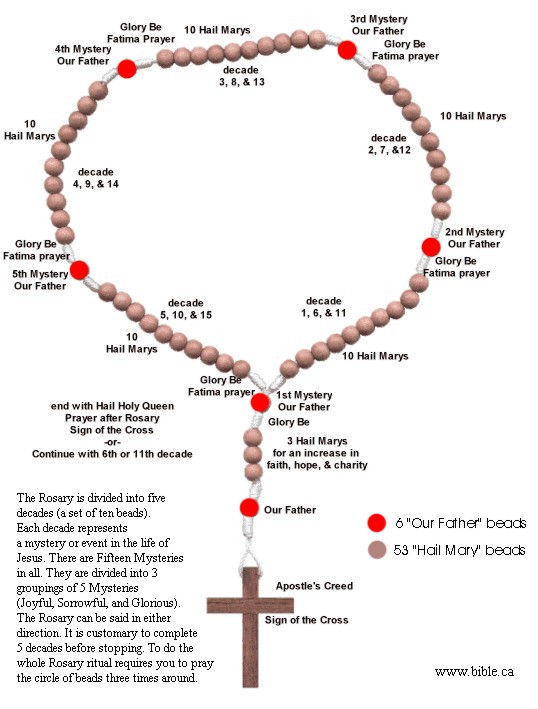
FACT: Catholics pray repetitive words with Rosary Beads that were first invented in 1090 AD, by "Peter the Hermit" and made popular by St. Dominic in 1208 AD. Catholics believe that Mary appeared to St. Dominic in 1208 AD, at the church of Prouille and revealed the Rosary Beads to him. From this time, Catholics prayed 15 sets of 10 consecutive "hail Marys" in a row (150 times), in the Rosary. However, in 2003 AD, Pope John Paul added a new set of Mysteries, so now it is 20 sets of 10 "Hail Marys", (200 times in the Rosary, in total.) Catholics will vainly appeal to Psalm 136 that alternates the same phrase 26 times with 26 different blessings God gives us. It is not 26 in a row as with the rosary! This is also a song, not a prayer. Revelation 4:8 has "angels singing" not "men praying".

Click to View

Click on photo for high resolution


Historical note: Roman Catholics borrowed the idea of praying with beads from the pagan religions who were already using them hundreds of years before: In 456 AD, Hindus are thought to have introduced the concept of praying with beads to the world. The earliest reference to a rosary (boberkhas) is in their "Jain Canon" (456 AD) These boberkhas had various numbers of beads 6,9,12,18,36 (any sub-multiple of 108) Islam (610 AD) uses a rosary of 99 beads, one for each of the names of God. Buddhists have 108 prayer beads on the string. The Rosary is of pagan origin and no Christian prior to 1000 AD used beads to pray.

Question #1: Did Jesus forbid repetitive prayer using Rosary Beads?


Answer: Matthew 6:7 

"And when you are praying, do not use meaningless repetition as the Gentiles do, for they suppose that they will be heard for their many words. Matthew 6:7


3. Virgin Mary

FACT: Roman Catholics are taught the virgin Mary never had sex after Jesus was born and that Jesus had no brothers and sisters. The Pope teaches that Mary is the mediator between God and man. Catholics also engage in more praising of Mary than Jesus Christ himself and actually pray to her to have their prayers answered. Rosary Beads graphically represent how Roman Catholics heap 10 times more praise upon Mary than God himself. Of the 59 total beads of the Rosary, 53 beads are "Hail Marys", but only 6 beads are "Our Father". The Rosary most often ends with a "Hail, Holy Queen" prayer to Mary, not God.


Question #1: Did Jesus have brothers and sisters from the womb of Mary?


Answer: Matthew 13:55-56 

"Is not this the carpenter's son? Is not His mother called Mary, and His brothers, James and Joseph and Simon and Judas? "And His sisters, are they not all with us? Where then did this man get all these things?" Matthew 13:55-56
.


Question #2: Did Joseph begin normal sexual relations with his wife after Jesus was born?


Answer: Matthew 1:24-25 

"And Joseph awoke from his sleep and did as the angel of the Lord commanded him, and took Mary as his wife, but kept her a virgin until she gave birth to a Son; and he called His name Jesus." Matthew 1:24-25

Question #3: The Bible says there is only one mediator between God and man. Is mary that one mediator?

Answer: 1 Timothy 2:5

"For there is one God, and one mediator also between God and men, the man Christ Jesus." 1 Timothy 2:5

Question #4: Catholics engage in endless praise of Mary. When a woman praised Jesus' mother to his face, did Jesus commend encourage this woman to continue praising Mary?


Answer: Luke 11:27-28 

"While Jesus was saying these things, one of the women in the crowd raised her voice and said to Him, "Blessed is the womb that bore You and the breasts at which You nursed." But He said, "On the contrary, blessed are those who hear the word of God and observe it."" Luke 11:27-28


4. Every Christian drinks of the communion cup

FACT: From 1200-1970 AD, Roman Catholics laity were forbidden to drink the blood. This is known as communion under one kind, or communion of one species. During this time, Roman Catholics are permitted to eat the bread (body) of the Lord's Supper, they are generally not allowed to drink the wine (blood) of the Lord's Supper, as any Catholic knows from his own experience from attending Mass. (Except on rare special occasions.) The laity (the people in the pews) are withheld the cup of the Lord and it is usually reserved for church leaders only. Yes there are denominations within the Roman Catholic "communion" where some RC sects actually offer the juice, but most Mass attending Catholics know they rarely drink the cup of wine.


Historical note: Two early popes condemned withholding the cup, (Pope Leo I [died 461 AD] and Pope Gelasius [died 496 Ad]; but in the 12th century the practice was begun, and formally approved by the Catholic Council of Constance in 1415 AD. So for the first 1000 years, the Catholics in the Pews drink the cup, then the Pope changed this apostolic tradition. Under the reforms of Vatican II, the laity were once again permitted to have "communion under both kinds/species". Today many Roman Catholics are unaware that for almost 900 years, the average members were forbidden to drink the blood. While Catholics have restored their practices back to the original first century tradition which they call, "communion under both kinds", it illustrates the ever shifting and changing doctrinal evolution that is present in the Roman Catholic church.


Question #1: Did Christ and the apostle Paul command that every Christian should drink of the communion cup?

Answer: Matthew 26:26-28; 1 Corinthians 11:23-28 

To the disciples: "Drink from it, all of you" Matthew 26:27

To the whole church in Corinth: "in so doing he is to eat of the bread and drink of the cup." 1 Corinthians 11:28

"While they were eating, Jesus took some bread, and after a blessing, He broke it and gave it to the disciples, and said, "Take, eat; this is My body." And when He had taken a cup and given thanks, He gave it to them, saying, "Drink from it, all of you; for this is My blood of the covenant, which is poured out for many for forgiveness of sins." Matthew 26:26-28

"For I received from the Lord that which I also delivered to you, that the Lord Jesus in the night in which He was betrayed took bread; and when He had given thanks, He broke it and said, "This is My body, which is for you; do this in remembrance of Me." In the same way He took the cup also after supper, saying, "This cup is the new covenant in My blood; do this, as often as you drink it, in remembrance of Me." For as often as you eat this bread and drink the cup, you proclaim the Lord's death until He comes. Therefore whoever eats the bread or drinks the cup of the Lord in an unworthy manner, shall be guilty of the body and the blood of the Lord. But a man must examine himself, and in so doing he is to eat of the bread and drink of the cup." 1 Corinthians 11:23-28


5. All Christians are saints


FACT: The Pope says only very special dead Catholic people qualify to be called "saints". For example, Pope John Paul II could not make Mother Teresa a saint (official canonization) until after she was dead. The average Catholic in the pew is never called a "saint" dead or alive! In fact if a pew dwelling Catholic started calling himself a "saint", he would be rebuked by the parish priest!


Question #1: Was every living Christian in the church in Corinth called a saint?


Answer: 1 Corinthians 1:2 

"To the church of God which is at Corinth, to those who have been sanctified in Christ Jesus, saints by calling, with all who in every place call on the name of our Lord Jesus Christ, their Lord and ours" 1 Corinthians 1:2

Question #2: Did Paul write the book of Ephesians to dead saints?


Answer: Ephesians 1:1 

"Paul, an apostle of Christ Jesus by the will of God, To the saints who are at Ephesus and who are faithful in Christ Jesus" Ephesians 1:1


Question #3: Was the average Christian in the church at Philippi called a saint, in distinction to bishops and deacons?

Answer: Philippians 1:1 

"Paul and Timothy, bond-servants of Christ Jesus, To all the saints in Christ Jesus who are in Philippi, including the overseers and deacons" Philippians 1:1


Question #4: Was every Christian living in Rome called to be a saint?


Answer: Romans 1:7 

"to all who are beloved of God in Rome, called as saints: Grace to you and peace from God our Father and the Lord Jesus Christ." Romans 1:7


6. All Christians are priests

FACT: The Pope decided to reserve the title of "priest" to worn by church leaders only. The average pew dwelling Catholic never refer to themselves as "priests". In fact if a lay Catholic started calling himself a "priest", he would be rebuked by "the parish Priest"!

Question #1: Did Jesus make all Christians to be priests, including the average member in the pew?


Answer: 1 Peter 2:5,9; Revelation 1:6; 5:10

"you (all Christians) also, as living stones, are being built up as a spiritual house for a holy priesthood, to offer up spiritual sacrifices acceptable to God through Jesus Christ. " 1 Peter 2:5

"But you (all Christians) are a chosen race, a royal priesthood, a holy nation, a people for God's own possession, so that you may proclaim the excellencies of Him who has called you out of darkness into His marvelous light; " 1 Peter 2:9

"Jesus has made us (all Christians) to be a kingdom, priests to His God and Father—to Him be the glory and the dominion forever and ever. Amen." Revelation 1:6

"You have made them (all Christians) to be a kingdom and priests to our God; and they will reign upon the earth." Revelation 5:10


7. Bishops must be Married.


FACT: In 1079 AD celibacy was first enforced for priests and bishops by Pope Gregory VII. Before this time, they were permitted to marry.


Question #1: Does the Bible teach that a bishop (overseer) must be married AND ALSO have children as one of the conditions of being qualified to be a bishop?


Answer: 1 Timothy 3:2-5

"A bishop, then, must be above reproach, the husband of one wife, temperate, prudent, respectable, hospitable, able to teach, not addicted to wine or pugnacious, but gentle, peaceable, free from the love of money. He must be one who manages his own household well, keeping his children under control with all dignity (but if a man does not know how to manage his own household, how will he take care of the church of God?)" 1 Timothy 3:2-5

Question #2: In the very next chapter of the Bible after bishops are told they must be married with children, does the Holy Spirit warn that "forbidding to marry" is a "doctrine of demons"?


Answer: 1 Timothy 4:1-3 

"But the Holy Spirit explicitly says that in later times some will fall away from the faith, paying attention to deceitful spirits and doctrines of demons, by means of the hypocrisy of liars seared in their own conscience as with a branding iron, men who forbid marriage and advocate abstaining from foods which God has created to be gratefully shared in by those who believe and know the truth." 1 Timothy 4:1-3


8. Peter was married

FACT: Most Catholics believe that Apostle Peter was the first Pope and was not married. As one Roman Catholic leader said, "if Peter had a wife when he first met Jesus, he got rid of her quick!"

Question #1: Did Peter have a wife?


Answer: Mark 1:30 

"Now Simon's mother-in-law was lying sick with a fever; and immediately they spoke to Jesus about her." Mark 1:30

Question #2: Did Paul say all the apostles including Peter had a right to be married?


Answer: 1 Corinthians 9:5 

"Do we not have a right to take along a believing wife, even as the rest of the apostles and the brothers of the Lord and Cephas?" 1 Corinthians 9:5


9. Latin Mass forbidden

FACT: For over 1000 years, the Roman Catholic church often conducts their mass services entirely in the Latin language, when no one sitting in the pews understands the Latin language. Most Roman Catholics who have sat through such a Latin Mass service have wondered what is going on. It was not until 1965 AD that the Pope finally understood 1 Cor 14:19 and allowed masses to conducted in the same vernacular language of the local people. (English in North America)

Question #1: Is Latin Mass forbidden in the Bible when no one in the pews understands Latin?


Answer: 1 Corinthians 14:19 

"in the church I desire to speak five words with my mind so that I may instruct others also, rather than ten thousand words in an unknown tongue." 1 Corinthians 14:19


10. Observance of special days condemned

FACT: The Roman Catholic church has invented an entire yearly calendar of non Biblical holy Days like Lent, Easter, Christmas.


Historical note: No one prior to 335 AD celebrated the birthday of Jesus. The word "Christmas" (Christ + Mass) was first used in 1038 AD. Before 335 AD, the pagan cult of Mithra, the Iranian "god of light", had long celebrated December 25 as Mithra's birthday. December 21, being the winter solace, marked the beginning of days with increasing amount of light, hence December 25 celebrated Mithra's triumph over darkness. Because the pagan festival that celebrated Mithra's birthday was so popular, the Roman Catholic church adopted the day, but changed the meaning from the birthday of Mithra, the "god of light", to Christ's birthday, God the son, "light of the world". The old meaning of December 25 was connected with Mithra's triumph over physical darkness. The new meaning celebrated Jesus triumph over spiritual darkness. Eventually Christmas became dominant, the Mithra cult went extinct and today this origin is not widely known among Roman Catholics. None of the apostles or the early church celebrated the birthday of Jesus.


Question #1: Did the early Christians celebrate Christmas, Lent and Easter?


Answer: Galatians 4:10-11 

"You observe days and months and seasons and years. I fear for you, that perhaps I have labored over you in vain." Galatians 4:10-11


Question #2: Are Christians told to remember the Lord's Death every Sunday?


Answer: Acts 20:7 

"On the first day of the week (Sunday), when we were gathered together to break bread, Paul began talking to them, intending to leave the next day, and he prolonged his message until midnight." Acts 20:7


11. Worshipping images violates the 2nd commandment.

FACT: Catholics regularly bow down to idols, icons and images of Jesus, Mary and the apostles, kissing the feet of the statues and praying to them. Now Catholics get very upset when you accuse them of worshipping Mary. They deny they are worshipping Mary with loud illogical and irrational protests. What these need to understand, is that the Bible teaches that WE ONLY PRAY TO DEITY and Christians considers it paganism and polytheism to pray to anyone EXCEPT the Father, Son or Holy Spirit. So while Catholics pray to Mary, they fail to comprehend that only deity is to be prayed to, and this is the underlying reason why non-Catholics correctly lay the charge they worship Mary AND ALL THE SAINT, they pray to. The Bible clearly teaches that all dead humans, though conscious in the spirit world, are unable to know anything, much less hear prayers addressed to them. Bowing down to icons and kissing them etc. so closely resemble idol worship it is actually shocking that any Roman Catholic would attempt to defend the practice. But again, they simply do the practice but deny it is worship. To illustrate the point, Muslim deny they are worshipping the moon god as their "Allah" as moon worship is even condemned in the Koran. But the fact of history is that Muhammad rid the Kaaba in Mecca of the 365 gods inside the cubical building, but retained the one on the roof known as the moon god "Hubal". Muhammad simply took the moon god from the roof, denied it was the moon god and called Hubal "Allah". The historical vestage of this origin is confirmed in that every mosque in the world has a crescent moon on the roof… just like the original Hubal moon god on the roof of the Kaaba. Muslims get mad when you point out that Allah is really the moon god and Catholics get mad when you point out they are worshipping the Mary and the saints when they pray to them. When a child stands in the middle of a room and puts his hand over his eyes and says, "you can't see me", that doesn't mean they are invisible, except in the mind of the child. Roman Catholics put their hands over their eyes and say, "We do no worship idols and we do not consider praying to Mary and act of worship". Saying so doesn't make it so. Roman Catholic apologists who harshly criticize protestants who accuse them of worshipping idols and Mary need to take a close look in the mirror and be honest with reality. At the very least, they could tone down their ranting against protestants "misrepresenting Catholic faith" with a bit of self-reflection and a good history lesson.


Historical note: The Pope deleted the 2nd of the 10 commandments so they could use statues & images in worship. They split the 10th commandment on coveting into two commandments so they could still have 10 in number. Don't believe this? Look at the list of 10 commandments published by the Roman Catholic church! The issue here is not how the Ten Commandments are numbered, rather the issue is that most published lists of the 10 commandments do not include the words, "you shall not for yourself an idol". Open your Catholic Bible and look for yourself!


Question #1: Does the 2nd commandment approve of bowing down and kissing idols?


Answer: Exodus 20:4 

"You shall not make for yourself an idol, or any likeness of what is in heaven above or on the earth beneath or in the water under the earth. You shall not worship them or serve them." Exodus 20:4-5


12. Baptism is full immersion in water, not sprinkling.

FACT: The Catholic church baptizes babies by sprinkling a little water on them.

Historical note: Greek work for baptism literally means immersion. There are separate words in Greek for sprinkling, pouring and immersion. Only the Greek word for immersion is ever used for Baptism in the Bible. The first recorded case of sprinkling was in 257 AD to someone on a sick-bed. It was then an exception to the rule and brought about fierce opposition from the whole church. Not until 757 AD did the church accept sprinkling in such sick-bed cases of necessity. It wasn't until 1311 AD, when the Catholic council of Ravenna, declared that sprinkling was and acceptable substitute for immersion and from that time forward sprinkling replaced immersion in the Roman Catholic church. The Orthodox church refused sprinkling and still immerses to this day.


Question #1: Was Jesus baptized by full immersion in the Jordan River?


Answer: Matthew 3:16 


"After being baptized, Jesus came up immediately from the water; and behold, the heavens were opened, and he saw the Spirit of God descending as a dove and lighting on Him" Matthew 3:16

Question #2: When Philip baptized the Eunuch, did both of them go into the water?


Answer: Acts 8:38-39 


"And he ordered the chariot to stop; and they both went down into the waterPhilip as well as the eunuch, and he baptized him. When they came up out of the water, the Spirit of the Lord snatched Philip away." Acts 8:38-39


Question #3: Can babies be baptized since they do not first believe?


Answer: Mark 16:16; Acts 8:36-37 

"He who has believed and has been baptized shall be saved; but he who has disbelieved shall be condemned. Mark 16:16

"As they went along the road they came to some water; and the eunuch said, "Look! Water! What prevents me from being baptized?" And Philip said, "If you believe with all your heart, you may." Acts 8:36-37

Question #4: Can babies be baptized since they do not first repent?


Answer: Acts 2:38 

"Brethren, what must we do?" Peter said to them, "Repent, and each of you be baptized in the name of Jesus Christ for the forgiveness of your sins; and you will receive the gift of the Holy Spirit. Acts 2:37-38


13. Original sin is false doctrine

FACT: Catholics say that infants inherit their parent's sin at conception and are therefore spiritually condemned and totally wicked.

Question #1: Is the doctrine of inherited original sin found in the Bible?


Answer: Ezekiel 18:20

"The person who sins will die. The son will not bear the punishment for the father's iniquity, nor will the father bear the punishment for the son's iniquity; the righteousness of the righteous will be upon himself, and the wickedness of the wicked will be upon himself." Ezekiel 18:20

Question #2: Did Jesus say little children are better models of purity and conduct than adults?


Answer: Matthew 18:2-3 

"And He called a child to Himself and set him before them, and said, "Truly I say to you, unless you are converted and become like children, you will not enter the kingdom of heaven." Matthew 18:2-3


14. Every Christian can understand the Bible by merely read it.

FACT: Catholics are taught that only the priests can understand the Bible and the common man in the pew cannot understand the Bible without the priests help.


Question #1: Do the scriptures say that when anyone reads the Bible, they can understand for themselves?

Answer: Ephesians 3:4 

"By referring to this, when you read you can understand my insight into the mystery of Christ" Ephesians 3:4


15. Catholics are unwilling to defend their faith

FACT: When Roman Catholics are challenged from the Bible to defend their faith, they are unwilling or unable to defend what they believe and say the priest has the answer and never search the truth out for themselves. Priests and Bishops never get permission to have open public Bible discussions with honest Bible students like ourselves. Imagine a local parish priest publicly defending infant baptism against a Christian who taught the practice contradicted the Bible! It never happens! Forget what the Bible says, just trust the priest!


Question #1: Should a Christian be unable to defend what they believe from the Bible without the help of priests?

Answer: 1 Peter 3:15 

"sanctify Christ as Lord in your hearts, always being ready to make a defense to everyone who asks you to give an account for the hope that is in you, yet with gentleness and reverence" 1 Peter 3:15


16. Human tradition and man made doctrine is apostasy

FACT: The Pope teaches that he can change what is in the Bible if he wants.

Question #1: Did Jesus say it was OK for man to change what the word of God teaches for man-made Catholic doctrine?

Answer: Mark 7:7-9 

"'But in vain do they worship Me, Teaching as doctrines the precepts of men.' "Neglecting the commandment of God, you hold to the tradition of men." He was also saying to them, "You are experts at setting aside the commandment of God in order to keep your tradition." Mark 7:7-9


Conclusion: How the Catholic church views the Bible

Below are the kinds of replies you can expect from a Roman Catholic priest if you ask him about the contents of this Bible study.

  1. Yes I know Matthew 23:9, seems to condemn calling me "Father", but you are not able to understand the Bible like I do.
  2. Yes I know is appears like Jesus condemned the repetitive prayer of the Rosary beads in Matthew 6:7, but Mary appeared to St. Dominic in 1208 AD and revealed to him the Rosary Beads herself!
  3. Yes Matthew 13:55-56 seems to indicate that Jesus had brothers and sisters, but these were the children of Joseph from a previous marriage or just cousins.
  4. Yes, I agree that 1 Timothy 2:5 sounds like Jesus is the only mediator between god and man, but the Pope decided she was indeed also a mediator between God and man


Summary:

  1. Yes Christ and Paul did command every Christian to drink of the communion cup in Matthew 26:26-28; 1 Corinthians 11:23-28. And Yes I know that two early popes condemned withholding the cup, (Pope Leo I [died 461 AD] and Pope Gelasius [died 496 Ad]; but in the 12th century the practice was begun, and formally approved by the Catholic Council of Constance in 1415 AD. Yes I know that in 1970 the pope restored the cup to the laity.
  2. Was every living Christian in the church in Corinth called a saint?
  3. Yes I know that in the Bible (1 Corinthians 1:2; Ephesians 1:1; Philippians 1:1; Romans 1:7) every Christian was a saint and every saint was a Christian. Yes I agree, the Bible uses the word saint as interchangeably synonymous with being a Christian, but the Roman Catholic church has the power to change the Bible.
  4. Yes I know that in the apostolic church (1 Peter 2:5,9; Revelation 1:6; 5:10), every Christian was a priest and the two terms are used interchangeably synonymous with being a Christian, but the Roman Catholic church decided that only leaders should be called priests.
  5. Yes I know that the Bible appears to teach that 1 Timothy 3:2-5 bishops must be married with believing children, but you can't even understand the Bible anyway, why do you ask? Just trust me because only Catholic priests can understand the Bible.
  6. Yes I have read 1 Timothy 4:1-3, and is seems to condemn forbidding the marriage of Catholic priests, but the Pope decided that unmarried men are more holy than married men.
  7. Yes I know that Mark 1:30; 1 Corinthians 9:5 say that Peter had a wife 23 years after Christ died on the cross (53 AD), but Pope Gregory VII decided in 1079 AD from that time onward, that church leaders cannot marry.
  8. Yes I know that sitting through a Latin Mass service can be very boring for many Catholics in the pews. And yes I know that 1 Corinthians 14:19 condemns conducting a church service in a language the average member does not understand, but the Pope decided that Latin sounds real holy and has both historical and mystical qualities.
  9. Yes I know the early church did not begin to celebrate Christmas until the 4th century. And yes I know that Galatians 4:10-11 condemns the keeping of such holy days not found in the Bible, but the church at Rome needed a way to convert the pagan worshippers of Mithra, the god of light... and it worked!
  10. Yes I know that Acts 20:7 commands Christians to have weekly communion services and that the early church did not celebrate Easter as is done today, but having a yearly communion service was something later church leaders wanted to add to worship.
  11. Yes I know that the Roman Catholic church deleted the 2nd commandment (Exodus 20:4) in order to hid from the masses God's condemnation of bowing down and kissing images of Mary and Peter, but Mary revealed herself to us in a vision.
  12. Yes I know that Jesus was baptized by full immersion in the Jordan River (Matthew 3:16), and that sprinkling was not officially approved until 1311 AD, but it sure is more convenient.
  13. Yes I know that babies have no faith and cannot repent, and are therefor not really valid candidates for baptism (Mark 16:16; Acts 8:36-37; Acts 2:38). But the Pope invented the idea of where the faith and repentance that the infant lacks, is exchanged for the faith and repentance of a "God Parent". Yes I know none of this is in the Bible, but the Pope is the "holy see" and he must know what he is doing!
  14. Yes I know Ezekiel 18:20 proves the doctrine of total hereditary depravity (inherited original sin) contradicts the Bible, but you cannot understand the Bible anyway, only the priest can correctly interpret it.
  15. Yes I know that Matthew 18:2-3 teaches that children are better models of purity and conduct than adults, but the Pope teaches that infants are wicked defiled sinners condemned to hell until a Catholic priest baptizes them and removes the curse of original sin.
  16. Yes I know Ephesians 3:4 plainly seems to say that when you read the Bible by yourself, you can have the same insight that the apostle Paul had into spiritual things, but we Catholic priests cannot teach all our false doctrines that contradict the Bible unless we convince you that you can't understand the Bible unless the priest helps you.
  17. Yes I know that 1 Peter 3:15 teaches every Christian should be able to defend from the Bible what they believe, but isn't that what us Roman Catholic priests are supposed to do? Do you want to put us out of job and rob us of all our power and control?
  18. Yes I know that human traditions that contradict the Bible are condemned in Mark 7:7-9, but all the doctrines that contradict the Bible which the Pope through up were revealed to him directly by Christ and therefore, although they contradict the Bible, they are divinely approved by Christ himself.
  19. You really shouldn't be reading the Bible anyway. And while we are talking about it, what else do you want me to teach you about what the Bible says?


The World Cup: The Summit of Collective Hypnosis and the Disconnection with Nature

Versión en español  (click) We live in a hyper-connected society, yet we are profoundly disconnected from what truly matters. If you stop to...