
ENGLISH:
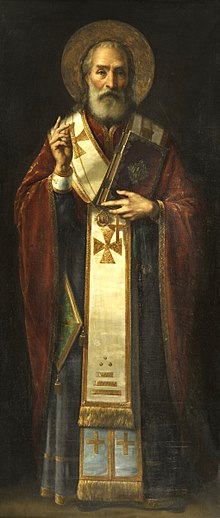 Saint Nicholas
 (Greek:
Ἅγιος Νικόλαος,
Hágios Nikólaos); (15 March 270 – 6 December 343),
also called
Nikolaos of Myra, was Bishop of Myra, in Asia Minor (modern-day Demre, Turkey),
and is a historic Christian saint.
Because of the many miracles attributed to his intercession, he is also known as
Nikolaos the Wonderworker (
Νικόλαος ὁ Θαυματουργός,
Nikólaos ho Thaumaturgós).
Saint Nicholas is the patron saint of sailors, merchants, archers,
repentant thieves, children, brewers, pawnbrokers and students in
various cities and countries. His reputation evolved among the faithful,
as was common for early Christian saints.
The historical Saint Nicholas was born at Patara, Lycia in Asia Minor
(now Turkey). In his youth he made a pilgrimage to Egypt and the
Palestine area. Shortly after his return he became Bishop of Myra and
was later cast into prison during the persecution of Diocletian. He was
released after the accession of Constantine and was present at the
Council of Nicaea.
Life:
St. Nicholas was born in Asia Minor (Greek Anatolia in present-day
Turkey) in the Roman Empire, to a Greek family during the third century
in the city of Patara (Lycia et Pamphylia), a port on the Mediterranean
Sea.
He lived in Myra, Lycia (part of modern-day Demre), at a time when the region was Greek in its heritage,
culture, and outlook and politically part of the Roman diocese of Asia.
In 325, he was one of many bishops to answer the request of Constantine
and appear at the First Council of Nicaea; the 151st attendee was listed
as "Nicholas of Myra of Lycia". There, Nicholas was a staunch
anti-Arian, defender of the Orthodox Christian position, and one of the
bishops who signed the Nicene Creed.
Tradition has it that he became so angry with the heretic Arius during the Council that he struck him in the face.
Secular fame
In
time his fame in northern Europe as a saintly bishop began changing to
that of a giver of gifts to children, usually done on December 6. As
immigrants from the Germanic and Nordic lands settled in the United
States the image of St. Nicholas, or "Sinterklaas," as he is known among
the Dutch, slowly changed to that of "Santa Claus" with little tie to
the spirituality of Christianity.
In
truth you were revealed to your flock as a rule of faith,an image of
humility and a teacher of abstinence;your humility exalted you;your
poverty enriched you.Hierarch Father Nicholas,entreat Christ our Godthat
our souls may be saved.
Kontakion (Tone 3)
You
revealed yourself, O saint, in Myra as a priest,For you fulfilled the
Gospel of ChristBy giving up your soul for your people,And saving the
innocent from death.Therefore you are blessed as one become wise in the
grace of God.
-------------------------------
ESPAÑOL:
San Nicolás (griego: Ἅγιος Νικόλαος, Hágios Nikólaos); (15 de marzo de 270 - 6 de diciembre de 343), también llamado
Nikolaos de Myra fue un obispo que vivió en el siglo IV. Más de
dos mil templos están dedicados a él en todo el mundo. Fue obispo de
Myra, en Asia Menor (hoy en día Demre, Turquía), y es un santo cristiano
histórico.
Debido a los muchos milagros atribuidos a su intercesión, también es conocido como
Nikolaos el Hacedor de Milagros
(Νικόλαος ὁ υαυματουργός, Nikólaos ho Thaumaturgós). San Nicolás es el
santo patrón de los marineros, mercaderes, arqueros, ladrones
arrepentidos, niños, cerveceros, prestamistas y estudiantes en diversas
ciudades y países. Su reputación evolucionó entre los fieles, como era
común para los primeros santos cristianos.
El histórico San Nicolás nació en Patara, Licia en Asia Menor (ahora
Turquía). En su juventud hizo una peregrinación a Egipto y al área de
Palestina. Poco después de su regreso, se convirtió en obispo de Myra y
luego fue encarcelado durante la persecución de Diocleciano. Fue
liberado después del acceso de Constantino y estuvo presente en el
Concilio de Nicea.
Vida: San Nicolás nació en Asia Menor (Anatolia griega en la
actual Turquía) en el Imperio Romano, en una familia griega durante el
siglo III en la ciudad de Patara (Lycia et Pamphylia), un puerto en el
Mar Mediterráneo. Vivió en Myra, Lycia (parte de la actual Demre), en un
momento en que la región era griega en su herencia, cultura y
perspectivas, y políticamente parte de la diócesis romana de Asia.
En 325, fue uno de los muchos obispos que respondieron al pedido de
Constantino y se presentaron en el Primer Concilio de Nicea; el
asistente 151 fue incluido en la lista como "Nicolás de Myra de Licia".
Allí, Nicolás era un firme anti-arriano, defensor de la posición
cristiana ortodoxa, y uno de los obispos que firmaron el Credo de Nicea.
La tradición dice que se enojó tanto con el hereje Arrio durante el
Concilio que lo golpeó en la cara.
Fama secular
Con
el tiempo, su fama en el norte de Europa como un santo obispo comenzó a
cambiar a la de un dador de regalos a los niños, generalmente el 6 de
diciembre. Cuando los inmigrantes de las tierras germánicas y nórdicas
se establecieron en los Estados Unidos, la imagen de San Nicolás, o
"Sinterklaas", como se le conoce entre los holandeses, cambió lentamente
por el de "Santa Claus" con poco vínculo con la espiritualidad del
cristianismo.
Himnos
Troparion (tono 4)
En verdad, fuiste revelado a tu rebaño como regla de fe,
imagen de humildad y maestra de abstinencia;
tu humildad te exaltó;
tu pobreza te enriqueció.
Padre jerarca Nicholas,
suplica a cristo nuestro Dios
para que nuestras almas se salven.
Kontakion (tono 3)
Te revelaste, oh santo, en Myra como sacerdote,
Porque cumpliste el evangelio de cristo
Al entregar tu alma por tu pueblo,
Y salvando al inocente de la muerte.
Por tanto, eres bienaventurado como quien se vuelve sabio en la gracia de Dios.


