Translate

sábado, 7 de enero de 2023

The Nativity of Christ: The Great Mystery of Piety


Bishop Alexander (Mileant).

Translated by Seraphim Larin and Daniel Olson


In the history of mankind, there is no event greater and more joyful than the incarnation and coming of the Son of God into the world. It is an act of the endless love of God the Father, Who so loved the world, that he gave his only begotten Son, that whosoever believeth in him should not perish, but have everlasting life.

The incarnation of the Son of God from the Virgin Mary changed the world for the better in a radical way: It gave men a new way of thinking, ennobled their morals and directed world events along a new course. It brought men power to struggle against sin, reconciled men to God, brought about the adoption of men by the Father, and regenerated their whole nature. It poured a stream of divine life into the corrupted human organism and thereby brought eternal life to men. For these reasons, the incarnation of the Son of God proved to be at the very center of world events, and chronology is reckoned relative to it - before and after the Nativity of Christ. The celebration of the Nativity of Christ became a most joyous festival of believing humanity.

In the present article, we shall recount the events surrounding the Nativity of Christ, we shall talk about the spiritual significance of this event, and finally we shall discuss the main features of the Nativity divine service.


The Event of the Nativity of Christ

Preceding the Nativity of Jesus Christ, there was a general expectation of the Saviour. The Jews expected His coming on the basis of prophecies, and all the prophecies relating to the coming of the Son of God had been fulfilled. For example, the Patriarch Jacob had foretold that the Saviour would come when the scepter would depart from Judah (Gen 49:10). The prophet Daniel had foretold that the Kingdom of the Messiah would begin at the seventieth week (490 years) after the issuance of a command concerning the restoration of Jerusalem, during the era of a powerful pagan kingdom, which would be as strong as iron (Dan 9:24-27). And, indeed, at the end of Daniel's seventy weeks, Judæa fell under the dominion of the mighty Roman Empire, while the scepter passed from Judah to Herod, an Idumæan by birth.
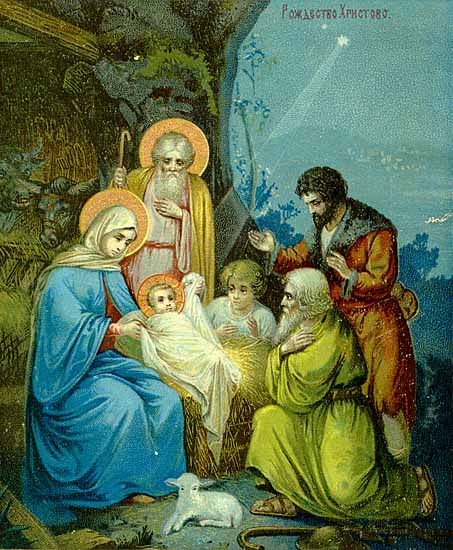
The pagans also, in misery from unbelief and a general dissipation of morals, expected a Deliverer with impatience. Men, having fallen away from God, began to deify earthly good things, wealth and worldly glory. The Son of God rejected these worthless idols as the fruit of sin and human passions and was pleased to come into the world under the most modest conditions.

Two Evangelists describe the events of the Nativity: Apostles Matthew (of the twelve) and Luke (of the seventy disciples). Since the Evangelist Matthew wrote his Gospel for the Hebrews, he set himself the aim of proving that the Messiah descended from the forefathers Abraham and King David, as had been foretold by the prophets. Therefore, the Evangelist Matthew begins his narrative of the Nativity of Christ with a genealogy (Matt. 1:1-17).

Knowing that Jesus was not the son of Joseph, the Evangelist does not say that Joseph begat Jesus, but says that Jacob begat Joseph, the husband of Mary, from whom was born Jesus, Who is called Christ. But why, then, does he adduce Joseph's genealogy and not Mary's? The Hebrews did not have the custom of reckoning genealogies according to the female line, but their Law commanded a man to take a wife without fail from the tribe to which he belonged. Therefore, the Evangelist, not deviating from custom, adduces Joseph's genealogy, to show that Mary, Joseph's wife, and consequently also Jesus, descend from the same tribe of Judah and clan of David.

The most holy Virgin, informed by the Archangel Gabriel that she had been chosen to become the mother of the Messiah, set out for a meeting with Elizabeth, being only the espoused bride of Joseph. Almost three months had already passed since the good tidings of the angel. Joseph, who had not been initiated into this mystery, noticed her condition; her outward appearance gave him cause to consider unfaithfulness. He could have publicly denounced her and subjected her to the severe punishment established by the Law of Moses, but, in accordance with his goodness, he did not want to resort to such a drastic measure. After long vacillations, he decided to put his bride away secretly, without making any publicity, having delivered to her a bill of divorcement.

But an angel appeared to Joseph in a dream and declared that the bride espoused to him would give birth from the Holy Spirit; therefore he advised Joseph, 'fear not to take unto thee Mary thy wife.' And he was further instructed to name the Son born of her Jesus (Ieshua), that is, Saviour, since He would save His people from their sins. Joseph recognized this dream as inspiration from on high and obeyed it, taking Mary as his wife, but knew her not, that is, he lived with her not as a husband with a wife, but as a brother with a sister (or, judging from the enormous difference in years, rather as a father with a daughter). In narrating this, the Evangelist adds for himself: Now all this was done, that it might be fulfilled which was spoken of the Lord by the prophet, saying, Behold, a virgin shall be with child, and shall bring forth a son, and they shall call his name Emmanuel (Isaiah 7:14). The name "Emmanuel" means "God with us." Here, Isaiah is not calling the One born of the Virgin Emmanuel: he is saying that men will call him such. Thus, this is not the proper name of the One born of the Virgin, but only a prophetic indication that God will be in His person.

The holy Evangelist Luke notes that the time of the Nativity of Christ coincided with a census of the inhabitants of the Roman Empire. This census was carried out in accordance with the command of Cæsar Augustus, that is, the Roman emperor Octavian, who had received the title Augustus ("sacred") from the Roman Senate. The edict on the census came out in the 746th year from the founding of Rome, but in Judæa the census began approximately in the 750th year, during the final years of the reign of Herod, who was surnamed the Great.

The Hebrews reckoned their genealogies according to tribes and clans. This custom was so strong that, having learned of the command of Augustus, they went to be registered each to the town of his clan. Joseph and the Virgin Mary descended, as is well known, from the clan of David. Therefore, they went to set out for Bethlehem, called the city of David because David was born there. Thus, by God's Providence, the ancient prophesy of the Prophet Micah was fulfilled, that Christ would be born precisely in Bethlehem: But thou, Bethlehem Ephratah, though thou be little among the thousands of Judah, yet out of thee shall come forth unto me that is to be a ruler in Israel; whose goings forth have been from of old, from everlasting (Micah 5:2, Matt. 2:6).

According to Roman laws, women were subject to the universal census equally with men. Therefore, Joseph went to Bethlehem not alone, but with the Most Holy Virgin. An unexpected journey to his native Bethlehem, a journey so close to the delivery of the Infant, must have convinced Joseph that Cæsar's decree was providential, directing events for the Son of Mary to be born precisely where the Messiah-Saviour ought to be born.

After an exhausting journey, the elderly Joseph and the Virgin Mary arrived in Bethlehem. There was no room in the inn for the mother of the Saviour of the world, and she, with her companion, was forced to lodge in a cave, where livestock were driven from pasture during bad weather. Here, during a winter night, under the most wretched conditions, the Saviour of the world - Christ - was born.

Having borne a Son, the Most Holy Virgin herself swaddled Him and laid Him in a manger. In these brief words, the Evangelist informs us that the Mother of God gave birth painlessly. The Evangelist's expression, brought forth her firstborn son, causes unbelievers to say that, after Jesus the first-born, the Most Holy Virgin had other children, since the Evangelists mention the "brethren" of Christ (Simon, Joses, Judas and James). However, according to the Law of Moses (Ex. 13:2), every infant of the male sex that openeth the womb was called the first-born, even if he were the last. The so-called "brethren" of Jesus in the Gospels are not His own brothers, but only relatives, the children of the aged Joseph by his first wife, Salome, and also the children of Mary the wife of Cleophas (whom the Evangelist John calls his mother's sister). In any case, they all were much older than Christ and therefore could not in any way be the children of the Virgin Mary.

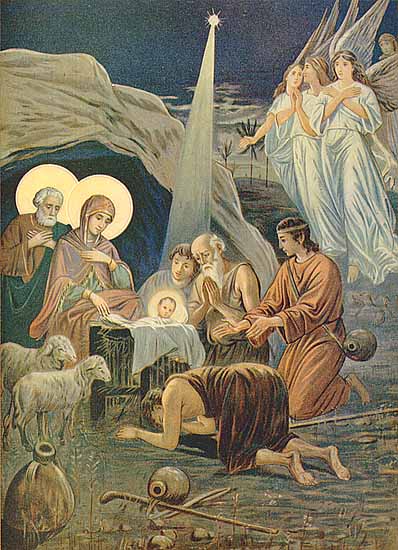
Jesus Christ was born at night, when everyone in Bethlehem and its environs was sleeping. Only the shepherds, who were watching over the flock entrusted to them, were not sleeping. Unto these modest men, who labored and were heavy laden, an angel appeared with the joyous tidings of the birth of the Saviour of the world. The resplendent light surrounding the angel amidst the nocturnal darkness frightened the shepherds. But the angel at once calmed them, saying: Fear not: for, behold, I bring you good tidings of great joy, which shall be to all people. For unto you is born this day in the city of David a Saviour, which is Christ the Lord. By these words, the angel gave them to understand the true purpose of the Messiah, Who had come not for the Jews alone, but for all people, for joy would be to all people who would accept Him as the Saviour. The angel explained to the shepherds that they would find Christ, the Lord Who had been born, in swaddling clothes, lying in a manger.

Why did an angel not announce the birth of Christ to the Jewish elders, to the scribes and the Pharisees, calling them also to worship the Divine Infant? Because these blind leaders of the blind had ceased to understand the true meaning of the prophecies concerning the Messiah and, on account of their exclusiveness and haughtiness, they imagined that the Deliverer would appear in the full splendor of a majestic conqueror-king, to subjugate the whole world. The modest preacher of peace and love toward one's enemies was unacceptable to them.

The shepherds did not doubt that the angel had been sent to them from God, and therefore they were counted worthy to hear the triumphant heavenly hymn: Glory to God in the highest, and on earth peace, good will among men. The angels glorify God, Who had sent the Saviour to men, for from that time, the peace of the conscience has been restored and the enmity between heaven and earth, which arose as a consequence of sin, has been eliminated.

The angels withdrew, while the shepherds hastily set out for Bethlehem; they found the Infant lying in a manger and were the first to worship Him. They told Mary and Joseph about the event that had brought them to the cradle of Christ; they told the same to others also, and all that heard their story were astonished. But Mary kept all these things, and pondered them in her heart, i.e., she remembered all that she had heard. The Evangelist Luke, who describes many events in the life of the Virgin, such as the Annunciation and the details of the birth of Christ (Luke, Ch. 2), evidently wrote from her words. On the eighth day after his birth, the Infant was circumscribed as prescribed by the Law of Moses.


The Adoration of the Magi

A further Gospel story, concerning the adoration of the Magi (Matt., Ch. 2), is very edifying. This is, first of all, a story about the "epiphany" or manifestation of Christ to the pagans.

Joseph and the Most Holy Mother of God with the Infant Jesus were still in Bethlehem when Magi came to Jerusalem from a distant land to the east (Persia or Babylon). Learned men, engaged in observing and studying the stars, were called Magi or wise men. At that time, men believed that, at the birth of a great man, a new star appears in the sky. Many pagans within the confines of Persia, had learned from the dispersed Jews of the coming of the Messiah, the Great King of Israel. From the Jews, they could even have learned the following prophecy of Balaam relating to the Messiah: I shall see him, but not now: I shall behold him, but not nigh: there shall come a Star out of Jacob, and a Sceptre shall rise out of Israel, and shall smite the corners of Moab (Num. 24:17). ("Moab" is a personification of the enemies of the Messiah.) The Persian Magi thus expected that, when the promised King would be born, a new star would appear in the sky. The prophecy of Balaam spoke of a star in the spiritual sense; nevertheless, the Lord, in His mercy, to bring the pagans to faith, gave a sign in the sky in the form of the appearance of an extraordinary star. Having seen it, the Magi understood that the expected King had been born.

After a protracted and long journey, they finally reached Jerusalem, the capital of the Jewish kingdom, and began to ask: Where is he that is born King of the Jews? For we have seen his star in the east, and are come to worship him. These words from such conspicuous strangers, stirred up many of the inhabitants of Jerusalem, including King Herod, to whom the arrival of the exotic eastern scholars was immediately reported.

From the first days of his accession, Herod's throne had been shaky. The people hated him as a usurper of the Davidic throne and a tyrant, and they abhorred him as a pagan. The last years of Herod's life were complicated still more by personal adversities and bloody reprisals. He became extremely suspicious, and for the least cause executed enemies both real and imagined. Thus perished several of Herod's children and even his wife, whom earlier he had loved ardently. Ill and decrepit, Herod now resided in his new palace in Sion. Having heard of a King Who had been born, he became particularly agitated. Vulnerable in his old age, he feared that his rule would be overthrown and handed over to the new-born King.

In order to clear up just who this new pretender to the throne was, Herod gathered all the priests and scribes - men that knew the books of Sacred Scripture well - and he inquired of them where Christ should be born. They answered: In Bethlehem of Judæa: for thus it is written by the prophet Micah. Then Herod privately summoned the Magi, found out from them the time of the appearance of the star, and sent them on to Bethlehem. Feigning piety, the cunning Herod said to them: Go and search diligently for the young child; and when ye have found him, bring me word again, that I may come and worship him also. In fact, Herod was going to use their report to put the Infant to death.

The Magi listened to King Herod without suspecting anything, and went to Bethlehem. There again that star appeared, which they had seen before in the east. Moving across the sky, it went before them, indicating the way. In Bethlehem, the star stopped over that spot where the Infant Jesus was, Who had been born.

The Magi went into the house and saw the Infant Jesus with His mother. They bowed down to the ground before Him and presented to Him their gifts: gold, frankincense and myrrh (a precious aromatic oil). In the gifts of the Magi, one may see the following symbolic significance. They brought gold to Him, as to a King (as tribute or taxes); frankincense, as to God (incense is used at divine services); and myrrh, as to a Man Who must die (the dead were anointed with oils mixed with aromatic myrrh).

Having worshipped the King awaited by all, the Magi would have returned to Jerusalem and to King Herod. However, an angel appeared to them in a dream, revealing Herod's perfidious designs, and commanded them to return to their own country by another way, without passing through Jerusalem. Tradition has preserved the names of the Magi, who afterwards became Christians: Melchior, Gaspar and Balthasar.

Thus, the first to worship the Saviour Who had been born were shepherds, nature's true children, who could open up before Him only the treasure of their hearts, full of simplicity, faith and humility. Significantly later came the Magi from the East, imbued with erudite wisdom, who laid down gold, frankincense and myrrh, together with reverent joy, before the Divine Infant. They had had to make a long journey to reach Judæa, and even from Jerusalem, they were not immediately able to find the birthplace of the King of the Jews. Does this not indicate that both simplicity of heart and profound, conscientious erudition lead equally to Christ? But the first way is more direct, short and sure than the second. The shepherds were guided directly by angels, while the Magi were "taught" by an unreasoning star, and, through Herod, by the scribes and the Jewish elders. Not without difficulties and dangers did they attain their desired goal, and they did not hear the heavenly harmony that sounded over the earth - Glory to God in the highest, and on earth peace, good will among men. (Metropolitan Anastasy's thought).


The Son of God

and the Son of Man

"Great is the mystery of godliness [piety]: God was manifest in the flesh" (I Tim. 3:16). These words of the holy Apostle testify that the miracle of the incarnation of the Son of God exceeds the understanding of our limited mind. Indeed, we can believe, but cannot explain, the event that took place two thousand years ago in Bethlehem: that, in the one Person of Jesus Christ, two natures so different and contrary in essence were joined together: the superterrestrial, eternal and infinite divine nature with the material, limited and feeble human nature.

Nonetheless, the Gospels and the apostolic epistles reveal to us, to the extent of our abilities, certain aspects of the miracle of the incarnation of the Son of God. Saint John the Theologian, at the very beginning of his Gospel, elevates our thought to the pre-eternal existence of the Second Person of the Most Holy Trinity, Whom he calls the Word, saying: In the beginning was the Word, and the Word was with God, and the Word was God. The same was in the beginning with God. All things were made by him; and without him was not anything made that was made. And the Word was made flesh, and dwelt among us (John 1:1-3, 14).

The Son of God's name, the Word, indicates that one must not understand His birth from the Father in the sense of an ordinary birth: it occurred passionlessly and without separation. The Son of God is born from the Father like a word is born from a thought. A thought and a word are distinct from one another, and at the same time inseparable. There is no word without a thought, and a thought is without fail expressed in a word.
The subsequent apostolic preaching reveals all the more fully the truth of Christ's divine-human nature: He is the only begotten (the only) Son of God, Who was begotten of the Father before all ages, i.e., He is eternal, as God the Father is also eternal. The Son of God has the same divine nature that God the Father has, and is therefore omnipotent, omniscient and omnipresent. He is the Creator of the visible and invisible worlds, and of us men. In a word, He, being the Second Person of the Most Holy Trinity, true and perfect God. Faith in Jesus Christ as the incarnate Son of God represents the stronghold or rock upon which the Church is established, according to the word of the Lord: Upon this rock I will build my church; and the gates of hell shall not prevail against it (Matt. 16:18).

Being perfect God, Christ the Saviour is at the same time also perfect Man. He had a human body and soul with all its properties - reason, will and senses. As a man, He was born of the Virgin Mary. As the Son of Mary, He obeyed her and Joseph. As a man, He was baptized in the Jordan and went around the towns and villages with His salvific preaching. As a man, He experienced hunger, thirst, fatigue; he had a need for sleep and rest; he endured painful sensations and physical sufferings. Living the physical life inherent to a man, the Lord also lived a spiritual life as a man. He strengthened His spiritual powers by fasting and by prayer. He experienced human feelings - joy, wrath, sorrow; he shed tears. In this way, the Lord Jesus Christ, having taken on our human nature, was in all things like unto us, except for sin.

Having two natures, Jesus Christ also had two free wills. Jesus Christ's rational, conscious, human will invariably subordinates its human aspirations and desires to His divine will. But the human will in Christ is clearly visible during His difficult experiences in the garden of Gethsemane: O my Father, if it be possible, let this cup pass from me: nevertheless not as I will, but as thou wilt (Matt. 26:39).

Thus, by His obedience to God the Father, the Lord Jesus Christ corrected our disobedience and taught us to put God's will above our own desires.


The Purpose of the Incarnation

of the Son of God

The parable of the lost sheep speaks graphically and vividly of the purpose of the coming of the Son of God into the world. The good shepherd leaves the ninety-nine sheep, by which is meant the angelic world, and sets out for the mountains in order to seek out his lost sheep - the human race perishing in sins. The shepherd's great love for the perishing sheep is evident not only in the fact that he solicitously seeks it, but especially in the fact that after finding it, he takes it upon his shoulders and carries it back. In other words, God, by His power, returns to man the innocence, holiness and blessedness lost by him; having united Himself with our human nature, the Son of God, according to the word of the Prophet, hath borne our griefs, and carried our sorrows (Isaiah, Ch. 53).

Christ became man not only to teach us the true way and to show us a good example. He became man in order to unite us with Himself, to join our feeble, diseased human nature to His divinity. The Nativity of Christ testifies to the fact that we attain the ultimate aim of our life not only by faith and by striving for good, but chiefly by the regenerating power of the incarnate Son of God, with Whom we are united.

Delving deeply into the mystery of the incarnation of the Son of God, we see that it is closely bound up with the mystery of Holy Communion and with the Church, which, according to apostolic teaching, is the mystical Body of Christ. In the Holy Communion of the Body and Blood of Christ, a man is joined to the divine-human nature of Christ; he unites with Him and in this union is wholly transfigured. At the same time, in Holy Communion, a Christian unites also with other members of the Church - and thus the mystical Body of Christ grows.

Heterodox Christians who do not believe in Holy Communion understand union with Christ in an allegorical, metaphorical sense, or in the sense of only a spiritual communion with Him. But for spiritual communion, the incarnation of the Son of God is superfluous. After all, even before the Nativity of Christ, the prophets and the righteous were counted worthy of grace-filled communion with God.

One must understand that man is ill not only spiritually, but also physically: all of human nature has been harmed by sin. It is essential, therefore, to heal the whole man, not only his spiritual part. To remove any doubt in the necessity for total communion with Himself, the Lord Jesus Christ, in His discourse on the Bread of Life, speaks thus: Except ye eat the flesh of the Son of man, and drink his blood, ye have no life in you. Whoso eateth my flesh, and drinketh my blood, hath eternal life; and I will raise him up at the last day... He that eateth my flesh, and drinketh my blood, dwelleth in me, and I in him (John 6:53-54, 56). Later, Christ uses the metaphor of the grapevine to explain to His disciples that it is precisely in close union with Him that man receives the strength essential for spiritual development and perfection: As the branch cannot bear fruit of itself, except it abide in the vine; no more can ye, except ye abide in me. I am the vine, ye are the branches: He that abideth in me, and I in him, the same bringeth forth much fruit: for without me ye can do nothing (John 15:4-5).

Some holy Fathers have justly likened Holy Communion to the mystical tree of life, from which our primogenitors ate in Eden, and which afterwards St. John the Theologian saw in paradise (Gen. 2:9, Rev. 2:7, 22:2). In Holy Communion, a Christian is joined to the immortal life of the God-Man.

Thus, the purpose of the incarnation of the Son of God lies in the spiritual and physical regeneration of man. Spiritual renewal is accomplished throughout the course of a Christian's whole life. But the renewal of his physical nature is completed on the day of the general resurrection of the dead, when the righteous shall shine forth as the sun in the kingdom of their Father (Matt. 13:43).


The Divine Services

on the Nativity of Christ

Next to Pascha, the Nativity of Christ is the most joyous festival, and may justly be called the "Winter Pascha." The celebration of the Nativity of Christ was established very early, possibly already in the first century. But until the end of the fourth century, the Nativity of Christ was celebrated with His Baptism on the 6th of January (the 19th according to the New Style) and was called Theophany. Beginning in the fourth century, the Nativity of Christ began to be celebrated on the 25th of December (on the day of the pagan festival in honor of the "Invincible Sun"). At present, this takes place on the 7th of January according to the Gregorian Calendar. The Church prepares the faithful for a worthy celebration of the Nativity of Christ by a forty-day fast, which begins on the 15 th/28th of November, on the day after the commemoration of the Apostle Philip (hence "Philip's Fast"). Orthodox Christians spend the Eve of the Nativity of Christ in strict fasting. According to the Typicon, on this day one may only eat sochivo (boiled wheat with honey), so this day is called Sochel'nik.

On the Eve of the Nativity of Christ, the "Royal Hours" are performed. This divine service differs from the usual "Hours" by the reading of special "paremias" (readings from the Bible, primarily from the Old Testament) corresponding to the feast. Furthermore, the Apostol and Gospel are read.

The Liturgy of St. Basil the Great is then performed with Vespers. At this Vespers, the stichera on "Lord, I have cried," depict both the inner significance and the outward picture of the Nativity of Christ. Thus, we hear how, with the Incarnation of the Son of God, the strife between God and men ceases, the fiery sword of the angel (blocking the entry to paradise) is turned back, and we receive access to paradise. We also hear of the doxology of the angels, of Herod's confusion, and of the unification of all men under the authority of the Roman emperor Augustus.

Additional paremias are read at Vespers. The first paremia (Gen. 1:1-13) speaks of the creation of man by God. The second (Num. 24:2-9, 17-18) speaks of the prophetic significance of the star out of Jacob and the birth of the Messiah, to whom all men will submit. The third (Micah 4:6-7, 5:2-4) speaks of the birth of Christ in Bethlehem. The fourth (Isaiah 11:1-10) speaks of the Rod (i.e., the Messiah) that would come forth from the root of Jesse and of the fact that the Spirit of God would rest upon Him. The fifth (Baruch 3:36-38; 4:1-4) speaks of the appearance of God on earth and of His life among men. The sixth (Dan. 2:31-36, 44-45) prophecies the restoration of the Heavenly Kingdom by God. After the conclusion of the Liturgy, the priests stand before the icon of the feast in the middle of the Church, and glorify Christ with the singing of the troparion and the kontakion of the feast.

In the evening, on the Eve of the Nativity of Christ, a solemn All-night Vigil is served. This begins with Great Compline and the triumphant singing of the verses: God is with us, containing a prophecy of the birth of the Messiah (see Isaiah 7:14, 8:8-15 and 9:6-7). The stichera at the Litia express the triumph of heaven and earth, of angels and men, who rejoice over the descent of God to the earth and the spiritual and moral change in men that followed. The stichera for the Aposticha proclaim that a most glorious miracle has been performed: the Word is born incorruptibly from a Virgin and is not separated from the Father. After "Now lettest Thou Thy servant depart," the following troparion is sung.


Troparion

Thy Nativity, O Christ our God, shined the light of knowledge upon the world: for therein they that adored the stars were taught by a star to worship Thee, the Sun of righteousness, and to know Thee, the Dayspring from on high: O Lord, glory be to Thee.

Before the reading of the Six Psalms at the beginning of Matins, the church choir joins with the heavenly choir to sing: Glory to God in the highest, and on earth, peace, good will among men.

In the Canon, the thought is expressed that He Who was born of the Virgin is not a simple man, but God, Who has appeared in the flesh on earth for the salvation of men, as was foretold concerning Him in the Old Testament. In the Canon, Jesus Christ is called the Benefactor Who has reconciled us with God, and the Father Who has freed us from the authority of the devil and saved us from sin, the curse and death (see the Canon of Matins below). After the sixth ode of the Canon and the Small Litany is sung the following kontakion.


Kontakion

Today the Virgin giveth birth to Him Who is beyond being, and the earth offereth a cave to Him Who is unapproachable; angels doxologize with shepherds, and Magi journey with a star; for a young Child, the pre-eternal God, is born for our sake.


On the very feast of the Nativity, at the beginning of the Liturgy, instead of the psalms "Bless the Lord, O my soul" and "Praise the Lord, O my soul," special antiphons are sung. The prokeimenon before the Apostol expresses the worship of Jesus Christ by all creation: Let all the earth worship Thee and chant unto Thee; let them chant unto Thy name, O Most High. The reading from the Apostol explains how, through the incarnation of Jesus Christ, we have become children of the Heavenly Father: But when the fullness of the time was come, God sent forth his Son, made of a woman, made under the law, to redeem them that were under the law, that we might receive the adoption of sons. And because ye are sons, God hath sent forth the Spirit of his Son into your hearts, crying, Abba, Father. Wherefore thou art no more a servant, but a son; and if a son, then an heir of God through Christ (Gal. 4:4-7). The Gospel reading tells of the adoration by the Magi of the Lord Who had been born.

Instead of "It is truly meet," the following zadostoinik is sung:


Zadostoinik

It would be easier for us, because free from all danger, to keep silence in fear: while it is hard indeed, O Virgin, in love to devise songs harmoniously put together. But do thou, O Mother, give us strength so that we may fulfill our good intent.


Canon for the Nativity

At the All-night Vigil for the Nativity of Christ, two canons are sung, written by the renowned hymnographers of the eighth century, St. Cosmas of Maiuma and St. John of Damascus. Both canons are saturated with sublime and profound thoughts, with beautiful images and majestic turns of speech: they are worthy of the solemnity of the feast.

The theme of the canon of St. Cosmas is that Christ, having become man, abides also as he was, as God. The writer of the canon, imbued with this event, glorifies with rapture and reverence the God-Man Who came down to earth, ascribing to him the names, properties and actions that were attributed to him by the ancient prophets. The inspired writer arouses others to joy and to a worthy meeting with the newborn King of glory, beginning the canon with the words of St. Gregory the Theologian: Christ is born, give ye glory (from a Nativity sermon by St. Gregory the Theologian), and at the end of the canon repeats the words of St. Chrysostom: A strange and most glorious mystery do I see. Saint John of Damascus, in his canon, depicts those salvific actions that took place for the human race because of the appearance of the Son of God in the flesh, events clearly revealed in the New Testament. We present here only the Canon of Cosmas of Maiuma. "Canons" always have nine "odes," but the second ode exists only in the canons of Great Lent.


Canon

Ode 1

First Canon. Tone 1

Irmos: Christ is born; glorify Him! Christ comes from heaven; go to meet Him! Christ is on earth; be exalted! Sing to the Lord, all the earth! And praise Him in gladness, O people, for He has been glorified!

Glory to Thee, our God, glory to Thee.

Man was made in the image of God, but he sinned, and lost immortality. He fell from the divine and better life, enslaved completely by corruption. Now the wise Creator fashions him again, for He has been glorified!

Glory to Thee, our God, glory to Thee.

The Creator shaped man with His own hands, but when He saw us perishing eternally, He bowed the heavens and came down to earth, and clothed Himself completely in our nature, truly incarnate from a pure and holy Virgin, for He has been glorified!

Glory to Thee, our God, glory to Thee.

Wisdom, and Word, and Power, Christ our God is the Father's Son, His Radiance. He was made man, a mystery concealed from every spirit above or on the earth. He has won us for Himself, for He has been glorified!

Glory to the Father, and to the Son, and to the Holy Spirit, now and ever, and unto ages of ages. Amen.

Katavasia: Christ is born, glorify Him. Christ is from heaven, receive Him. Christ is on earth, be lifted up; sing to the Lord, all the earth and praise Him with joy all people: For He has been glorified.


Second Canon (written originally in iambic verse). Tone 1

Irmos: Of old the Master that works wonders saved His people, making the watery wave of the sea into dry land; and now of His own will has He been born from a maiden, and so He established a path for us whereby we may mount to heaven. We glorify Him Who in essence is equal to the Father and to mortal men.

Glory to Thee, our God, glory to Thee.

Plainly foreshadowed by the burning bush that was not consumed, a hallowed womb has borne the Word. God is mingled with the form of mortal men, and so He looses the unhappy womb of Eve from the bitter curse of old. We men give Him glory.

Glory to Thee, our God, glory to Thee.

A star showed plainly to the Magi the Word that was before the sun, Who has come to make transgression cease. They saw Thee wrapped in swaddling clothes, within a poor and lowly cave, Who sharest all our sufferings, and in joy they gazed upon Thee, Who art at once both man and Lord.

Katavasia: Of old the Master that works wonders saved His people, making the watery wave of the sea into dry land; and now of His own will has He been born from a maiden, and so He established a path for us whereby we may mount to heaven. We glorify Him Who in essence is equal to the Father and to mortal men.


Ode 3

First Canon

Irmos: To the Son, begotten of the Father, before all ages and incarnate of the Virgin without seed in these latter days- To Christ our God, let us cry out: "Thou hast raised up our horn. Holy art Thou, O Lord!"

Glory to Thee, our God, glory to Thee.

Adam was made from dust, yet he shared God's life-giving breath. He was deceived by woman and fell, but from the dead, he saw Christ born of woman. He shouted, "For my sake Thou hast become like me. Holy art Thou, O Lord!"

Glory to Thee, our God, glory to Thee.

Thou hast assumed a body of lowly clay, O Christ. By sharing our humble flesh, Thou hast made our race partakers of divinity. By becoming mortal man yet remaining God, Thou hast raised us from death to life. Holy art Thou, O Lord!

Glory to Thee, our God, glory to Thee.

Make merry, O Bethlehem! Thou art the King of Judah's princes. Christ, the Shepherd of Israel, who rides on the shoulders of the cherubim, has come forth from thee for all to see. He has raised us from death to life, and reigns over all.

Glory to the Father, and to the Son, and to the Holy Spirit, now and ever, and unto ages of ages. Amen.

Katavasia: To the Son who before all times was born immortal of the Father, and in these latter days became incarnate without seed of the Virgin, let us cry out to Christ our God, Thou who hast raised our horn, Holy art Thou, O Lord.


Second Canon

Irmos: Graciously accept, O Benefactor, the praises of Thy servants, and bring down the despiteful and haughty looks of the enemy. O blessed Lord Who sees all, raise us up far above sin, and establish Thy singers firm and unshaken upon the foundation of the faith.

Glory to Thee, our God, glory to Thee.

The choir of shepherds abiding in the fields was overwhelmed by the strange sight they were counted worthy to behold: For they looked upon the all-blessed Offspring of an all-pure Bride; and they saw also the ranks of bodiless angels, who sang in praise of Christ the King, incarnate without seed.

Glory to Thee, our God, glory to Thee.

He Who rules the heights of heaven, in His compassion, has become such as we are, born of a Maiden who has not known man. The Word Who before was wholly outside matter, in these last times has assumed the material substance of the flesh so that He might draw unto Himself fallen Adam, the first-formed man.

Katavasia: Graciously accept, O Benefactor, the praises of Thy servants, and bring down the despiteful and haughty looks of the enemy. O blessed Lord Who sees all, raise us up far above sin, and establish Thy singers firm and unshaken upon the foundation of the faith.


Hypakoe. Tone 8

Heaven brought the first fruits of the Gentiles as a gift for Thee: A star summoned the wise men to the babe in the manger. They were amazed to see neither throne nor scepter, but only abject poverty. What is more humble than a cave? What is more lowly than swaddling clothes? Yet the riches of Thy divinity shone through all these. O Lord, glory to Thee!


Kathisma Hymn. Tone 8

Let the heavens rejoice and let the earth be glad! The Lamb of God has been born on earth, Granting redemption to the world. The Word, Who rests in the bosom of the Father, Has come forth without seed from the Virgin. The wise men were struck with amazement, Seeing Him born as an infant in Bethlehem. Let all creation glorify Him!

Glory to the Father, and to the Son, and to the Holy Spirit, now and ever, and unto ages of ages. Amen.

Let the heavens rejoice...


Ode 4

Irmos: Stem and flower of the root of Jesse, Thou hast blossomed from the virgin, O Christ. From the mountain overshadowed by the forest Thou art come, made flesh from her that knew no man. O God, not formed from matter - glory to Thy power, O Lord!

Glory to Thee, our God, glory to Thee.

Thou art the Expectation of the nations, O Christ, foretold by Jacob in days of old. Thou have sprung from Judah's tribe, to plunder the might of Damascus and the spoils of Samaria, replacing error with faith acceptable to God. Glory to Thy power, O Lord.

Glory to Thee, our God, glory to Thee.

Thou hast filled the star-gazers with joy, O Lord. They knew the hidden meaning of the prophet Balaam's words. Thou hast made the star of Jacob to rise. As the first-fruits of the Gentiles it led them unto Thee. Thou didst openly receive their precious gifts. Glory to Thy power, O Lord!

Glory to Thee, our God, glory to Thee.

Thou hast descended into the Virgin's womb, O Christ, like rain on the fleece and as raindrops watering the earth. All earth's rulers fall down before Thee: Ethiopia and the islands of Arabia, the kings of Tarshish, of Sheba, and the Medes. Glory to Thy power, O Lord!

Glory to the Father, and to the Son, and to the Holy Spirit, now and ever, and unto ages of ages. Amen.

Katavasia: Rod of the stem of Jesse, and flower that budded forth from a virgin, O most lauded Christ. From the mountain covered with darkness Thou art come, made flesh from Her that knew no wedlock, O God who art not formed from matter. Glory to Thy might, O Lord.


Second Canon

Irmos: Of old Habakkuk the Prophet was counted worthy to behold ineffably the figure and symbol of Christ's birth, and he foretold in song the renewal of mankind. For a young babe, even the Word, has now come forth from the Mountain that is the Virgin, unto the renewal of the peoples.

Glory to Thee, our God, glory to Thee.

Of Thine own will, O Most High, Thou hast come forth equal to mortal men, Taking flesh from the Virgin, to purge the poison of the serpent's head. God by nature, Thou hast lead all from the gates that know no sun to the life-giving light.

Glory to Thee, our God, glory to Thee.

O you people that before were sunk in corruption, but now have escaped wholly from the perdition of the adversary, lift up your hands and clap them in songs of praise, honoring Christ alone, our Benefactor, Who in His compassion is come into our midst.

Glory to Thee, our God, glory to Thee.

O Virgin, sprung from the root of Jesse, thou hast passed beyond the boundaries of human nature, for thou hast borne the pre-eternal Word of the Father. According to His good pleasure, by a strange self-empting, He passed through thy womb, yet kept it sealed.

Glory to the Father, and to the Son, and to the Holy Spirit, now and ever, and unto ages of ages. Amen.

Katavasia: Of old Habakkuk the Prophet was counted worthy to behold ineffably the figure and symbol of Christ's birth, and he foretold in song the renewal of mankind. For a young babe, even the Word, has now come forth from the Mountain that is the Virgin, unto the renewal of the peoples.


Ode 5

Irmos: O God of Peace, Father of Mercies, Thou hast sent Thine angel of great counsel to grant us peace. We are guided to the light of the knowledge of God, and keeping watch by night, we glorify Thee, O Lover of Man!

Glory to Thee, our God, glory to Thee.

Thou wast registered as Caesar's subject, O Christ, in obedience to his decree. We were slaves of sin, and subject to the hateful enemy; by Thy poverty Thou hast set us free! Thou wast united to our nature in every way. Though we were formed from dust, by this communion we are made divine!

Glory to Thee, our God, glory to Thee.

Behold, the Virgin, as foretold of old, has conceived and given birth to God made man. She remains a virgin still. Through her we are reconciled to God. Let us sinners faithfully sing her praise: she is truly Theotokos.

Glory to the Father, and to the Son, and to the Holy Spirit, now and ever, and unto ages of ages. Amen.

Katavasia: O God of Peace, Father of Mercies, Thou hast sent Thine angel of great counsel to grant us peace. We are guided to the light of the knowledge of God, and keeping watch by night, we glorify Thee, O Lover of Man!


Ode 6

Irmos: The sea monster cast forth Jonah as it had received him, like a babe from the womb. And when the Word came to dwell in the Virgin and was made flesh, He came forth preserving her uncorrupt, for as He Himself was not subject to decay, He kept His mother free from harm.

Glory to Thee, our God, glory to Thee.

Christ our God has come in the flesh. The Father begot Him from the womb before the morning star. He rules the heavenly hosts, yet now He lies in a manger of dumb beasts. He Who looses the tangled knots of sin now is wrapped in swaddling clothes.

Glory to Thee, our God, glory to Thee.

A Son is born and given to the faithful, a newborn child of Adam's race, yet He is Father and Ruler of the world to come. He is called the Angel of Great Counsel. He is the Mighty God; He rules all creation by His might.

Glory to the Father, and to the Son, and to the Holy Spirit, now and ever, and unto ages of ages. Amen.

Katavasia: The sea monster cast forth Jonah as it had received him, like a babe from the womb. And when the Word came to dwell in the Virgin and was made flesh, He came forth preserving her uncorrupt, for as He Himself was not subject to decay, He kept His mother free from harm.


Kontakion. Tone 3

Today the Virgin gives birth to the transcendent One, and the earth offers a cave to the unapproachable One. Angels, with shepherds, glorify Him. The wise men journey with the star, since for our sake the Eternal God was born as a little child!

Ikos

Bethlehem has opened Eden: come let us see! We have found joy in a secret place: come, let us seize Paradise hidden in the cave! There the unwatered Root has appeared, blossoming with forgiveness. There is found the undug Well, from which David longed to drink of old. There the Virgin has borne a child, quenching Adam's and David's thirst. Let us hurry to this place, where the Eternal God was born as a little child!


Ode 7

Irmos: The children brought up together in godliness scorned the impious decree of the tyrant. They were not afraid of the threat of fire, but standing in the midst of the flames, they sang: "Blessed art Thou, O God of our fathers!"

Glory to Thee, our God, glory to Thee.

The shepherds abiding in the fields were terrified by a dazzling sight. Around them shone the glory of the Lord. An angel shouted unto them, "Sing praises. The Messiah is born!" Blessed art thou, O God of our fathers!

Glory to Thee, our God, glory to Thee.

After the angel spoke, the hosts of heaven suddenly cried out: "Glory to God in the highest. Peace on earth, good will to men. Christ has shone forth." Blessed art Thou, O God of our fathers!

Glory to Thee, our God, glory to Thee.

"What news is this?" asked the shepherds. "Has God's Messiah truly come? Let us go to Bethlehem." They saw Thee there, and worshipped Thee. With Thy mother, they sang: "Blessed art Thou, O God of our fathers!"

Glory to the Father, and to the Son, and to the Holy Spirit, now and ever, and unto ages of ages. Amen.

Katavasia: The children brought up together in godliness scorned the impious decree of the tyrant. They were not afraid of the threat of fire, but standing in the midst of the flames, they sang: "Blessed art Thou, O God of our fathers!"


Ode 8

Irmos: The furnace moist with dew was an image prefiguring a wonder beyond nature, for it did not burn the children whom it had received, nor did the Fire of Divinity consume the Virgin's womb when it entered it. So let us raise the song: "Let all creation bless the Lord and exalt Him throughout all ages!"

Glory to Thee, our God, glory to Thee.

The daughter of Babylon drove David's children from Zion with sword and spear. Now she sends her sons, the wise men, bearing gifts, to worship in David's city, where God has come to dwell. So let us raise the song: "Let all creation bless the Lord, and exalt Him throughout all ages!"

Glory to Thee, our God, glory to Thee.

Grief had silenced the harps. Zion's children would not sing in a foreign land. But now Christ has shone forth in Bethlehem destroying the din of Babylon's idolatries. So let us raise the song: "Let all creation bless the Lord, and exalt Him throughout all ages!"

Glory to Thee, our God, glory to Thee.

Babylon plundered Zion, and captured all her royal wealth. But now, with a guiding star, Christ lures her treasure-laden wise men back to Zion. So let us raise the song: "Let all creation bless the Lord, and exalt Him throughout all ages!

Glory to the Father, and to the Son, and to the Holy Spirit, now and ever, and unto ages of ages. Amen.

We praise, bless and worship the Lord, singing and exalting Him throughout all ages.

Katavasia: The furnace moist with dew was an image prefiguring a wonder beyond nature, for it did not burn the children whom it had received, nor did the Fire of Divinity consume the virgin's womb when it entered it. So let us raise the song: "Let all creation bless the Lord and exalt Him throughout all ages!"


Ode 9

Magnify, O my soul, the most pure Virgin Theotokos, more honorable and more glorious than the heavenly hosts!

Irmos: I behold a strange, most glorious mystery! Heaven-the cave! The cherubic throne-the Virgin! The manger-the place where Christ lay, the uncontainable God, Whom we magnify in song!

Magnify, O my soul, God born in the flesh, from the virgin.

The wise men saw a new, uncharted star, following an unexpected course. Its brightness surpassed every star in heaven. It foretold the Messiah's birth: Christ, the King, born on earth in Bethlehem, for our salvation.

Magnify O my soul, The King born in the cave!

The wise men...

Magnify, O my soul, God, worshipped by the wise men!

The wise men...

Magnify, O my soul, God worshipped by the wise men!

"Where is the newborn Infant-King? We have seen His star," the wise men said. "We have come to worship Him." Godless Herod trembled with fury. In his raging madness he plotted to kill Christ.

Magnify, O my soul, the Lord Who revealed Himself to the wise men by a star!

Where is the newborn...

Magnify, O my soul, the pure virgin who gave birth to Christ the King!

Herod inquired where the star appeared which had led the wise men to Bethlehem, but after they worshipped Christ with gifts, that same star led them back to their own land, confounding their pursuer, that godless murderer of children.

Wise men and shepherds came to worship Christ, born in the City of Bethlehem.

Herod inquired...

Glory to the Father, and to the Son, and to the Holy Spirit, now and ever, and unto ages of ages. Amen.

Magnify, O my soul, the most pure Virgin Theotokos, more honorable and more glorious than the heavenly hosts!

Katavasia: I behold a strange, most glorious mystery! Heaven-the cave! The cherubic throne-the Virgin! The manger-the place where Christ lay, the uncontainable God, Whom we magnify in song!


The Exapostilarion

Our Savior, the dayspring from the East, has visited us from on high, and we, who were in darkness and shadow, have found the truth, for the Lord is born of the Virgin!


Conclusion

And so, the Nativity hymns remind those praying how, during this memorable night, each creature hastened to bring its gift to the Saviour-King: heaven - a star; the earth - a cave; the wilderness - a manger; the angels - singing; the shepherds - worship; the Magi - gifts. Therefore, we too should not come to Him "empty-handed," but should bring to Him what is more valuable than anything else - our pure, believing hearts. For the high God has appeared on earth, in order to raise us up to heaven!

viernes, 16 de diciembre de 2022

Святой пророк Софония


Вси светии  


Св. пророк Софония

VІІ век преди Христа

Чества се на 3 декември


Кондак, глас 4

Явился еси светозарен божественным духом, пророче Софоние, Божие явление возгласив: ращуйся зело дщи Сионя, Иерусалимови проповеждь: се Царь твой грядет спасаяй.


Житие на свети пророк Софоний

Св. пророк Софоний, живял в VІІ век преди Христа, бил съвременник на св. пророк Йеремия и пророчествувал в дните на цар Йосия. Като предсказал бедствията, които трябвало да постигнат Юдея и околните страни, той предвещал на юдейския народ и светлите новозаветни времена, когато Господ щял да посети Своя народ и си избере люде кротки и смирени, които ще се уповават на името Господне, няма да вършат неправди и няма да говорят лъжа.

"Ликувай, дъще Сионова! – се провиква той. – Весели се и се радвай от все сърце, дъще Йерусалимова! Господ отмени присъдата над тебе, изгони врага ти! Господ, цар Израилев, е посред тебе: повече няма да видиш зло... Господ, Бог твой, е посред тебе: Той е силен да те спаси." (Софон. 3:14-17)

Старий Завет на Господа Нашего Иисуса Христа


КНИГА НА ПРОРОК СОФОНИЯ


ГЛАВА 1.

1. Слово Господне, което биде към Софония, син на Хусия, син на Годолия, син на Амория, син на Езекия, в дните на Иосия, син Амонов, цар иудейски.
2. Всичко ще изтребя от лицето на земята - казва Господ:
3. ще изтребя човеци и добитък, ще изтребя птици небесни и риби морски, и съблазните заедно с нечестивите; ще изтребя човеците от лицето на земята, казва Господ.
4. И ще простра ръката Си върху Иудея и върху всички жители на Иерусалим; ще изтребя от това място остатъците на Ваала, името на жреците със свещениците,
5. и ония, които върху покривите се покланят на воинството небесно, и ония от покланящите се, които се кълнат в Господа и се кълнат в царя си,
6. и ония, които отстъпиха от Господа, не търсиха Господа и не Го подирват.
7. Замълчи пред лицето на Господа Бога, защото близо е денят Господен. Вече приготви Господ жертвеното клане, назначи, кого да повика.
8. И в деня на жертвата Господня Аз ще споходя князете, синовете на царя и всички, които се обличат в дреха на чуждоплеменници;
9. ще споходя в оня ден всички, които прескачат праг, които дома на своя Господ напълнят с насилие и измама.
10. И ще има в оня ден, казва Господ, вик при Рибни порти и ридание при другите порти и голямо разрушение на хълмовете.
11. Плачете, жители от долната част на града, защото ще изчезне целият търговски народ, и изтребени ще бъдат натоварените със сребро.
12. И в онова време Аз ще огледам Иерусалим със светило и ще накажа ония, които седят на дрождието си и казват в сърце си: "Господ не прави ни добро, ни зло", -
13. и ще станат богатствата им плячка, и къщите им ще запустеят; те ще построят къщи, а няма да живеят в тях, ще насадят лозя, а вино от тях няма да пият.
14. Близо е великият ден Господен, близо - и твърде бърза: вече се чува гласът на деня Господен. Горчиво ще завика тогава и най-храбрият!
15. Ден на гняв е тоя ден, ден на скръб и на теснотия, ден на опустошение и разорение, ден на тъма и на мрак, ден на облак и на мъгла,
16. ден на тръба и на боен вик против укрепени градове и високи кули.
17. И Аз ще стесня човеците, и те ще ходят като слепи, защото съгрешиха против Господа, и разхвърлена ще бъде кръвта им като прах, и плътта им - като смет.
18. Ни среброто им, нито златото им не ще може да ги спаси в деня на гнева Господен, и от огъня на ревността Му ще бъде погълната цялата тая земя, защото изтребване, и при това внезапно, ще извърши Той над всички жители земни.


ГЛАВА 2.

1. Изучете се внимателно, изучете, народе необуздани,
2. докле не е дошло определението - денят ще прехвръкне като мекина - докле не е дошъл върху ви пламенният гняв Господен, докле не е настъпил денят на яростта Господня.
3. Потърсете Господа, всички смирени на земята, които изпълнявате законите Му; потърсете правдата, потърсете смиреномъдрието; може би ще се скриете в деня на гнева Господен.
4. Защото Газа ще бъде напусната, и Аскалон ще опустее, Азот ще бъде изгонен посред ден, и Екрон ще се изкорени.
5. Горко на жителите от приморската страна, на критския народ! Словото Господне е върху вас, хананейци, земя Филистимска! Аз ще те изтребя, и ти няма да имаш жители, -
6. и ще стане приморската страна овчарска кошара и ограда за добитък.
7. И тоя край ще се падне на остатъка от Иудиния дом, и ще пасат там и в къщите на Аскалон вечер ще си почиват, защото Господ, техният Бог, ще ги споходи и ще върне плена им.
8. Чух Аз хулата на Моава и обидите на синовете Амонови, как те се подиграваха с Моя народ и се големееха на пределите му.
9. Затова жив съм Аз! казва Господ Саваот, Бог Израилев: Моав ще бъде като Содом, и синовете на Амона ще бъдат като Гомора, притежание на коприва, солна ровина, пустиня навеки; остатъкът от народа Ми ще ги вземе плячка, и оцелелите от човеците Ми ще ги получат в наследство.
10. Това им е за високомерието им, задето те се подиграваха и се големееха над народа на Господа Саваота.
11. Страшен ще бъде за тях Господ: Той ще изтреби всички земни богове, и Нему ще се покланят - всеки от мястото си - всички острови на народите.
12. И вие, етиопци, ще бъдете избити с Моя меч.
13. Господ ще простре ръката Си на север, ще унищожи Асур и ще обърне Ниневия в развалини, в място сухо като пустиня,
14. и стада ще лежат сред нея и всякакъв род животни; пеликан и еж ще нощуват в резбените й украшения; гласът им ще се разнася из прозорците, разрушението ще се покаже на вратните стълбове, защото няма да има на тях кедрова обложка.
15. Ето какво ще стане тържествуващият град, който живее безгрижно и казва в сърце си: "аз съм, и няма други освен мене". Как стана той развалина, леговище за зверове! Всеки, минавайки покрай него, ще подсвирне и ще махне с ръка.


ГЛАВА 3.

1. Горко на града нечист и омърсен, който притеснява!
2. Не слуша гласа, не взима от наставления, на Господа не се уповава, към своя Бог не се приближава.
3. Князете му посред него са рикащи лъвове, съдиите му - вечерни вълци, които не оставят до сутринта нито една кост.
4. Пророците му са човеци лекомислени, вероломни; свещениците му оскверняват светинята, тъпчат закона.
5. Господ е праведен посред него, не върши неправда, всяка сутрин явява Своя съд неизменно; но беззаконникът не знае срам.
6. Аз изтребих народи - разрушени са твърдините им; пусти направих улиците им, тъй че никой не ходи по тях; разорени са градовете им: няма нито един човек, няма жители.
7. Аз казах: "бой се само от Мене, приемай наставления!" и няма да бъде изтребено жилището му, и няма да го постигне злото, каквото му бях определил; а те прилежно се стараеха да покварват всичките си действия.
8. И тъй, чакайте Ме, казва Господ, до оня ден, когато ще се дигна за опустошение; защото е определено от Мене да събера народи, да свикам царства, за да излея върху тях Моето негодувание, всичката ярост на Моя гняв; защото от огъня на яростта Ми ще бъде погълната цялата земя.
9. Тогава Аз пак ще дам на народите чисти уста, та всички да призовават името на Господа и да Му служат единодушно.
10. От страните отвъд реката на Етиопия поклонниците Ми - децата на Моите разпилени - ще Ми принесат дарове.
11. В оня ден ти няма да се срамиш от своите различни постъпки, с каквито грешеше против Мене, защото тогава Аз ще отстраня из средата ти ония, които напразно се хвалеха със своята знатност, и няма вече да се превъзнасяш на светата Ми планина.
12. Но ще оставя всред тебе народ смирен и прост, и те ще се уповават на името Господне.
13. Остатъците от Израиля няма да вършат неправда, няма да говорят лъжа, и няма да се намери в устата им коварен език, защото сами ще се пасат и ще лежат, и никой няма да ги разтревожи.
14. Ликувай, дъще Сионова! тържествувай, Израилю! весели се и радвай се от все сърце, дъще Иерусалимова!
15. Господ отмени присъдата над тебе, изгони врага ти! Господ, Цар Израилев, е посред тебе: повече няма да видиш зло.
16. В оня ден ще кажат на Иерусалим: "не бой се", и на Сион: "да не отслабват ръцете ти!
17. Господ, Бог твой, е посред тебе: Той е силен да те спаси; ще се развесели за тебе с радост, ще бъде милостив по любовта Си, ще тържествува за тебе с песни".
18. Тъгуващите за тържествени празненства Аз ще събера; твои са те, върху тях тежи укор.
19. Ето, Аз ще стесня всички твои притеснители в онова време и ще спася онова, що хроми, ще събера разсеяното и ще ги туря на почит и именитост по цяла тая земя на техния укор.
20. В онова време ще ви доведа и тогава пак ще ви събера; защото ще ви направя именити и почетни между всички земни народи, когато ще върна вашия плен пред очите ви, казва Господ.
+++


jueves, 15 de diciembre de 2022

Святой пророк Аввакум


Свя­той про­рок Ав­ва­кум, один из 12 ма­лых про­ро­ков, про­ис­хо­дил из ко­ле­на Си­мео­но­ва, про­ро­че­ство­вал око­ло 650 го­да до Р. X.

Про­рок Ав­ва­кум пред­рек раз­ру­ше­ние Иеру­са­лим­ско­го хра­ма, ва­ви­лон­ское пле­не­ние и воз­вра­ще­ние плен­ных на ро­ди­ну. Во вре­мя вой­ны с ва­ви­ло­ня­на­ми про­рок уда­лил­ся в Ара­вию, где с ним про­изо­шло сле­ду­ю­щее чу­до. Ко­гда он нес обед жне­цам, ему встре­тил­ся Ан­гел Гос­по­день и мгно­вен­но пе­ре­нес его си­лою сво­е­го ду­ха в Ва­ви­лон, где в это вре­мя то­мил­ся в тем­ни­це про­рок Да­ни­ил. Так, пи­щей, пред­на­зна­чав­шей­ся для жне­цов, уто­лил го­лод го­ни­мый про­рок. По­сле окон­ча­ния вой­ны с ва­ви­ло­ня­на­ми про­рок Ав­ва­кум вер­нул­ся в свое оте­че­ство и умер в глу­бо­кой ста­ро­сти. При свя­том кон­стан­ти­но­поль­ском ца­ре Фе­о­до­сии Млад­шем (408–450) бы­ли об­ре­те­ны его мо­щи.


Жития святых Память святого пророка Аввакума

Память 2 декабря

Святой пророк Аввакум был сын Асафата и происходил из колена Симеонова, как повествует о нем святой Епифаний Кипрский в своей книге «О жизни пророков». По преданию, записанному святыми отцами 7948 , родиной Аввакума было небольшое селение Бетзохар, иначе называемое Виезахир.

Самое имя – Аввакум 7949 , – данное ему при рождении, предзнаменовало, что из него выйдет сильный духом подвижник. Придя в возраст совершенный, он, ради славы имени Божия, ревностно выступил на обличение беззаконий своего народа. Сам же он, горя духом о Господе, строго соблюдал заповеди Божии, твёрдо стоял на пути добродетели, и был удостоен от Господа дара пророческого.

Аввакум пророчествовал и жил после царствования благочестивого иудейского царя Езекии, когда на престоле царствовали нечестивые цари: Манассия, сын Езекии и потом Амон, сын Манассии 7950 . По свидетельству Священного Писания ( 2Пар.33:9 ; 4Цар. 21:2–10 ), в народе Иудейском при Манассии были постоянные раздоры и злодейства: сильный угнетал слабого, и негде было искать суда справедливого. Сам царь Манассия был первым гонителем невинных: он пролил весьма много невинной крови, так что наполнил ею Иерусалим от края и до края ( 4Цар.21:16 ). По преданию, в числе невинных пострадал в это время и святой пророк Исаия, равно как пострадали многие другие обличители неправд и нечестия царя и народа.

Впоследствии царь Манассия, наказанный Богом и взятый в плен Ассирийцами, раскаялся и обратился к Истинному Богу. Но зло, посеянное им, пустило уже глубокие корни среди народа еврейского; Манассии же наследовал нечестивый сын Амон, подобно отцу своему преданный грубому идолопоклонству.

Пророк Аввакум глубоко скорбел о развращении своих современников. Не находя нигде правды, он изливал свою скорбь, взывая ко Господу:

– Доколе, Господи, я буду взывать – и Ты не слышишь меня, буду вопиять о насилии – и Ты не спасаешь? Для чего даешь мне видеть злодейство и смотреть на бедствие? Грабительство и насилие предо мною, и восстает вражда и поднимается раздор. От этого закон потерял силу, и суда правильного нет: так как нечестивый одолевает праведного, то и суд происходит превратный» ( Авв.1:2–4 ).

Так взывал пророк ко Господу, видя беззакония людские и ожидал праведного суда от Самого Бога. В ответ на сие, Господь возвестил Своему избраннику, что скоро должно наступить наказание за всеобщее нечестие. По повелению Божию, пророк Аввакум предсказал евреям такое страшное событие, которому в его время даже трудно было поверить, – именно разрушение храма и самого Иерусалима и пленение Вавилонское 7951 .

Пророк ясно указал, что орудиями сего наказания Господь избрал Халдеев 7952 , – народ свирепый и необузданный, который быстро проходит по пространствам земли, чтобы завладеть чужими селениями.

В трепетном ожидании грозного нашествия, пророк Аввакум недоумевал: неужели праведный Господь попустит гордым и нечестивым Халдеям совершенно истребить избранный народ Свой. В надежде, что наказание это будет временным, он ожидал нового откровения от Господа и в своем молитвенном ожидании был подобен стражу, зорко смотрящему вдаль с городской башни 7953 , чтобы возвестить о приближении врага. Он пламенно молил Господа спасти народ еврейский от рабства Вавилонского, как некогда Он спас его от рабства Египетского, и ждал, что возглаголет ему Господь.

Тогда Господь открыл пророку Своему, что всё спасение избранного народа среди этих бедствий заключается в вере, а гордые и необузданные Халдеи сами должны будут испытать ту же участь, которую они приготовили побежденным народам ( Авв.2:4 ). После того пророк Аввакум, чтобы не повергнуть соотечественников в отчаяние от предстоящего им испытания от Бога, произнес притчу на погибель Халдеев, возвестив пятикратное горе угнетателям ( Авв.2:9–19 ). В этой притче он показал всё ничтожество идолов и могущества Халдеев, пред величием Бога Истинного, шествующего во спасение людей Своих. Пророк, в озарении свыше, предвещал, что Бог грядет для спасения народа Своего от горы приосененные чащи (Фарана), для спасения помазанного Своего, и наступит такое время, когда вся земля наполнится познанием славы Господа, как воды наполняют море ( Авв.3:13 ) 7954 .

Когда Навуходоносор подступал к Иерусалиму, то, по свидетельству предания, пророк Аввакум удалился из города. Зная, что бедствие уже неотвратимо, и что сопротивление столь сильному завоевателю будет бесполезно, пророк с горестью оставил свое отечество, чтобы не видеть разорения его и избежать жестокости победителя. По указанию Божию, Аввакум поселился в земле Аравийской, в городе Остракине 7955 и жил здесь добровольным изгнанником до самого удаления врагов из его отечества.

По удалении Халдеев, он возвратился в землю свою, оплакал бедствие ее и вместе с уцелевшими из народа стал заниматься земледелием. В молитве к Богу за народ свой ожидал он возвращения плененных из Вавилона.

Однажды, во время жатвы, пророк сварил похлёбку и, взяв хлеба, пошел в поле, чтобы отнести этот обед жнецам. Но на пути ему предстал Ангел Господень и сказал:

– Отнеси этот обед в Вавилон к Даниилу, в ров львиный.

В это время, действительно, пророк Даниил, живший при дворе царя Вавилонского, по ненависти нечестивых Вавилонян, был ввергнут в львиный ров.

Но Аввакум, не зная города Вавилона, отвечал Ангелу:

– Господи! Вавилона я никогда не видал и рва львиного не знаю.

Тогда Ангел Господень силою духа своего восхитил Аввакума и, подняв его за волосы, перенёс в Вавилон и поставил прямо надо рвом, куда ввергнут был Даниил.

И воззвал Аввакум:

– Даниил! Даниил! Возьми обед, который Бог послал тебе.

Даниил же возблагодарил Бога и сказал:

– Вспомнил Ты обо мне, Боже, и не оставил любящих Тебя.

Даниил поднялся и вкусил пищи. Ангел же Господень мгновенно поставил Аввакума на его прежнее место.

После чудесного посещения Даниила, пророк Аввакум возвратился к жнецам своим во время обеда их, и никому не сказал о случившемся. Он проразумел, что народ Иудейский возвращен будет Господом из Вавилона в Иерусалим, подобно тому как совершилось чудесное перенесение его в Вавилон и возвращение оттуда. Но это испытание народа Божия длилось 70 лет, и Аввакум не дожил до возвращения евреев из плена и умер в старости и погребен был с честью на собственном поле 7956 .

Кондак, глас 8:

Возгласивый вселенней от юга пришествие Божие от Девы, Аввакуме богоглаголиве, и на божественней стражи предстоянием слышания от светоносна ангела, Христово воскресение возвестил еси миру. Сего ради весело зовем ти: радуйся, пророков светлая доброто.

* * *

7948

Блж. Епифанием Кипрским и св. Исидором Испалийским.

7949

Аввакум – с еврейского значит собственно обнимающий, обхватывающий, а потом-сильный борец, подвижник.

7950

Начало пророческой деятельности Аввакума нужно отнести к тем годам царствования Манассии, когда сей нечестивый царь, взятый в плен Асаргаддоном, смирился и покаялся в заточении. Пророчества Аввакума относятся к периоду времени с 660 г. и захватывают собою годы царствования преемника Амона, благочестивого царя Иосии, до 611 г.

7951

Кн. прор. Аввакума ( Авв. 1:6–12 ). Об этом же наказании, за нечестие народа в царствование Манассии и его сына, говорится в 4Цар. 21:12–14 .

7952

Халдеи – по-еврейски: хасидим, произошли от Хеседа, сына Нахорова, брата Авраама ( Быт. 22:22 ). Происходя от семитического корня, Халдеи первоначально жили в северной гористой стране Месопотамии, ближе к Армении, на юг от озера Ван. Из этой древней местности Халдеи расселились по течению Евфрата, на юг и восток по всей Месопотамии и Вавилонии и вскоре сделались народом господствующим. В период владычества Ассириян, они с последними сделали многие завоевания и, по отделении Вавилонии от Ассирии, при Набополассаре особенно при Навуходоносоре, победили многие народы и царства. Всюду, при завоеваниях, Халдеи отличались крайнею жестокостью и воинственностью.

7953

( Авв. 2:1 ). Образ речи взят от обычая устраивать сторожевые башни на горах и высоких местах для того, чтобы стражники благовременно узнавали об опасности для селений, возвещали бы о близости неприятеля, о победе и поражении. Свв. пророки были стражи, поставленные Богом как бы на некоторой высоте для наблюдений и возвещение воли Его. На этой божественной страже святой пророк Аввакум, отрешившись от всего земного, бодрствовал духом и пламенно молился Богу об открытии воли Его о Своем народе. Находясь в таком состоянии, он благоговейно ожидал, когда луч света Божия проникнет в его ум, озарит душевные его очи, и что возглаголет ему Господь.

7954

Здесь не только предрекается избавление Евреев из плена Вавилонского, но и спасение рода человеческого. Таким образом, это пророчество – мессианского характера. Указывая на южную страну по отношению к Палестине, где и была гора Фаран, покрытая тенистым лесом, Аввакум открыл евреям, что они получат избавление от рабства Вавилонского чрез народ, пришедший с южной стороны. Действительно, Кир, царь Персидский, привел Мидян и Персов с юга, по отношению к Палестине и, покорив Вавилонян, освободил евреев. Но взор пророка провидел избавление еще от другого рабства – греховного рабства всего рода человеческого в его обновлении. По объяснению блаж. Феодорита, Аввакум сими словами «предвозвещает вочеловечение Бога и Спасителя нашего, совершившееся в Вифлееме, который лежит к югу от Иерусалима». Св. Церковь , под горою приосененною, разумеет Божию Матерь, как бы некую гору добродетелей, осененную Святым Духом. «Гору Тя благодатию Божиею приосененную прозорливыма Аввакум усмотив очима», – воспевает Церковь в каноне, – «из Тебе изыти Израилеву провозглашаше Святому, во спасение наше и исправление». «Христос грядый явственно Бог наш, приидет и не закоснит, от горы присосененныя чащи, отроковицы раждащия неискусомужныя, пророк древле глаголет» (4-я песнь канона в неделю Ваий). «Христе от Девы прозябл еси, из горы хвальный, приосененныя чащи» (4 песнь на Рож. Хр). Вообще, в основание 4-й песни всех церковных канонов положено пророчество Аввакума о пришествии Господа во спасение людей Своих «спасти помазанныя своя». Ввиду такого ясного мессианского значения пророчества Аввакума, Церковь христианская усвоила ему наименование «Богоглаголивого». (похвальный канон, песнь 4-я, ирмос). – Вышеприведенная молитвенная песнь Аввакума служит основанием 4-й песни церковных канонов, изображающей всемогущество Бога и непостыдную надежду на него.

7955

Остракина – город на границе Аравии, Палестины и Египта.

7956

Кончина прор Аввакума последовала приблиэительно за 600 лет до Р. Х. По сказанию церк. историка IV века, Евсевия Кесарийского , гробницу пр. Аввакума указывали в Кеиле, или в Киле, в колене Иудином. По свидетельству церк. историка V в. Созомена , мощи сего св. пророка, по Божественному Откровению, были обретены вместе с мощами св. пророка Михея в царствование Феодосия II младшего (408– 450 г.). Тела обоих пророков указаны были Божественным сновидением Зевенву, бывшему в то время епископом церкви Елевферопольской.


+++

lunes, 12 de diciembre de 2022

The Guadalupan Myth


Versión en español: https://khristosanesti.blogspot.com/2020/12/el-mito-guadalupano.html

Although the "Virgin" of Guadalupe is best known as the patron saint of the Americas, the story of her "miraculous" appearance in Tepeyac, Mexico has its roots in the province of Extremadura, Spain. It was here that a Spaniard named Gil Cordero discovered a small Islamic image resembling the Virgin Mary on the bank of the Guadalupe River sometime in the mid-13th century. The wooden image had dark brown skin and was on top of a crescent moon, a symbol of Islam. In fact, the very name of the river "Guadalupe" had an Islamic influence, since it is derived from the Arabic word "guadale" which means "river," and "Lupo", which is Latin for Wolf. Both the image and the name of the river were the remains of the Moorish occupation of Spain. The discovery of the carved image was seen as a great sign from God, and in 1338, King Alfonso XI ordered a temple to be built on the spot where it was found. The image became known as "Our Lady of Guadalupe," and the temple was built in her honor. In order to help spread the veneration of "Our Lady," artists began painting replicas of the carving and they earned their money by selling copies of it.
In February 1495, Christopher Columbus started the transatlantic slave trade by sending 550 Native Tainos from the newly discovered American continent out of Spain. And since these strange and wild people were of the same complexion as the image of Our Lady, the King and Queen of Spain declared the Virgin "Protector of the Indians." In 1496, the native slaves were brought to the temple and baptized in honor of the Virgen del Río Lobo. The discovery of the Virgin was seen as proof that the expulsion of the Moors had been the will of the gods, and her temple quickly developed a loyal following. Among his devotees was a soldier named Hernán Cortes. Cortés was fanatically devoted to the worship of the Virgin, and carried an image of her on his flag, taking it with him wherever he went. In 1519, Cortés invaded Ana Wak, bringing the image of La Virgen with him to the New World. The Italian historian Lorenzo Boturini described the flag as follows: "A beautiful image of the Virgin Mary was painted on it. She wore a gold crown and was surrounded by 12 gold stars. She had her hands folded in prayer, asking his son to protect and give strength to the Spanish so they could conquer and Christianize the pagans." It was the flag of Cortés that served as the "official" flag of the Spanish until the first Spaniards began to arrive. How Cortés and his men carried out constructions in the Indigenous places of study, of papist churches on their ruins.

In 1520, the Spanish destroyed the Tonantzin temple in Tepeyac and in its place planted another temple glorifying the Virgin of Guadalupe - A reproduction of Cortés' banner was created and hung inside. The Spanish thought that they could easily replace the symbol of the earth (Tonantzin Koatlikwe) with the Mother of God.

On August 13, 1521 Mexico-Tenochtitlan fell to the invading forces. The genocide that followed was carried out under the pretext of religious conversion. The ancestors were given two choices: they could accept the new religion of the Spanish or face a death that went unnoticed for nearly a century, but when Father Sanchez's book came out, the story of the "miracle" spread rapidly and grew embedded. in the consciousness of Mexicans. The Church in Tepeyacac ​​would not be poor again. As the years passed, the Marcos Zipactli painting became badly deteriorated by mold and exposure to the elements. In 1751, Archbishop Rubio commissioned the famous painter Miguel Cabrera, a fanatical Catholic, to touch up the painting. In order to consolidate the idea that the image was a miracle, Cabrera published a book in 1756 entitled "American Marvel." But not everyone was convinced of Cabrera's lofty claims, and in 1787, José Ignacio Bartolache took it upon himself to examine the "miracle" of the image. Aided by a group of specialized painters, Bartolache discovered that the image had been "much retouched and covered in spots and that in some places it is crumbling due to the effect of fungus and humidity." In addition to this, the group came to the conclusion that the divine image was:

1. The work of more than one artist.

2. It was not made in maguey cloth, but in a blanket of fine palm

3. Glued to a wooden frame 4. Badly deteriorated

Bartolache was not the only one who doubted the divine origin of the image. In 1883, Joaquín García Icazbalceta was directed by Archbishop Labastida to investigate the matter. After an intense and meticulous examination of the tilma, Icazbalceta admitted that the image was actually a fraud. In his report to the Archbishop, Icazbalceta stated that "With all my heart, I hoped that this miracle which would prove to be a great honor for my country would turn out to be true, but it does not seem to me that it is. If we are forced to believe and proclaim the miracles that have occurred, we are also prohibited from publishing their falsehood." By the way, after Izcalbacet died, the Roman Church had a Jesuit historian write a book to refute what Izcalbacet had written. The result was the "Historical Album of the Virgin of Guadalupe", which had 25 worthless, unprovable and lengthy already discredited "proofs" of apparitions of the Virgin. Among the "evidence" presented in the album were different stories describing the event, and dates that do not match the events described. In 1895 the tilma was deteriorated beyond repair and Father Antonio Plancarte ordered it replaced with a new one. In Plancarte's statement can be read in the December 3, 1895 issue of El Universal. However, when the new image was put into place, the priests made a startling discovery - the artists had completely omitted the crown that rested on the head of "The Virgin"! In an attempt to cover up this mistake, the church declared that the crown had miraculously disappeared, and those faithful to the image actually believed it.


This total the sordid event was recorded in great detail in the book "Echoes of Oblivion", which was published in 1900 by Bishop Sánchez Camacho. In 1928 the new, crownless version of the image was examined by the great painter and Mexicanist Dr. Atl . Dr. Atl concluded that the image was definitely not made of maguey fiber as claimed, and went on to add that "The painting of Guadalupe is a parody of her image that is in Fuenterrabla Spain, which in turn is a parody of Byzantine images of decadence. The Virgin of Guadalupe is a purely decorative work, executed by a person with mediocre images." Despite all the historical documentation (not to mention common sense) that clearly illustrates how the Guadalupe hoax was removed, millions of devout Mexicans still pray to her image and dedicate themselves to her cult. But what possible evidence do they have that the image of the Virgin is authentic?


Well, the most often cited "evidence" of the Virgin's apparition is referred to as the "Valeriano Relation", or the Nikan Mopohua as it is often called. This document, supposedly written in Nahuatl by Antonio Valeriano in the mid-1500s, should serve as an official confirmation of the miracle at Tepeyacac. But let's take a look at the claims made by this piece of "evidence."

In the first place, the Nikan Mopohua begins by stating that Juan Diego was going to the parish in Tlatelolco to receive the sacraments and find a priest to confess his sick uncle before he died. It should be noted that sacraments, such as confession and communion, were not granted to indigenous people until the 1540s - since Mexicans were not thought to be human and possibly did not have souls. Not only that, but Tlatelolco did not have a parish until 1572! In fact, not even Father Sahagún's "Historia general de las cosas de la Nueva España", which was written starting from Tatelolco, makes any mention of the virgin apparitions! There is not a single written document available from 1531 to 1648 that has a single record of Juan Diego or the supposed miracle! Spaniards such as Bernal Díaz del Castillo, Diego de Durán, Bernardino de Sahagún, Bartolomé de las Casas, Hernán Cortés, and even Zumárraga himself never mention the apparition at Tepeyacac.


This sounds strange considering how important the apparition would have been to the Catholic invaders. Another error in the Nican Nican worth mentioning is that the document reports events that occurred long after Antonio Valeriano died in 1605. This makes it impossible for Valeriano to have written the things for which he has been credited. And if this wasn't bad enough, the original Nican Mapohua document has never been shown to have existed at all. The only "evidence" of the existing original documents is a supposed copy of the manuscript published in 1649 by Luis Lasso de la Vega. But this copy, the "Huey Tlanahuikoltika," is nothing less than a Nauatl translation of the book written by Father Miguel Sánchez in 1648 - another bona fide fraud! But despite the painfully obvious truth, "La Virgen de Guadalupe" remains one of the most recognizable and revered symbols of Mexico. Literally millions of our people converge on the Tepeyacac ​​Basilica to waste their time, energy, money and resources in the hope that "La Virgen" will grant them eternal peace. But not all Mexicans are quick to bow down to the false image, and even some high-ranking Catholic officials are questioning the divine origin of the tilma. In 1996, William Schulenberg was overthrown by the Vatican after serving as Abott of the Basilica for 33 years. Schulenberg believes that the creation of the myth of The Virgin was justified, since it won an entire nation for the Catholic religion. His real crime, however, was doubting the existence of Juan Diego, and knowing the truth behind "The Virgin."

Bibliography: Trial of Spain - Xokonoschtlet The Guadalupan Myth - Rius Nikan Mopohua Echoes of Olvido - Bishop Sánchez Camacho American Marvel - Miguel Cabrera – Original titled “The Myth of La Virgen de Guadalupe” – Translated for www.historiaYverdad.org – Guatemala, December 2010

The Virgin of Guadalupe is as divine as a Daffy Duck postcard stuck to a lunch box. This image, which has millions of people plunged into idolatry, is not immune to criticism, since the so-called "Guadalupan believers" are not very reserved when imposing their vision of the world on others. It is true that having criteria in a world of religion is difficult, except when the religious are largely tolerant, although I do not intend to offend anyone, I will show verifiable facts that are proof by themselves of the inconsistencies of the Guadalupano miracle. But let's cut the roll and show the tests: Test 1: The Virgin of Guadalupe was not called Guadalupe As we saw in the article: Virgin of Guadalupe: Two images that definitively deny "The Miracle", the Mexican Virgin of Guadalupe is actually a copy of the Virgen del Coro de Extremadura, part of the Spanish cult of the "Virgin of Guadalupe de Cáceres" in Extremadura, where we can see the statue on which the painting is based, much earlier than 1531.


The Virgin of Extremadura, which is usually represented as a "brown virgin", has its origins at the end of the Islamic invasion of Spain in the 7th century. This is the statue supposedly found in the 7th century:


The typical story of the appearance and the request for the construction of a church that allowed the expansion of the church's properties for two millennia, whose basic function was the sale of documents related to the forgiveness of sins, alms and other economic benefits that highly percentage filled the coffers of the Vatican.

The main goal of the appearances of the Virgin Mary throughout time was to replace the gods of conquered civilizations, the same premise pursued by the saints whose role has been to replace the polytheistic cult. The very origin of the Virgin Mary appears to replace the worship of the goddess Isis that spread throughout the Mediterranean and Anatolia, reaching Rome with force.

Story
It is supposed that it was donated by Pope Gregory I the Great, who was then Bishop of Seville, the figure was hidden at the beginning of the "Moorish" invasion of Spain in 711, being lost for hundreds of years and then being rescued by a humble shepherd who acted under “heavenly influence” in 1326, found near the Guadalupe River in the Spanish province of Cáceres.

Meaning of Guadalupe
The figure is a representation of the Virgin Mary, named Guadalupe in reference not to the name, but to the region where she was found, in this case, the banks of the Guadalupe River, whose name means Hidden River in Arabic.

Brown Skin
The brown skin of the virgin is apparently due to discoloration of the wood due to humidity or simply due to the coating on the wood that has discolored to a dark color over time. All I want is a chapel The shepherd named Gil Cordero related that while he was looking for a lost cow, a radiant Lady emerged from the bushes. After indicating the place to dig to unearth the treasure, she asked that a chapel be built for her... how original.

Exhibit 2: Christopher Columbus
On his second trip to what would later be defined as "The Americas", let us remember that the discovery was attributed to a fraudster named Américo Vespucio, in 1493, on November 14, the island that Columbus would name "Guadalupe" would be discovered, the name is in honor of the Virgin of Extremadura.
It is said that Christopher Columbus prayed in the sanctuary of Guadalupe before carrying out his historic expedition, and upon discovering Karukera Island on November 4, 1493, he changed the name to Guadalupe in honor of the patron saint of Cáceres. Since 1635, the Island of Guadalupe has been a French colony. As we can see, the concept of Guadalupe was already around even before arriving in Mexico, if such a virgin were a divine fact, why then, would she appear as in the European traditions and not in the indigenous ones or those typical of Israel of the 1st century?

Exhibit 3: The missing crown of the Virgin of Guadalupe; The priest Hidalgo and his banner This is the current conception of the Virgin of Guadalupe of Mexico, note that it is an artistic representation of the current one, which shows the vision of the people in our country, not the "divine" painting that has a rarity, technically speaking:

As you can see in the image above, the head of the Virgin of Guadalupe is covered by her cape and the top of her head is surrounded by rays. In the lower image, the upper segment of the painting, supposedly divine, until before 1980 is hidden by the frame that currently shows a great retouching, the tilma is supposed to measure 1.72 cm, why then only show less than 1.47 cm that occupies the painting?

Once it was restored in the 1990s, note that unlike the bright and worn part of the hood, the upper part is a solid-colored paste with a rectangular shape at the junction of the zones:

Here you can see better that the entire head cap has a rectangular pattern, which if you see in the previous image looks blurred, a problem caused because the retouching settled poorly in the paint and was absorbed as it would be with a water-based paint:

Notice the changes of color in the area:

The recent return of the banner of Ignacio Allende by Spain to Mexico and another on loan, shows us another reproduction of the authentic version of the Virgin of Guadalupe, wearing the crown:

Old paintings showing the same singularity, where we can appreciate the drop shape, as if it were a fruit:


Hidalgo's banner
On September 16, 1810, when the insurgents arrived in the town of Atotonilco, the priest Miguel Hidalgo y Costilla, who led them, took a replica of the image of the Virgin of Guadalupe that was in the sacristy of the sanctuary and placed it in hands of his improvised soldiers, to carry it as a banner in front of the people who followed him. The drawn virgin was a reproduction long before the time when part of the painting of the virgin was hidden, in which the original form could be seen, later Allende would make his own reproduction:


The Crown of the Seven Sorrows of the Virgin Mary
The crown is the proof that shows in an obvious way that the virgin is painted by human hands, which is why it had to be hidden. What did a European-style crown have to do in a Marian apparition to indigenous people?, when it was not a symbol of pre-Hispanic royalty? Worse still, what is a crown doing that refers to the popular Saint Brigida of Sweden from the 13th century, with her Crown of Seven Sorrows of the Virgin Mary?

The Roses
This section is wrong, it has been removed, because in the first edition there was a confusion that I did not edit and I deleted due to forgetfulness in the final revision, thanks for clarifying it Anonymous. Book: "Cistiana Rule" by Fray Juan de Zumarraga For 1547, a year before his death, Fray Juan de Zumarraga, finished one of his books: Regla Cristiana, where he asked an absurd question for someone who experienced a portentous miracle 16 years ago: Why don't miracles happen anymore? responding to himself: Because the Redeemer of the world thinks that they are no longer needed. purely European symbols An objective historian would have to doubt the strange presence of strongly European elements that have little to do with Mary, mother of Jesus, but a vision typical of fifteenth-century Europeans, with all the distortions that implies. Test 4: Juan Diego's height It is amazing, not to say ridiculous, that no one questions that a tilma measuring 172 cm by 103 cm wide, which represents the front of Juan Diego's clothing, could be worn by an indigenous person, which at that time was not likely. that he measured more than 1.60 meters, even now it is rare to see indigenous people who are over 1.70 meters. It was also too big for the width of his body, which should not have exceeded 50 cm. It is assumed that the smock that she wore as a dress in the "miracle story" was like a gown that covered the front and back, so there must have been a blank area corresponding to the back area, did they cut it out?


Conclusion
A 160 cm tall person could only wear a 1 meter high x 1 meter wide Ayate that would cover from the base of the neck to the ankles, although it should be much shorter, but it is likely that an indigenous person like Juan Diego was smaller and with a thin waist. If we add the missing 72 cm, Juan Diego's height would be in the order of 2.30 and 2.40 meters in height, unless he was a prodigious Nordic, that height would be unlikely, in addition to the fact that the width of his body would be between 100 cm representing the front.
Exhibit 5: This is linen, this Ayate Everyone says that the virgin was made in Ayate, according to the study ordered by Guillermo Schulenburg, former abbot of the Basilica of Guadalupe, it is made of materials more suitable for painting, such as linen. Schulenburg was thrown out the back door when he refused to recommend and opposed Juan Diego's beatification process in 1996. The former abbot, who died in 2009, stated "Diego is a symbol, not a reality." This is Ayate: It degrades quickly due to environmental agents, insects, bacteria and fungi that destroy its fibers. Although it is very strong, it is not suitable due to the separation of its fibers to paint over:

This is Linen: It lasts a long time, even hundreds of years and its fibers are very close:

The painting of the Virgin -the white base can clearly be seen- and the closed fabric


If you believe that my purpose in life is to take away your beliefs, you are very wrong, I doubt that any scientific, historical or logical proof can do it, because "Faith" is an irrational fact, a belief, an unfounded expectation. I only give simple samples of how easy it is to find arguments against, behind the supposed divine origins of many Marian apparitions, science and logic show the cruel and objective side of things. Reality is a bucket of cold water that is received naked, you decide whether to get wet or stay dirty, objectivity is incompatible with religion. But as Cipher would say in The Matrix: Ignorance is bliss. One of the most shameful frauds perpetrated by our most holy male leaders of the Mexican Catholic Church is that of the Virgin of Guadalupe. The fraud began a few years after the Spanish conquest, apparently as a way to substitute the worship of the goddess Tonantzin for that of the mother of the son of God. One of the shrines of said Mother Goddess was located on the Tepeyac hill, where the Indians came from distant regions. It is no coincidence that the chapel of the Virgin of Guadalupe and her image were erected right there, which for decades was considered only as a painting that worked miracles.
 
The most shameful thing begins about a hundred years after the supposed apparition, precisely with the spread of the legend of the apparition of the Virgin to the Indian Juan Diego and the miraculous formation of the image on his tilma. This was followed by various manipulations to the simple original painting to make it more glorious. Alterations that the Mexican Catholic Church recognizes today because they are falling apart. 
 
Many are those who participated in exalting the myth. Some collaborated in good faith, with their ignorance, their naivety, or their lack of rigor in demanding proof. Others participated with their silence knowing the monumental deception. Others, moved by pity and with the healthy desire to magnify the faith of an orphaned people, simply added details to the painting to perfect the forgery. And finally there are those who investigated and knowingly, instead of correcting the error or at least leaving it as it was, they finished cooking up the fraud, adding titles to the Virgin and canonizing the non-existent Indian Juan Diego. We must also acknowledge the few who dared to oppose and question the myth, sometimes at the cost of their reputation and position.
 
THE EXTRORDINARY SIMILARITY WITH THE SPANISH VIRGIN OF GUADALUPE
 - The original Virgin of Guadalupe is originally from Extremadura. Hernán Cortez and many of his soldiers were from Extremadura. One of them brought an image of the said virgin with everything and frame, which he had to leave in the field for being injured in the famous flight of the sad night. 
 
- The Spanish Virgin of Guadalupe supposedly appeared in the Sierra de Guadalupe just over two hundred years before the Mexican (1322). Curiously, the Spanish legend is extremely similar to the Mexican one. The Virgin appears on the hill to a humble shepherd and asks him to build a church right there. The pastor takes the request to the clergy, who ignore him. The apparition and the request are repeated. A son of the shepherd boy is resurrected after being left for dead. The clerics go to the place of the apparition with the shepherd and find a hidden sculpture of the virgin, "sculpted without human intervention". They build the sanctuary and the virgin is also known as "morenita de las Villuercas" (nearby town) because the wooden image is brown. The first document that recounts the legend of the apparition of the virgin and the sculpture is from 118 years after the supposed apparition (in 1440).
 
FRAY JUAN DE ZUMARRAGA DID NOT KNOW JUAN DIEGO 
- In his multiple accounts, archives and letters, the first bishop of Mexico - supposedly the main eyewitness of the miraculous appearance of the image of Guadalupe in Juan Diego's cloak - does not mention Juan Diego or the miracle or the miraculous virgin or He doesn't even give a hint that he's ever heard of them. 
- Curiously, there is a sermon by Zumarraga (after the supposed apparition) that speaks of the fact that there are no miracles in his time, nor are they necessary to believe in Christ.
 
THE IMAGE OF GUADALUPE WAS NOT CONSIDERED TO HAVE A MIRACULOUS ORIGIN 
- There are documents that prove that the image of Guadalupe and the chapel of Tepeyac existed since before 1556 and the Indians considered the image "miraculous", in the sense that it performed miracles. But there is no mention of the apparition, nor of the Indian Juan Diego, nor the supernatural representation of the image. 
 
 - Zumarraga's successor, Bishop Fray Alonso de Montufar in a sermon (1556) adds to the rumors that the Virgin performs miracles to attract greater devotion from the Indians towards her. Which brings him severe criticism from the Franciscans, enemies of idolatry. 
 
- Fray Antonio de Huete (1556) asks the archbishop to at least stop calling her Our Lady of Guadalupe, but Tepeaca (Tepeyac), since in Spain there was already a virgin with that name because of the place that was called that (Guadalupe ). 
 
- Fray Francisco de Bustamante (1556) says in a sermon that "to tell the natives that an image painted yesterday by the Indian named Marcos (Marcos Cipac de Aquino) worked miracles, was to sow great confusion". 
 
- Archbishop Montufar (1556) orders it to be said through paid witnesses: "that no reverence be made to the canvas, or paint, or sticks of the images, but to the images for what they represent", a curious way of calling the product so mighty miracle. - Fray Bernardino de Sahagún (1570) calls the adoration of the Virgin of Guadalupe a satanic invention to hide idolatry, which only disguises the adoration of the goddess Tonantzin, "as the Indians also call Our Lady of Guadalupe."
 
THE CONFLICT OVER ALMS
 - In 1574, an inspection of the monastery of Guadalupe de Extremadura falls on the hermitage for the matter of alms that the Guadalupana de México house had to deliver to the Matrix house in Extremadura. Something like the rights of use (royalties) of the original image.
 
A CENTURY LATER THE MIRACLE BEGINS 
- A century later, some documents begin to mention the Guadalupano miracle. Few give the date 1531 as the year of the miracle, several give the year 1555 and 1556. 
 
- In 1648 the preacher Miguel Sánchez published a book with the story that gives its current form to the Guadalupana legend. It is there where all the details that we now know are given. 
 
- The first person surprised by the story of Miguel Sánchez is the vicar of the Guadalupe chapel, Luis Lasso de la Vega, who is in charge of the chapel and the image of Guadalupe and was ignorant of everything about the portentous print of the Virgin of Tepeyac before to read Sánchez, as he himself writes. 
 
- The vicar Lasso in a pious outburst decides to adapt the difficult text to a simple language and translates it into Nahuatl. This story is known as "Nican mopohua..." and is considered by many to be the greatest evidence of the Guadalupano miracle.
 
HE CANNOT FIND DOCUMENTS AND DECIDED TO WRITE A BOOK 
- In 1675 Luis Becerra Tanco, who investigates the miracle, writes that he regrets not having found any document in the archives that speaks of such an outstanding prodigy. Therefore, he feels compelled to write a book that corrects the omission and avoids oblivion. With a stroke of the pen he passes Juan Diego from living in Cuautitlán and puts him to live in Tulpetlac so that on his way to Tlatelolco he will have Tepeyac on the way.
 
THE VIRGIN WOULD BE CROWNED AND A NEW MIRACLE 
- In the middle of the 18th century, Lorenzo Boturini tries to obtain authorization to crown the Virgin of Guadalupe. Does not achieve it. 
 
- At the end of the 19th century, everything seemed to indicate that the virgin would finally be crowned, but an obstacle arose. The virgin already had a crown. A crown with spikes and it could not be crowned if it had already been crowned by heaven itself. 
 
 - All the painters of the three previous centuries portray her with a crown. Historians and the Nican Mopohua also testify that the virgin did have a crown. 
 
- The crown miraculously disappeared on January 20, 1887. Rumor has it that the painter Pina and the abbot of the Basilica of Guadalupe had erased it. 
 
- The painters Gonzalo Carrasco and Bartolomé Pina certify in a notarial deed of 1895 that the image never had a crown. 
 
- In 1895 as a result of the festivities for the coronation of the Virgin, the Bishop of Tamaulipas, Monsignor Eduardo Sánchez, resigned from his diocese for considering the Guadalupan cult as an abuse against a credulous and ignorant people.
 
IT COSTS THE POSITION OF THE ABBOT OF THE BASILICA AND JUAN DIEGO IS CANONIZED 
 - At the end of the last century, Monsignor Guillermo Schulenburg, abbot of the Basilica of Guadalupe, denied the real existence of Juan Diego and cost him his position. 
 
- A few years later, Pope John Paul II canonized Blessed Juan Diego. Where is the dogma of the infallibility of the pope if he has canonized a man who only exists in popular imagination?
 
MIRACULOUS PRESERVATION OF THE IMAGE OF GUADALUPANA 
- Although it is in very poor condition and many pieces of the painting's details have fallen apart, there is talk of the miraculous preservation of the image. 
 
- Given the obvious damage that the image has suffered, the church was forced to acknowledge that the angel, the moon, the embroidery, the stars, the golden rays, the neck brooch, the black bow were added to the original image , the ermine of the sleeves and the orange clouds. "This is all human work, albeit pious," says Gonzalez de Alba. 
 
- Attention is drawn to the black moon in the waning quarter at the feet of the Virgin, a symbol of Islam. It was originally silver, but since they used silver nitrate it soon turned black. It is not known if the symbol is of integration with the Moorish culture or if the virgin is trampling on the moon of Islam as a symbol of superiority. And this common symbol for the Iberians of the time is completely alien to Mexicans. 
 
- The worst damage was to the hands: "The hands were retouched to shorten the fingers and convert the originally formed slender-fingered hands into shorter indigenous fingers." Other crude alterations are the angel with disproportionate hands, a meaningless black stripe coming out of the angel's left hand, the golden stars that sometimes invade the black border of the cloak, the embroidery that does not follow the folds of the tunic, the rays gold leaf and cloud background. Even an Aztec hieroglyph known as a "tilma fold" was added, used to indicate the tilmas of a tribute. 
 
- With the infrared photography taken with the permission of the church and thanks to the multiple errors of the inexperienced painters who altered the image, it was possible to know what was added and in what order. In infrared light, the crown of peaks obliterated a little over a century ago appeared partially.
 
BUT THE MIRACULOUS IMAGE IS THERE 
- Removing all the "small" additions, restorations and erasures that were made to it, the original Guadalupan image remains, this one of inexplicable origin: "the beautiful face of the Virgin, the pink tunic without the embroidery, the blue mantle without the stars and perhaps a primitive glow." 
 
- To all this it should be mentioned that the pigments that make up the original image have not been recognized. Not because of a lack of desire or technology, but because of a lack of authorization from the church authorities, who for more than 40 years have not allowed any investigator to touch it. 
 
- Another mystery is why such a coarse fabric was chosen to make the painting. González de Alba ventures to speculate on a possible explanation: the first image could have been made of flowers and supported on the coarse fabric. The image could well be that of the Extremaduran virgin of the conquerors. Images of flowers were common at that time. The flowers withered and left a stain like the flashes of moisture that appear today due to natural phenomena. A skilled painter, Marcos Cipac de Aquino, gave the details to the face, the hands, the pink tunic and the blue cloak, taking advantage of the beautiful stain formed. That would be the image of unexplained origin. The phenomenon of adding details was repeated several times over the years and centuries by less skilled hands and with less durable materials. All this happened by the will of God and for the benefit of the Indians and the Mexican nation.
 
AND THE EVIDENCE OF THE MIRACLE CONTINUES TO APPEAR 
 - The religious fervor of some believers and a faith that is proof of any evidence to the contrary has made them continue to meet and when not, fabricate new evidence of the Guadalupan miracle. 
 
- From a small drawing of the miracle, the virgin, Juan Diego and the Tilma, made with paper and ink of the time with the signature of Fray Bernardino de Sahagún, the most fervent enemy of Guadalupana idolatry that the believing "investigators" have used to redeem Fray Bernardino from his lack of faith. Forgery that would make the friar roll over in his grave. 
 
- The little white spots that can be seen in the magnified photo of the virgin's eyes, in which only very pious eyes full of blinding fervor can see human figures. In them they even recognize Fray Juan de Zumarraga. The photos can be seen in the same basilica in the corridor below the image of Guadalupana. 
 
- Not even to mention the badly drawn stars of the mantle of the virgin in which "astronomers" have recognized the stellar pattern exactly as it would be seen at the time of the apparition. 
 
- An email is circulating on the internet that ensures that the analysis of the image discovered that it is not in the tilma, but 4 millimeters in front of it, miraculously floating in the air. 
 
 - Images of the Virgin of Guadalupe continue to appear on the sidewalks, walls, griddles, fallen trees, on the marble of a subway station and even in the glow of used underpants.
 
 
Aztec Pagan Goddess Tonantzin - La Guadalupe
 
 
The 20 Guadalupan myths where the writer and historian Juan Miguel Zunzunegui (twitter @JMZunzu) tells us that "the miracle of Tepeyac" never existed, and it is duly documented and evidenced as the friars of New Spain confirm that this supposed apparition never existed and had the objective of manipulating the indigenous peoples in a political rather than religious way at that time when paganism and social-economic policy reigned in the ancient Aztec empire. 
 
1. Since before the arrival of Cortés, Tepeyac was already a pilgrimage center to venerate the goddess Tonantzin, mother of the gods. 
 
2. From the s. XIV already existed in Extremadura a Virgin of Guadalupe, of which Don Hernan Cortés was devoted, that is why he took her image to America. 
 
3. When Cortés took Tenochtitlan, he demolished the idols of the Templo Mayor and put up a cross and the image of the Virgin of Extremadura de Guadalupe. 
 
4. In 1531 Zumárraga was not in New Spain as he had to travel to Europe to be anointed bishop. He never had a temple built on Tepeyac. 
 
5. In all of Zumárraga's letters, memoirs, and writings, he never mentions Juan Diego, the apparitions, Tepeyac, or the Virgin. 
 
 6. NASA never investigated the image, it is a myth that the Basilica itself has helped propagate. NASA studies ASTROPHYSICS, not miracles. 
 
7. Schulenburg, abbot of the Basilica for 33 years, always made it clear that these NASA investigations were a myth and were never carried out. 
 
 8. In investigations made, from the s. XVII to the XX, the pigments of the paintings and the fiber of the canvas have been identified.

9. CHRONICLES OF THE TIME: BERNAL DÍAZ DEL CASTILLO, BERNARDINO DE SAHAGÚN, DIEGO DE DURÁN, NO ONE MENTIONS THEM THE APPARITIONS. CULTURAL DATA, in fact Bernadino de Sahagún said that Guadalupanism was satanic, because it was a cult of Tonantzin. 
 
10. THE APPARITIONS WERE NOT DISCUSSED UNTIL 1648, 117 YEARS LATER, IN A BOOK CALLED “IMAGE OF THE VIRGIN MARY” BY FATHER MIGUEL SANCHEZ. 
 
11. THE CURRENT PAINTING IS NOT THE ORIGINAL, AS IT WAS CHANGED IN THE 19TH CENTURY. THE ORIGINAL WAS PAINTED BY THE INDIAN MARCOS CIPACTLI. Now we go with some phrases, such as the declarations of Fray Francisco Bustamante, Franciscan prior in 1556. 
 
12. FRAY FCO. BUSTAMANTE: IF IT'S A TRY TO TAKE AWAY THE INDIANS FROM IDOLATRY, WHY ARE THEY FORCED TO WORSHIP THE VIRGIN PAINTED BY THE INDIAN MARCOS. 
 
13. BY 1895, THE POOR STATE OF THE PAINTING FORCED IT TO BE CHANGED. IN THE UNIVERSAL OF DECEMBER 3, 1895 THE SCANDAL IS TALKED ABOUT.
 
In this regard, the bishop of Tamaulipas spoke out against the apparitions..., here are some phrases. 
 
14. EDUARDO SÁNCHEZ, BISHOP OF TAMAULIPAS: IT IS FALSE THAT THE MOTHER OF CHRIST APPEARED IN THE TEPEYAC, THE APPARITION OF GUADALUPANA IS FALSE. 
 
15. EDUARDO SÁNCHEZ, BISHOP OF TAMPAULIPAS. THE PAINTING THAT WAS VENERATED THERE AS THE WORK OF THE ANGELS, HAS DISAPPEARED AND A NEW ONE IS IN ITS PLACE. 
 
16. EDUARDO SÁNCHEZ IS IT GLORY TO IMPOSE A FALSE BELIEF ON THE INDIANS AND MAKE THEM SPEND THEIR MISERABLE WAGE ON GOING TO WORSHIP AN OLD RAG? 
 
 17. EDUARDO SÁNCHEZ: I AM NEVER MORE SURE LIKE TODAY OF THE DECEPTION AND EXPLOITATION THAT MY PEOPLE SUFFER BECAUSE OF THE GUADALUPANA FARCE. and remember that there was a failed attempt to canonize Juan Diego in 1982, promoted by Corripio Ahumada, at the time the Vatican ANSWERED... 
 
 18. SANDRO CORRADINNI, RAPPORTEUR OF THE CONGREGATION FOR THE CAUSE OF THE SAINTS THE VIRGIN OF GUADALUPE IS A MYTH INVENTED TO EVANGELIZE MEXICO. 
 
19. THEY SAY THE PAINTING IS ON JUAN DIEGO'S TILMA; THE COMPLETE FRAME MEASURES 1.80, SO JUAN DIEGO MUST HAVE BEEN ABOUT 2.20 M. 
 
20. The legend of the apparitions to Juan Diego is identical to the legend of the apparitions of the Virgin in Extremadura. I also leave you 7 slides left by the writer and historian Juan Miguel Zunzunegui that tell us more about this millennial lie.

1.


2.

3.

4.

5.

6.

7.


+++


The World Cup: The Summit of Collective Hypnosis and the Disconnection with Nature

Versión en español  (click) We live in a hyper-connected society, yet we are profoundly disconnected from what truly matters. If you stop to...